
Read this guide in
COCOA POWDER BEVERAGE FORMULATION GUIDE
Cocoa powder beverage reconstitution: separate wetting, dispersion and mouthfeel
Troubleshoot floating cocoa powder, clumps and sediment. Compare wetting, mixing and standing observations, with a free Excel trial record.
A sweet cocoa drink can still float, clump or leave a gritty deposit. Our starting point is to locate the failed step before changing the sweetener: observe the powder as it meets the liquid, after mixing and after standing.
Use this guide to choose the next preparation trial. Keep sweetness and physical behavior as separate decisions, then use the companion scorecard to record sediment, re-dispersion and mouthfeel.
Download the blank comparison record
Use the same Excel record as the companion sedimentation scorecard. Fill in the preparation and observation fields for a control and a trial; leave unmeasured fields blank. Download directly without an email or registration. Sharing the completed file is optional.
Start with the product lane, not the sweetener name
Write whether the project is pure cocoa powder, an instant cocoa beverage, a milk-based cocoa drink or a nutrition powder with cocoa. Add cocoa treatment, fat level when available, protein or milk solids, carrier, current sugar system and serving format. These lanes may share a cocoa note, but they do not share one reconstitution test.
Treat wetting, dispersion and dissolution as different events
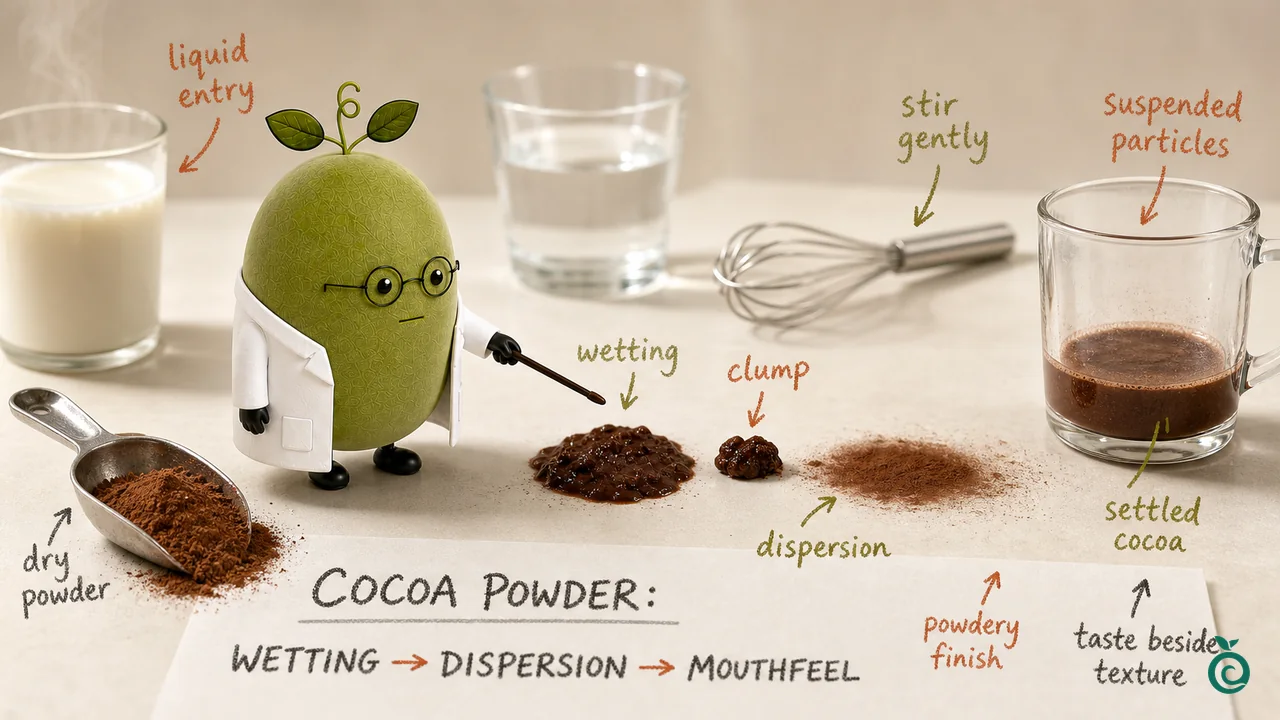
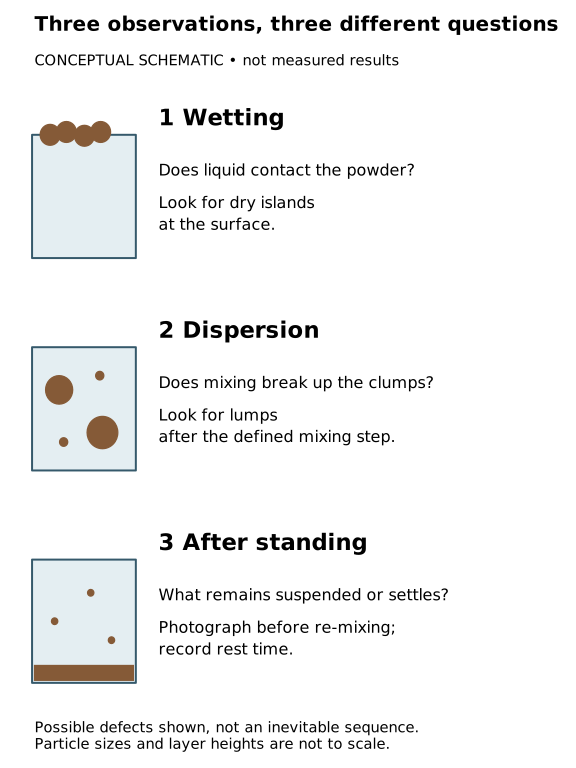
Wetting asks whether liquid can enter and cover the powder. Dispersion asks whether stirring breaks the wetted particles into the liquid. A soluble ingredient may then dissolve, while insoluble cocoa particles may remain suspended. A powder that wets quickly can still leave clumps, settle or create a gritty mouthfeel.
Record the real reconstitution method
Keep powder mass, liquid amount, temperature, addition order, stirring tool and stirring time fixed when comparing powders. If you are testing a preparation change, change that step deliberately and keep the other conditions matched. Compare a pre-slurry with direct addition as two named methods, not as an unrecorded adjustment midway through the trial. Start with the preparation method the customer will actually use.
Use the visible defect to choose the next check
These are troubleshooting starting points, not diagnoses from appearance alone. Repeat the same control and change one defined variable in the next trial.
| Observation | Check first | Record in the next comparison |
|---|---|---|
| Dry powder floats on the surface | Liquid contact, addition order and powder treatment. | Time to the agreed wetting endpoint; remaining dry islands. |
| The surface wets but lumps remain | The agreed mixing method and whether lumps have dry centers. | Tool, mixing time and visible clumps after mixing. |
| The drink looks mixed, then settles | Standing time, vessel, fill height and re-dispersion. | Photograph untouched, then apply the same re-mixing step. |
| The drink feels gritty or powdery | When the sensation appears: immediately, after standing or at the cup bottom. | Serving temperature, sip order and separate taste/texture notes. |
| Sweetness or aftertaste misses the target | Sweetener direction with the powder and preparation held steady. | Entry, peak, finish and cocoa character against the control. |
A better-looking cup immediately after vigorous mixing does not establish performance under the customer’s usual preparation method.
Keep powder state and sweetness in separate rows
Record particle or agglomeration information when available, along with wetting, visible clumps, dispersion, cup-bottom sediment and the mouthfeel immediately after mixing and after standing. Record entry sweetness, peak, bitterness, licorice-like notes and finish beside those rows. A sweetener can change taste; it does not by itself prove that cocoa particles will disperse or remain suspended.
Use the evidence as a test plan, not a copied formula
Published cocoa-powder work examines wetting, dispersion, lecithination and agglomeration. These are useful directions for a trial, but a treatment that helps one powder system does not establish the right level or method for another. Ask for the selected powder’s treatment information and test it in the intended water, milk or nutrition base. Set your own observation endpoint before comparing times.
Compare immediate and rested samples
Read the cup immediately after the agreed mixing step, then again after the project-defined standing period. Note surface foam, floating powder, visible particles, cup-bottom sediment, re-mixing behavior, thickness and powdery or gritty mouthfeel. If the product is stored as a powder, add moisture pickup, caking, flow and package observations at the checkpoints that matter to the project.
Technical references and boundaries
Further reading on cocoa powder reconstitution and suspension. Each study uses its own materials and method; this guide does not adopt a universal mixing time, particle-size target, stabilizer level or shelf-life conclusion.
Record these fields before comparing cocoa powder samples
- Product lane and real liquid base
- Powder treatment, fat or agglomeration information
- Water or milk amount and temperature
- Addition order and mixing method
- Wetting, clumps and dispersion
- Immediate and rested sediment
- Powdery or gritty mouthfeel
- Sweetness and aftertaste
Common questions
Why does cocoa powder float even when the drink tastes sweet?
Sweetness does not show whether liquid has wetted the cocoa powder. Record the remaining dry surface powder separately from sweetness, then compare the addition order or selected powder treatment using the same liquid base.
Discuss this requestCan I compare pure cocoa powder with an instant beverage powder?
You can compare them for your intended use, but label the two formats clearly. Their carriers, sugar or milk solids, fat and powder treatment may differ. Use the intended preparation method for each, and do not interpret the result as a test of one ingredient alone.
Discuss this requestShould I use warm water or make a paste first?
Treat temperature and pre-slurry preparation as test variables. If the intended product is mixed cold, a warm-water success is not a substitute for the cold-use test. For a fair method comparison, keep powder and liquid quantities fixed and document both routes.
Discuss this requestDoes lecithination or agglomeration guarantee a smooth cocoa drink?
No. Powder treatment is one part of reconstitution. Compare wetting, remaining clumps, the rested drink and mouthfeel in the actual base before choosing a powder or process.
Discuss this requestWhat should I send for a cocoa beverage sweetener discussion?
Start with the drink format, real base and main problem. A photo before re-mixing and a short description of the preparation method can make the discussion more useful. The Excel record is optional; you can contact us directly with the details you already have.
Discuss this request