
Read this guide in
ALLULOSE SOURCING GUIDE
Allulose Powder vs Syrup: Sourcing Guide for Food and Beverage Buyers
Allulose powder vs syrup: choose by application, process flow and packaging. A practical sourcing guide for food and beverage buyers.
Our recommendation is to choose the allulose form around the production line: start with powder for a dry premix or sachet, and evaluate syrup where the line already handles liquid sweeteners. A beverage application alone does not make syrup the better purchase; a powder-dissolving step may already fit your process.
Compare the confirmed composition, required dose and handling trial before comparing the delivered price. Powder, syrup and an allulose-based sweetener blend are different purchasing items, even when their names look similar.
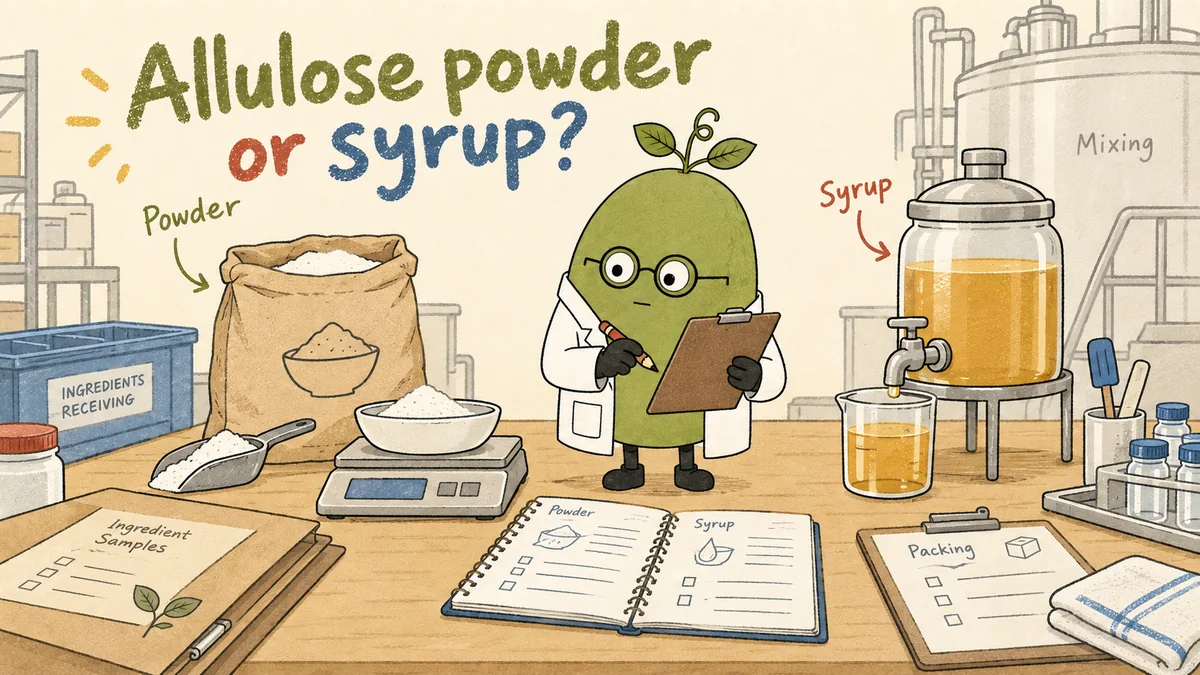
Name the purchasing item before comparing formats
Pure allulose powder, an allulose syrup and an allulose-based sweetener blend are different purchasing items. Ask for the full composition and specification of the quoted material. A blend product page does not establish the specification, availability or packing options of a pure-allulose powder or syrup. Confirm the required supply form in the enquiry.
Choose the form around the line, then test it
Use the following comparison to select samples. It is a starting point for the production trial, not a claim that one form is always easier to use.
| Production question | Powder route | Syrup route |
|---|---|---|
| Dry blends or sachets | Check particle size, flow, dust and segregation during mixing and filling. | A liquid addition needs a process that can handle the added moisture; it is not a direct dry-blend substitute. |
| Beverage or sauce line | Check the existing dissolving step, water temperature, mixing time and lumps. | Check pumping, viscosity at the handling temperature and dispersion into the base. |
| Formula water and solids | Use the composition and moisture specification for the material supplied. | Obtain allulose assay and total solids separately; include the liquid contribution in the water balance. |
| Packaging and receiving | Confirm pack format, moisture protection, storage and dispensing arrangements. | Confirm container, unloading connections, transfer equipment and storage instructions. |
| Production trial | Record the actual dose and prepared-product result, not just powder appearance. | Record the actual dose and prepared-product result, not just ease of pouring. |
Check specifications beyond sweetness
For powder, review particle size, flowability, moisture, solubility and caking risk. For syrup, review solids basis, viscosity, pH, color, miscibility and storage behavior. In both forms, ask for specification, COA, shelf life, packing information and market-related documents.
Keep sample and quotation specifications together
Record the product name, supplier sample reference, specification revision and batch COA reference where available. For a liquid, distinguish the stated allulose content from total solids and check the reporting basis. Keep packaging, storage instructions and delivery terms with the offer so a price per unit of material is not mistaken for a like-for-like comparison.
| Keep with the offer | Buyer check |
|---|---|
| Product name, composition and sample code | Confirm the quoted material is the same form and formulation that was tested. |
| Specification revision and available lot COA | Separate agreed requirements from results for a particular batch. |
| Assay and reporting basis | Confirm whether allulose content is stated on an as-is or dry basis. |
| Packing, storage and delivery terms | Compare the same delivery scope and the equipment needed to receive it. |
| Chosen dose and finished batch size | Compare the cost of the quantity actually used in the accepted application trial. |
Confirm market and label fit early
Allulose is not treated the same way in every market. Before building a formula around it, buyers should confirm local ingredient approval, nutrition label treatment, claim direction and any certificate or registration needs.
Prepare a quotation-ready request
Start with the product you want to make and whether you need powder, syrup or a blend. Share the country of sale and any known quantity, packing format, document or sample requirement. We can clarify the remaining details together. A complete formula is not required for the first discussion.
Compare solids, delivery and dosing on the same basis
For syrup, request total solids and allulose content separately, with the basis for each result. Total solids are not automatically allulose content; the difference between the two does not measure water. Ask for the water contribution and other declared constituents when preparing the formula balance. For powder, request the applicable composition and water-content specification. Compare the quantity needed for the same agreed trial, including any adjustment to the other water in the formula. Then compare the delivered packaging, unloading arrangements, storage instructions and the dosing equipment already available at your site. Record actual dispensing and mixing observations in a small trial before deciding that a liquid or dry route is easier. Keep material, freight and handling costs separate so a lower quoted unit price does not hide a change in the quantity or process required.
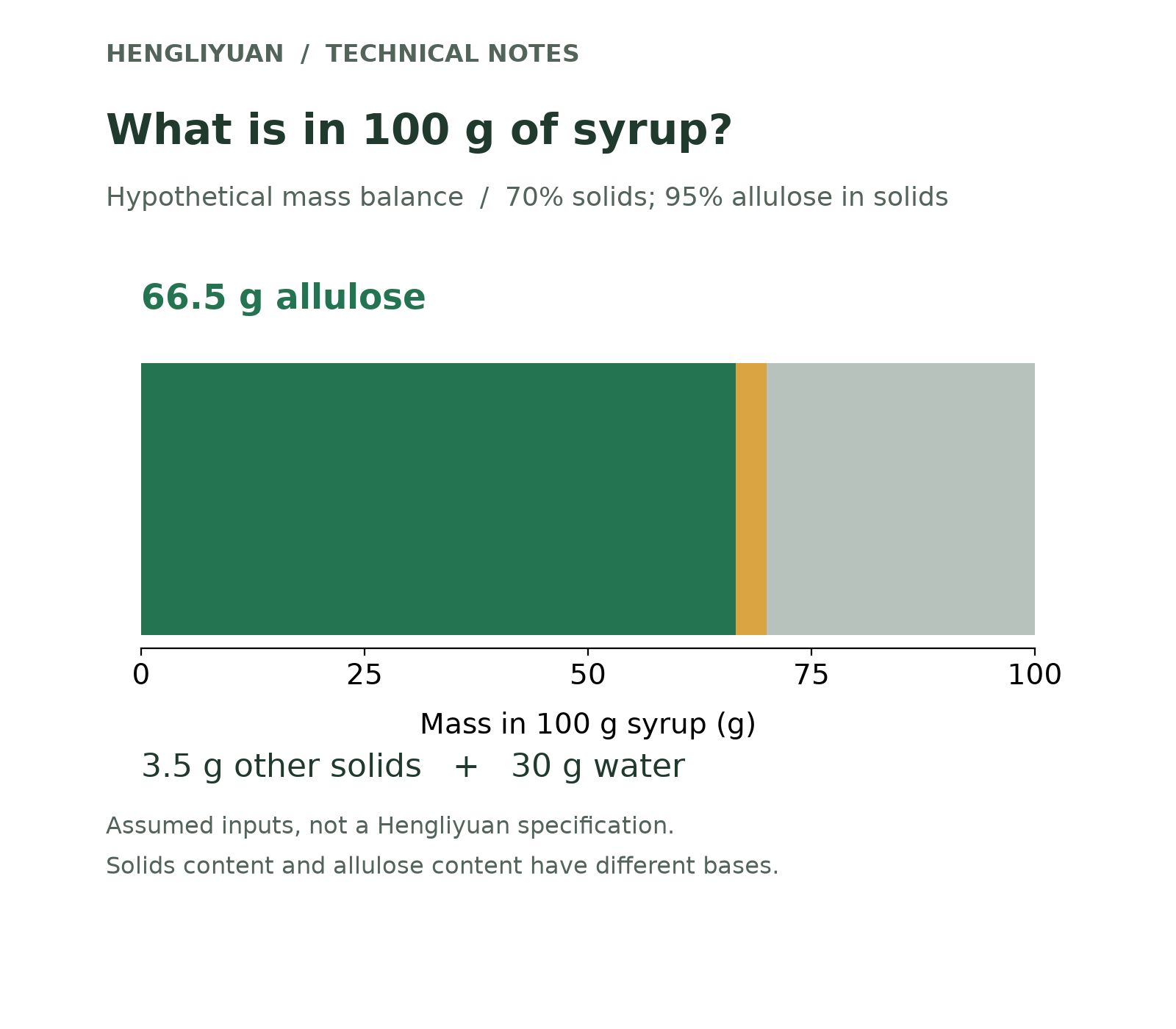
The diagram reuses our allulose basics example: 100 g of a hypothetical syrup at 70% total solids, with allulose at 95% of those solids, contains 66.5 g allulose. The remaining 3.5 g are other solids; 30 g is water under the stated example assumptions. These are calculation inputs, not a product offer. For a composition comparison, cost per kilogram of allulose equals delivered material price per kilogram divided by the confirmed as-is allulose mass fraction. A syrup at an assumed fraction of 0.665 therefore uses price ÷ 0.665 in that calculation. This normalizes the ingredient amount only: it does not establish the same taste, texture or process cost. Choose the actual application dose before making the purchasing decision.
Will finer allulose powder dissolve faster?
Finer particles can dissolve faster under comparable mixing conditions, but a fine-powder label does not specify a dissolution time or the amount that will stay dissolved. For a beverage premix, request the particle-size distribution and test method, then compare samples at the same dose, water temperature and mixing procedure. Record wetting, lumps, time to dissolve and the result after cooling separately. Check powder flow and segregation as well as the prepared drink. Published supplier grades illustrate these choices; their mesh ranges are not Hengliyuan specifications.
Does syrup Brix tell you the allulose content?
No. The Brix scale is based on sucrose in water. In an allulose syrup, a refractometer reading also reflects other dissolved constituents, so it is not a specific allulose assay. Request the Brix method and temperature, measured solids or water content, and a separate allulose assay with its wet- or dry-basis definition. Use the confirmed composition for the formulation balance; do not treat Brix as the percentage of allulose or as a sweetness value.
Review note
Reviewed October 16, 2026. Form selection is Hengliyuan’s purchasing and trial recommendation. The syrup arithmetic is hypothetical; actual supply, composition, packing and market requirements follow the selected material documents.
Common questions
Is allulose powder better than allulose syrup?
Choose around the process. Powder is a practical starting point for dry systems and sachets; syrup is worth evaluating where liquid handling already exists. A liquid finished product can still use powder through a suitable dissolving step. Compare the actual handling and finished-product trial before deciding.
Discuss the required allulose formWhat should buyers ask an allulose supplier for?
Ask for product form, specification, COA, shelf life, packing size, MOQ, lead time, market documents and sample availability.
Discuss the required allulose formCan allulose be blended with stevia or monk fruit?
Yes. Allulose can provide body and mild sweetness, while stevia or monk fruit may be used for sweetness lift, depending on application and market rules.
Discuss the required allulose formWhat information should I send before quotation?
Start with your target market and product idea. Share any known packaging specification, estimated quantity, required certificates/documents and whether samples are needed; we can clarify the remaining details together.
Discuss the required allulose formCan I compare the two offers by price per kilogram alone?
No. First confirm their composition and assay basis. For a composition comparison, divide delivered material price per kilogram by the as-is allulose mass fraction. Then compare cost at the dose accepted in your product, including any different delivery, storage or handling requirements.
Discuss the required allulose formDoes syrup Brix equal its allulose percentage?
No. Brix is not a specific allulose assay. Request the measurement method and temperature, solids or water content, and a separate allulose assay with its reporting basis. Use the confirmed composition for the formula balance.
Discuss the required allulose form