
Read this guide in
ALLULOSE MARKET NOTES
Allulose Market Access and Labeling: U.S., EU, Australia–New Zealand and South Korea
Check allulose rules for the US, EU, Australia, New Zealand and South Korea: market access, sugar claims and the documents to review before ordering.
Choose the sales market before choosing the allulose blend. Our factory view is straightforward: confirm the ingredient route, then test the formula, and review the finished label before printing packaging. One market’s permission does not travel with the sample.
For US projects, separate Nutrition Facts treatment from sugar claims. For EU projects, verify authorisation for the intended use. Australia–New Zealand has conditions under its Food Standards Code; South Korea requires manufacturing-route documents for shipments from October 1, 2026. The comparison below shows where each purchasing decision starts.
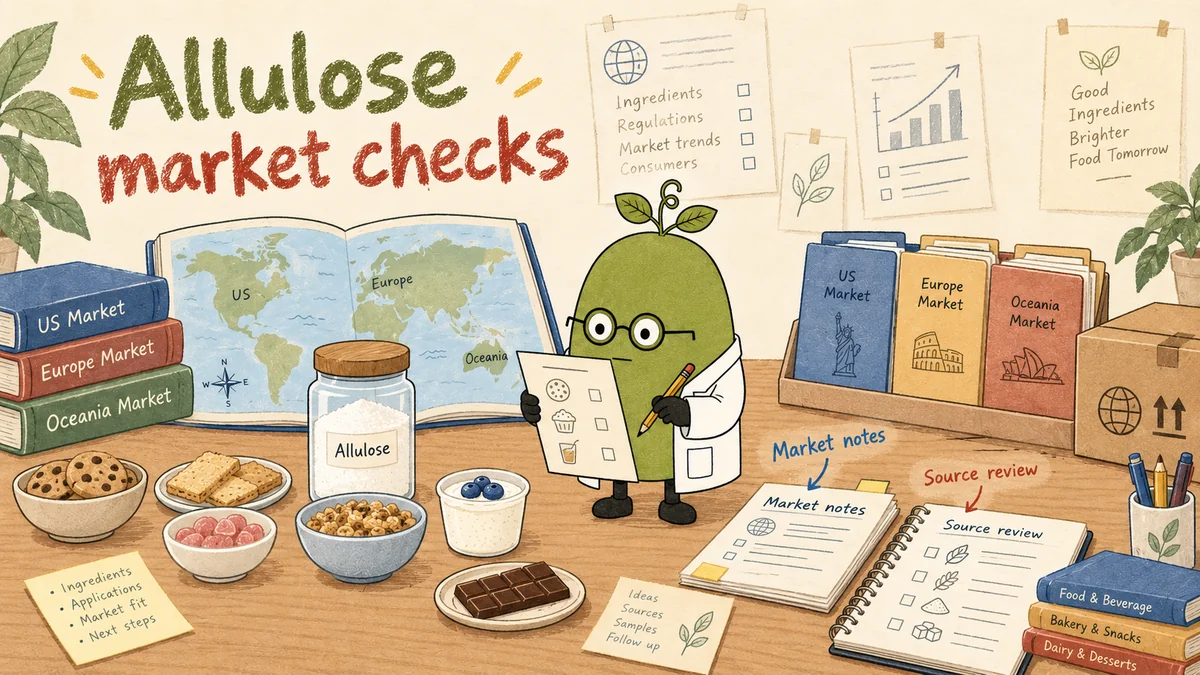
Allulose market comparison: what to check before ordering
Use this table to route the project to the right review. It summarises the sources discussed below; it does not certify a particular supplier, ingredient or finished product.
| Sales market | Main distinction | Prepare for review |
|---|---|---|
| United States | Nutrition Facts enforcement policy and packaging claims are separate. | Formula, serving size, sales states and proposed label wording. |
| European Union | The 2025 EFSA opinion did not establish safety for the assessed application. | Applicable authorisation and conditions for the proposed ingredient and use. |
| Australia–New Zealand | A1247 and Amendment No. 233 provide a conditional route. | Food category, use level, ingredient source and Code-compliant label. |
| South Korea | The October 1, 2026 shipment-date rule concerns production-route documents. | Manufacturer, microorganism/enzyme route and applicable recognition or safety-review documents. |
Agree on the market and product category before comparing quotations. A cheaper ingredient is not a useful option if its documents do not fit the intended project.
United States: label treatment is specific
FDA’s 2020 guidance states that it intends to exercise enforcement discretion for excluding allulose from Total Sugars and Added Sugars and using 0.4 calories per gram on Nutrition and Supplement Facts labels, while retaining it in Total Carbohydrate. The guidance is nonbinding and does not itself rewrite the nutrient-content-claim rules. Review the complete formula, serving basis, ingredient declaration and proposed claims separately for the selected US project.
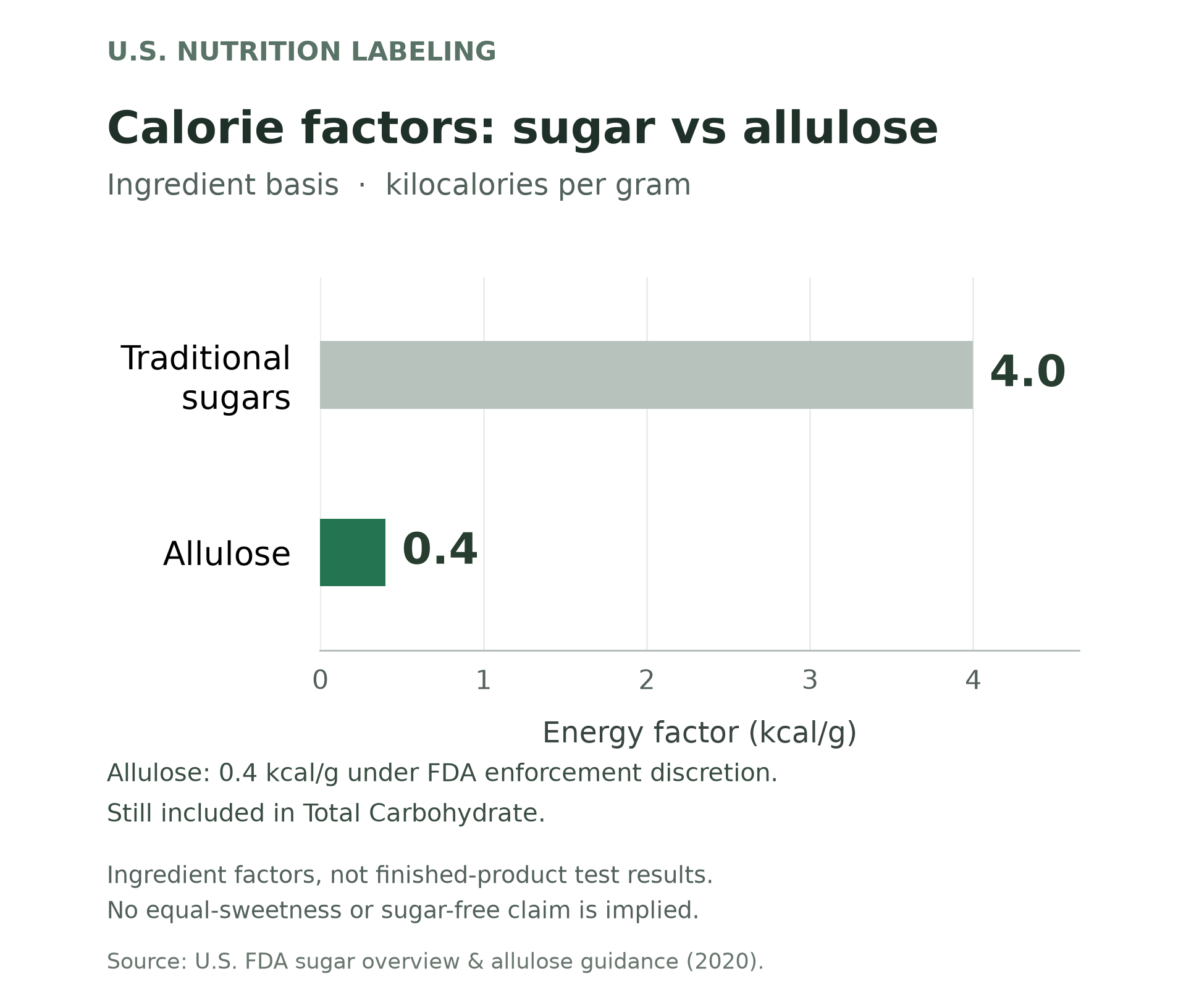
US allulose litigation: a sugar-line declaration is not a claim clearance
On July 27, 2026, the Seventh Circuit reversed the dismissal in Franco v. Chobani, No. 25-2087. It held that allulose falls within the regulation’s sugar definition and allowed the alleged deceptive-marketing claims to proceed. This was not a final liability decision. The opinion distinguishes FDA’s enforcement guidance from the regulation governing claims. Do not turn Nutrition Facts treatment into automatic clearance for zero-sugar packaging. OCA’s tracker, updated October 12, 2026, reports at least 21 proposed federal class actions filed from August 12 to October 6 across eight states. Its list includes Dunkin’ energy drinks, Blues Hog barbecue sauce and CVS Well Market drink mixes. This is the tracker’s reported count, not a nationwide court census or a finding against those companies. Sugar-free and no-added-sugar allegations also involve different claim rules; one term is not an automatic substitute for the other.
Prepare the US sales-state and packaging brief
For a new US allulose or allulose-blend project, tell us the principal sales states as well as the product category, formula, serving size and channels. Keep zero sugar wording out of the new packaging draft while the claim is under review. Do not replace it automatically with sugar free or no added sugar. Give the intended label and advertising wording to the buyer’s qualified US reviewer before artwork is released. A supplier COA answers an ingredient-quality question; it does not clear a retail claim.
European Union: do not assume approval
EFSA’s June 2025 opinion found that safety could not be established for the application it assessed because requested data were missing. That conclusion is not an authorisation. EU novel-food market access requires the applicable authorisation and its conditions of use. Have the importer or regulatory team verify those for the intended ingredient and finished food before committing to a commercial launch.
Australia and New Zealand: A1247 changed the path
FSANZ approved A1247 in August 2024; Amendment No. 233 was published on October 29, 2024. This creates a conditional route, not permission for every source or food. Check the ingredient and manufacturing details, permitted food category and use level, nutrition labelling and any required advisory statement against the current Food Standards Code. Do not copy a US label onto the Australian or New Zealand product.
South Korea: match the manufacturing route and import documents
An MFDS import notice published April 23, 2026 sets a shipment-date boundary of October 1, 2026 for allulose and processed foods containing allulose. It states that microorganisms or enzyme preparations used in manufacture must follow the recognition routes described in the amended Food Code. For imports from that shipment date, it calls for the applicable certificate recognising temporary food standards and specifications, or the notification of safety-review results for genetically modified foods, as relevant to that route. Before shipping an allulose ingredient or blend to South Korea, have the importer match the actual manufacturer, manufacturing route and recognition documents to the supplied material. A batch COA describes ingredient quality; it does not replace these documents. The notice does not establish that a particular Hengliyuan product or supplier already meets the requirement, and it does not clear a finished product’s sugar claim.
Market access affects blend design
If allulose fits the target market, it can be considered for bulk and texture as well as sweetness. Where it does not fit, develop another permitted system for that application. Monk fruit or stevia can change sweetness, but replacing a bulk ingredient also means rebuilding solids and texture. Check the alternative ingredients in the same target market before testing.
From the market check to a sample request
Send us the sales country and product you want to make. Add the ingredient form, estimated quantity and documents your importer needs if you already know them. We can then check which specifications, COA and supporting files are available for the selected material and agree on a sample direction. The documents need to match the actual manufacturer and product; a generic allulose file is not enough. For a US project, include the sales states and proposed claims. For South Korea, flag the production-route documents before shipment planning. Keep finished-label approval with the buyer’s qualified local reviewer.
Official references
Official sources checked October 16, 2026. Read the original documents for their scope and conditions; the US court opinion and South Korean notice are linked in their sections below.
Review note
Reviewed October 16, 2026. The dated litigation count is OCA’s October 12 tracker, not an independent court census. Market requirements and product-specific documents need another check before shipment or artwork approval.
Common questions
Can the same allulose blend be sold in every market?
No. Allulose status and label treatment differ by market, so buyers should confirm the target country, food category and local label rules before launch.
Discuss allulose samples and documentsIs allulose treated like sugar on U.S. labels?
FDA guidance describes a specific Nutrition Facts enforcement policy, while allulose remains a monosaccharide under the regulation discussed in Franco. Sugar declarations, carbohydrate and calorie calculations, and front-of-pack claims need separate review.
Discuss allulose samples and documentsCan EU buyers request allulose samples?
Discuss the evaluation purpose with us first, then have the importer confirm the conditions for bringing in and using the sample. A technical sample request does not establish permission for commercial sale.
Discuss allulose samples and documentsDoes Australia–New Zealand approval cover every allulose product?
No. Match the ingredient and its source to the current Code, then check the food category, use level and labelling requirements for the finished food. A reference to A1247 alone does not establish that a particular supply meets those conditions.
Discuss allulose samples and documentsWhat should buyers send before asking for allulose blend samples?
Start with your target market and product idea. Share any known packaging specification, estimated quantity, required certificates/documents and whether samples are needed; we can clarify the remaining details together.
Discuss allulose samples and documentsDoes FDA allulose guidance automatically permit zero sugar claims?
No. Its Nutrition Facts enforcement policy is separate from claim clearance. The 2026 Franco ruling allowed litigation to proceed, and new packaging claims require their own current review.
Discuss allulose samples and documentsIs a COA enough for an allulose shipment to South Korea?
A COA does not replace the recognition or safety-review documents described in the MFDS import notice. The importer should match the manufacturer, production route, supplied material and shipment date to the applicable requirements. Tell us which documents you need; we will check which files match the selected product.
Discuss allulose samples and documents