
Read this guide in
CANADA LABELING NOTES
Monk Fruit Sweetener Canada: Labeling Guide for Monk Fruit Extract and Stevia
Check Canadian food categories, monk fruit extract limits, steviol-equivalent limits and ingredient names before choosing a sweetener or approving label artwork.
Canada sweetener work should start with the product category, not with a broad ingredient claim. Monk fruit extract, steviol glycosides, allulose and sweetener blends do not share one simple rule.
This guide helps buyers separate ingredient selection from finished-product label approval for Canada. Start with the actual food category and material identity, then review the permitted use, calculation basis and label name before committing to artwork or a volume order.
Start with the finished food
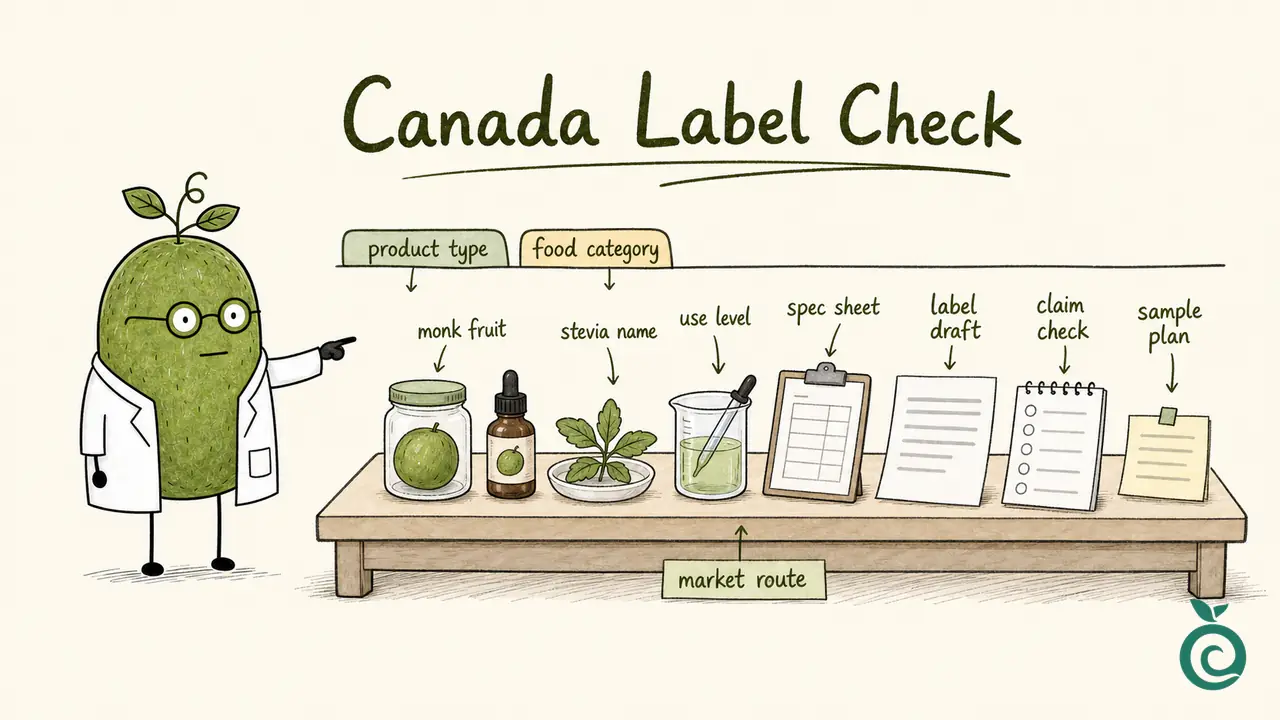
Ask where the product will be sold, what the finished food is, and whether the sweetener is used in a tabletop product, beverage, bakery item, bar, powder, syrup or other category. Health Canada permissions and CFIA label expectations are tied to the food and ingredient identity.
Check monk fruit extract carefully
CFIA identifies monk fruit extract as permitted in table-top sweeteners only. That category covers consumer-added sweeteners; it does not include table syrups or sundae toppings. Monk fruit juice concentrate is treated differently in CFIA guidance because of its lower mogroside V content. Confirm the material identity rather than treating extract and juice concentrate as interchangeable.
Check steviol glycoside identity
Steviol glycosides need to match Health Canada's permitted sweetener list, the applicable food category, use limit and specification route. CFIA also provides permitted label synonyms for steviol glycosides, including related ingredient-name notes. The production route and specification should be checked before label wording is locked.
Selected Canadian sweetener limits: compare the calculation basis
These selected rows come from Health Canada’s List of Permitted Sweeteners, published December 18, 2024, as accessed for this review. They are not the full list. Match the exact food category and all conditions in the official entry.
| Material and listed food | Listed maximum or condition | Calculation basis |
|---|---|---|
| Monk fruit extract: table-top sweeteners | 8,000 ppm | Calculated as mogroside V. |
| Steviol glycosides: unstandardized beverages, mixes and concentrates | 200 ppm in the beverage as consumed | Calculated as steviol equivalents. |
| Steviol glycosides: unstandardized bakery products | 350 ppm in the food as consumed | Calculated as steviol equivalents. |
| Steviol glycosides: table-top sweeteners | Good Manufacturing Practice | Use the conditions for the selected material and category. |
A limit expressed as mogroside V or steviol equivalents is not the same as the weight of a commercial powder. Use the material composition and the required calculation basis; do not compare a blend’s total addition rate directly with either limit.
Keep allulose separate
Do not assume a US allulose label approach applies to Canada. If a buyer wants allulose in a Canadian-market product, treat it as a separate regulatory and label review before samples, artwork or nutrition-panel assumptions.
Prepare the supplier review file
Start with your target market and product idea. Share any known packaging specification, estimated quantity, required certificates/documents and whether samples are needed; we can clarify the remaining details together. For Canada, add the intended food category, ingredient specification, proposed use level, label draft and any existing regulatory opinion.
Keep claims conservative
Natural, no added sugar, low calorie, keto-style, sugar-free and clean-label language depend on the finished product, nutrition data, ingredient list and Canadian rules. A supplier can help organize documents and samples, but final market launch should be confirmed with the buyer's regulatory adviser.
Use the label name that matches the steviol glycoside
CFIA accepts specified common names and synonyms subject to their identity and specification conditions. A trade grade such as Reb A or Reb M is not enough on its own to settle the finished label. CFIA recommends accompanying these abbreviations with a more familiar synonym in parentheses. It does not accept “stevia” or “stevia leaf” alone as the sweetener identity on the label. CFIA directs enquiries about glucosylated steviol glycosides, certain converted glycosides and materials outside the stated specifications to Health Canada. Do not assume a GSG grade follows the same route as a compliant conventional steviol glycoside.
Bring the material and label documents together
Send the complete ingredient composition, specification, intended food category, proposed addition rate and any draft label. For a blend, identify each sweetening ingredient and carrier. We can organize the available product documents and discuss samples; the buyer’s Canadian regulatory reviewer should confirm the finished use and artwork.
Sources and review date
Reviewed October 16, 2026 against the linked Health Canada list and CFIA guidance. The table reproduces selected limits with their calculation basis; it does not approve an individual product or replace checking the complete current entry.
Common questions
Is monk fruit allowed in Canada?
CFIA guidance lists monk fruit extract in the table-top sweeteners context. Buyers should still confirm the exact finished product category before planning a broader Canadian-market launch.
Discuss this requestCan stevia be used in Canada?
Steviol glycosides can be used only according to Health Canada's permitted sweetener list, food categories, limits and specifications. Check the ingredient identity and label name before artwork.
Discuss this requestIs allulose handled the same way in Canada as in the US?
No. Do not use US allulose nutrition-label guidance as a Canada approval statement. Confirm Canada-specific status before samples, claims or label work.
Discuss this requestWhat should buyers send before Canadian-market samples?
Start with your target market and product idea. Share any known packaging specification, estimated quantity, required certificates/documents and whether samples are needed; we can clarify the remaining details together. Add food category, use level, specification and label draft if available.
Discuss this requestCan I apply ordinary steviol glycoside guidance to a GSG grade?
Do not assume that equivalence. CFIA directs enquiries about glucosylated and certain other modified glycosides to Health Canada. Confirm the material identity and its applicable route before a Canadian-market formulation or label decision.
Discuss this request