
Read this guide in
LABEL AND DOCUMENT GUIDE
Monk Fruit Ingredient List Guide: How to Declare Monk Fruit Extract on Food Labels
How to list monk fruit extract on ingredient labels: naming, market-specific rules, certificates and files food brands need.
Declare the actual ingredient or full blend composition using the names required in the destination market. A pure monk fruit extract, a juice material and a carrier-based sweetener blend need different identity checks; “monk fruit sweetener” alone does not establish the correct ingredient list.
Monk fruit sweetener projects can slow down when formula, label wording and document needs are discussed too late. Buyers may have a good sample but still need ingredient-list details, product files and market-specific checks before launch.
This guide helps brands prepare better questions before requesting samples, quotation, OEM packaging or supplier qualification files.
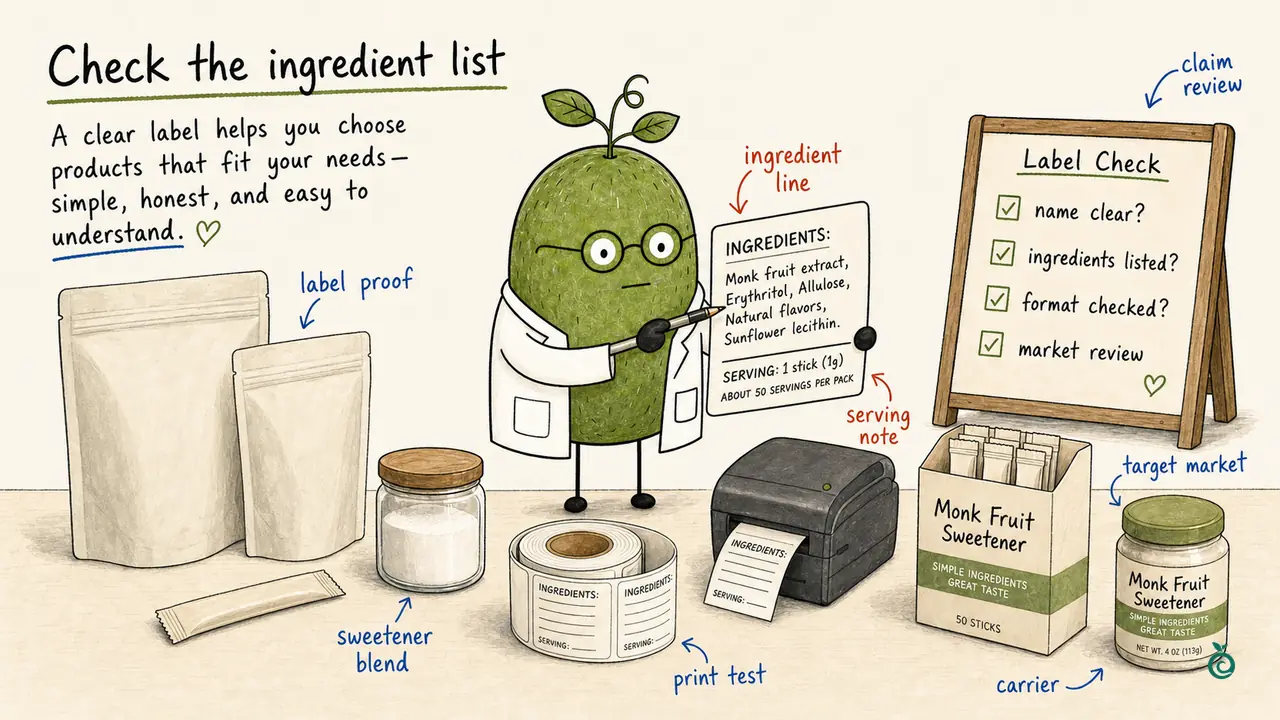
The Doctor illustration connects the ingredient line, serving information and market review. Its ingredient order, pack weights, serving counts and ticks are fictional examples, not a Hengliyuan formula, product specification or approved label. Build the actual statement from the complete formula and the destination rules before approving the artwork.
Ask for the exact formula identity
Confirm whether the sample is pure monk fruit extract, a standardized Mogroside V extract, a sweetener blend, a granulated product, a syrup direction or a finished private-label product. The ingredient list depends on the exact product. Request the composition of the supplied material, including carriers and other sweeteners, and keep it with the quoted product code and formula revision. Then identify where that material sits in the complete finished-food formula; the supplier product name is not the finished ingredient statement.
Example ingredient names are identity checks
Write the ingredient statement from the full formula and the destination-market rules. A label on a comparator is useful for asking questions, but it is not evidence that the same name is lawful for your material or use. Obtain the exact identity and composition first. If the purchasing item is a blend, identify its constituent ingredients, including any carrier; listing only the ingredient that supplies most of the sweetness can leave the composition unclear. The examples below show naming questions, not approved artwork. “Monk fruit extract” and “luo han guo extract” may describe a botanical source in supplier files, but a synonym does not establish legal status, purity or permitted use. A juice concentrate and a whole-fruit powder have different composition and process identities. Ask the local reviewer to reconcile the specification, supplier declaration and proposed label rather than choosing the shortest name.
| Material identity | Example wording to review | Check before use |
|---|---|---|
| Pure extract | Monk fruit extract / luo han guo extract | Botanical identity, extraction route and lawful market name |
| Carrier-based blend | Constituent ingredients in required order | Full composition and local ingredient-list rules |
| Juice material | Actual juice or concentrate identity | Process, composition and intended food category |
| Whole-fruit powder | Actual whole-fruit powder identity | Composition and applicable market classification |
US example: review names and weight order separately
For US conventional foods, 21 CFR 101.4 generally requires declared ingredients to use common or usual names and appear in descending order by weight, subject to its exceptions. Sweetness contribution is not the ordering basis. For qualifying compound ingredients, paragraph (b)(2) describes a parenthetical component declaration or incorporation of component names into the finished-food list. Have the reviewer check the conditions for the chosen approach rather than treating a generic blend name as an automatic shortcut. For a combined list, use the contributions in the finished food, not just the ranking inside the purchased blend. The existing ingredient-order guide explains that calculation; this US example does not prescribe the wording for another market.
Separate ingredient names from claims
Ingredient declaration, natural sweetener wording, sugar-free claims, no added sugar claims and nutrition statements are different questions. Buyers should check local rules before using claim language on packaging or online listings. Review a proposed claim against the whole finished product and its required basis, independently of the ingredient-name check. An accepted ingredient name or a sweet-tasting sample does not settle the nutrition panel or a sugar claim.
Market review record
Keep ingredient permission separate from ingredient naming. A food can use familiar English wording and still need an intended-use or market-access assessment. The US FDA GRAS notice route applies to the notified substance and conditions; it is not an approval of every extract or blend sold under the same commercial name. EU novel-food and additive questions depend on the specific material and food use. For Indonesia and China, obtain the current local classification and labeling review for the selected finished product rather than extending a foreign notice to those markets. Record the official source, the date checked and the reviewer’s conclusion next to the formula version. If the material route changes, reopen that row. A change from whole-fruit powder to a purified extract, or from extract to a multi-ingredient blend, can change the question that needs an answer. Treat “to be confirmed” as an open action before artwork approval.
- FDA GRAS inventory: substance, notifier, response letter and conditions of use
- Use the separate Canada monk fruit and stevia labeling guide
| Market | Source and identity review | Naming action |
|---|---|---|
| US | FDA notice / guidance for the exact substance and use | Confirm lawful ingredient names and full composition |
| EU | Current Union rules, novel-food / additive assessment where applicable | Confirm permitted route before label wording |
| Indonesia | Current BPOM review for the material and finished food | Confirm local name and product classification |
| China | Current national food standards and applicable permissions | Confirm material identity and Chinese declaration |
Documents checklist before artwork sign-off
Use a document register tied to the selected product. A factory certificate establishes its stated site and scope; a batch COA establishes reported measurements for one batch. Neither substitutes for the full ingredient declaration or proves a finished-product sugar claim. Check the issuing organization, product or site, dates and the scope relevant to the purchase. Keep storage and shelf-life information with its packaging condition. A number for one material or unopened pack does not automatically apply after opening or after formulation into a finished food. For claims, calculate or test the complete product as required by the market and record the basis. Ask for clarification while the formula and pack can still change, then approve the artwork against the agreed final version. Keep the reviewed ingredient statement, market/source check, claim decision and artwork version together with the reviewer and date. Record unresolved questions before sign-off and identify who will answer them. If the formula, carrier, supplier material or intended market changes, check which earlier decisions need to be reopened.
| File | Match to | Open question |
|---|---|---|
| Specification | Quoted material, form and grade | Acceptance items and methods |
| Batch COA | Sample or delivery batch | Assay basis and measured results |
| Composition declaration | Full formula and carriers | Ingredient order and naming |
| Certificate where required | Named site / product and current scope | Applicability to this purchase |
| Storage / shelf life | Material and packaging condition | Unopened and after-opening instructions |
| Artwork review | Final formula and destination market | Claims and mandatory wording |
Check packaging specification early
Stick packets, jars, pouches, bulk bags and beverage powder sachets may need different net weight, serving instruction, carton mark and label-language decisions. Packaging affects both quotation and label review. Check that the final proof carries the same approved formula and pack reference as the review file. Keep the unit pack, multipack and outer carton identifiable; the illustrative serving sizes in the Doctor image are not instructions for your product.
Ask about the wording before every order detail is settled
Start with the destination, exact extract or blend, finished-food use and the name, component or claim you are unsure about. Share the supplier declaration or proposed wording you already have, with its product or formula reference. You do not need a final order quantity to begin a document discussion. For a sample or quotation, confirm the selected material, packaging, estimated quantity, requested files and sample requirements as the project develops. The product review and artwork sign-off must still refer to the agreed final version.
Common questions
Can I write only monk fruit sweetener for a purchased blend?
Do not assume the commercial name supplies the ingredient statement. Obtain the complete blend composition, including carriers and other sweeteners, and review the names and declaration approach for the destination and finished food. Keep that composition tied to the actual material revision.
Discuss label documentsDoes the ingredient that supplies most sweetness go first?
For the US conventional-food example, the general order is based on weight rather than perceived sweetness, subject to the applicable exceptions. For a combined finished-food list, review the actual component contributions in that food. A small amount can dominate sweetness without being the first ingredient by weight.
Discuss label documentsCan I omit a carrier because its amount is small?
A low addition amount alone does not establish an exemption. Identify the component and have the reviewer check whether any applicable exception covers the actual use. Do not omit an ingredient simply because it contributes little sweetness or does not appear in a competitor label.
Discuss label documentsAre monk fruit extract and luo han guo extract interchangeable label wording?
They may identify a botanical source in supplier documents, but a synonym does not establish the lawful market name, material identity or intended-use status. Reconcile the exact material and destination requirements before choosing the final wording.
Discuss label documentsDoes a GRAS notice settle the label or sugar-free claim?
No. Review the substance, notifier, response letter and intended conditions associated with the notice. That review does not supply the complete ingredient statement or establish a claim for the finished food, and cannot be extended to another product just because it has a similar commercial name.
Discuss label documentsWhat needs checking when I change the blend or carrier?
Keep the new composition and revision with the product file. Recheck the ingredient statement, component order, material/use assessment and any affected nutrition or claim decisions before approving revised artwork. Do not carry a previous sign-off over without identifying what changed.
Discuss label documentsCan I ask Hengliyuan a label-document question before the quantity is fixed?
Yes. Send the destination, actual material or sample code, finished-food use and the specific wording or missing-file question. Add the declaration or proposed artwork when available. We can check which product files match the request; final label review remains tied to your formula and market.
Discuss label documents