
Read this guide in
LOW-SUGAR INGREDIENT BLENDING
Low-Sugar Sweetener Blend: Ingredients, Roles, Testing and Label Review
Choose sweetener blend ingredients by function, screen samples with Hengliyuan, and check market use and finished-product claims before finalising the label.
Build a low-sugar sweetener blend by separating the jobs that sugar performs, then choosing ingredients for those jobs. The sweetness source may be natural-source, such as monk fruit extract or steviol glycosides, or synthetic, such as sucralose, acesulfame potassium, aspartame, saccharin, neotame or advantame. Allulose, polyols such as erythritol, fibers and carriers may contribute bulk, mouthfeel or handling where they fit the product and target market. No single ingredient list or ratio works across beverages, bakery, powders and tabletop sweeteners.
Hengliyuan's sensory laboratory can prepare and taste-test several directions from your application brief, then send candidate samples for a second round in your actual product and process. This guide explains how to narrow those choices, what to test and when to review the label. It maps the wider ingredient field; current Hengliyuan supply, grades and documents must be confirmed for the selected product.
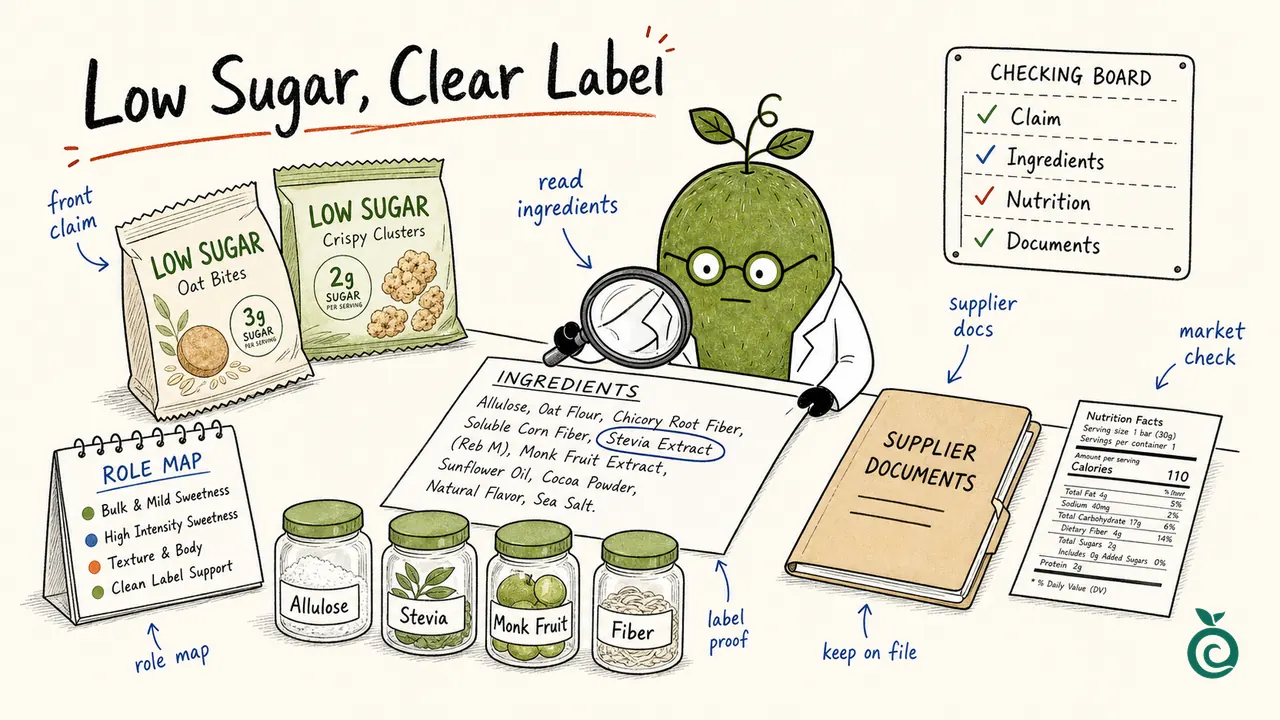
Start with the jobs sugar performs in the product
Write down what changes when sugar is reduced. Sweetness is one job, but sugar may also contribute solids, body, browning, moisture control, freezing behavior or serving weight. A beverage, cookie, drink powder and tabletop packet therefore need different blend decisions. The first sample should target the actual missing functions, not a generic sugar-replacement ratio.
Check the target market before making samples
Name the sales country, food category and intended use level before choosing a blend route. Check the identity and permitted use of every component, including carriers, against that market. A familiar ingredient name or a supplier specification alone does not establish permission for the finished food. Screen out unsuitable routes early; final label review follows once composition and dosage are settled. In this guide, low-sugar describes the formulation goal, not permission to print that claim on a pack.
Ask Hengliyuan's sensory laboratory to run the first screening
Share the application, current formula or sugar use, target sweetness, ingredients to use or avoid, process and sales market. Our sensory laboratory can prepare and taste-test several directions, then send several candidates for your second-round comparison. You can focus your product trials on these candidates instead of screening every ingredient and ratio from the beginning. The second round checks how each candidate behaves in your actual formula, process, packaging and storage conditions.
Map the main sweetener families before choosing ingredients
The table is a screening map, not a dosage chart. FDA describes the listed high-intensity sweeteners as many times sweeter than sucrose, so much smaller amounts may provide sweetness; those values do not predict the exact dose, sweetness curve or finished-product result. Bulk sweeteners and carriers solve different jobs and must not be compared with high-intensity sweeteners by sweetness alone.
- FDA: aspartame and other sweeteners in food
- EFSA: sweeteners authorised and assessed in the EU
- Nutrients: dose-response comparison across 16 sweeteners
| Ingredient family | Examples | Typical sweetness information | Main formulation question |
|---|---|---|---|
| Natural-source high-intensity | Monk fruit extract; steviol glycosides | FDA: about 100–250× and 200–400× sucrose | Which extract or glycoside profile fits the taste target, base and market? |
| Synthetic high-intensity | Aspartame; acesulfame potassium | FDA: about 200× sucrose for each | Does the taste curve and process fit the product? Aspartame is not suitable for every heat process. |
| Synthetic high-intensity | Sucralose; saccharin | FDA: about 600×; about 200–700× sucrose | What use level, aftertaste and process conditions need comparison? |
| Synthetic high-intensity | Neotame; advantame | FDA: about 7,000–13,000×; about 20,000× sucrose | Can the very low dose be controlled, dispersed and verified in production? |
| Bulk or lower-intensity sweeteners | Allulose; erythritol; xylitol; maltitol; sorbitol | Sweetness and physical behavior vary by ingredient and concentration | Is the project replacing bulk, solids, mouthfeel or serving weight as well as sweetness? |
| Other market-specific options | Cyclamates; thaumatin; neohesperidine DC; others | Authorisation and conditions differ by market and food category | Is the ingredient permitted, correctly specified and label-ready in the target market? |
| Non-sweet bulking or handling ingredients | Fibers; maltodextrin or other carriers where suitable | Not selected by sweetness equivalence alone | What body, flow, dilution, filling or serving function is needed? |
A 2018 sensory study of 16 sweeteners found different dose-response curves, peak sweetness and sweetness growth rates across sugars, polyols, aspartame, acesulfame-K, sucralose, stevia and monk fruit. In that study, sucralose potency relative to sucrose changed as the matched sucrose concentration increased. This is why a published "times sweeter" value is a starting reference, not a fixed formulation ratio.
Use Hengliyuan's own pages to identify the natural-source and bulk options
For Hengliyuan projects, start from the product identity rather than a broad "natural sweetener" label. Standardised monk fruit extract and a formulated monk fruit blend are different products. Stevia ingredient, allulose ingredient, erythritol ingredient and multi-ingredient blends also need separate specifications and sample briefs. Our linked pages show the product or formulation directions already described by Hengliyuan; they do not make every option suitable for every market or application.
Include synthetic high-intensity sweeteners when the project allows them
A complete screening step should not assume that every project requires a natural-source claim. Sucralose, acesulfame potassium, aspartame, saccharin, neotame and advantame can be candidates in markets and food categories where they are authorised. They differ in potency, taste profile, process fit, labeling and production-control needs. For example, FDA notes that aspartame is about 200 times sweeter than sucrose but is not heat stable and therefore is not typically used in baked goods. FDA also notes that acesulfame potassium is often combined with other sweeteners. These are formulation clues, not approvals for a buyer's finished product.
Assign a measurable role to every blend ingredient
A high-intensity sweetener may be selected for onset, peak sweetness, finish or cost-in-use, but it contributes little bulk at its normal low use level. Allulose and polyols such as erythritol may affect solids, body, cooling, crystallisation, browning, moisture or serving weight. Fibers and carriers may affect body, powder flow, dilution and filling. An ingredient may help more than one function, but each reason should be stated before sampling and checked with a relevant measurement or observation.
Choose sample routes before choosing a final ratio
A useful first round can include the current formula as a control, a route that mainly restores sweetness and a route that also addresses bulk or mouthfeel. The exact candidates depend on the application and ingredients the buyer accepts. This comparison is more useful than starting with one fixed monk fruit, stevia, allulose or erythritol ratio and trying to force it into every product.
Compare candidates at similar sweetness
Use the same product base, batch method, serving condition and reference sample. Bring the candidates to a similar sweetness range before judging flavor, then record sweetness onset, peak, finish, bitterness, lingering sweetness and interaction with the main aroma. If several ingredients or process settings change at once, the result will not show which change helped. Keep the first comparison controlled and document each version.
Test the blend in the real product and process
Water screening can narrow the sweetness range, but it cannot approve the blend. Beverages should be checked with the real acid, flavor, temperature and storage condition. Bakery trials also need volume, browning, moisture and texture observations. Powder and tabletop formats need flow, segregation, dissolving, serving weight and filling checks. Record sensory and physical results separately so one good score does not hide another failure.
Review the label in two stages
Do the market feasibility check before sampling, then complete the label review against the selected formula. Keep a product and sample code on the brief so the composition, trial result and documents refer to the same blend. The following checks serve different decisions; one document cannot answer them all.
- European Commission: nutrition claim conditions
- 21 CFR 101.60: US nutrient content claim conditions
- How ingredient list order differs from sweetness contribution
| Stage | Information to confirm | Decision it supports |
|---|---|---|
| Before sampling | Sales country, food category, ingredient identities, carriers and proposed use levels | Which blend routes can be evaluated for this product? |
| When selecting a candidate | Full blend composition, sample code, final dosage and other recipe ingredients | Which ingredients and quantities enter the finished food? |
| Before approving artwork | Finished-food nutrition data, serving basis, exact claim wording and required label statements | Does this particular label meet the target-market conditions? |
| Before ordering | Matching specification, batch COA, allergen information and agreed packaging documents | Do the supplied lot and documents match the approved product? |
A low-sugar blend does not automatically make the finished food eligible for a sugar claim. For example, the EU low-sugars condition is no more than 5 g sugars per 100 g for solids or 2.5 g per 100 ml for liquids. These are finished-food limits, not blend dosage limits. US sugar-related nutrient claims instead need review under 21 CFR 101.60; do not transfer EU wording or thresholds to a US pack. Check all applicable conditions, not only the sugar number.
Give Hengliyuan feedback that can guide the next sample
For an initial discussion, send the product type, current sugar or sweetener use, target sweetness or reduction goal, ingredients to use or avoid, process, target market and the main problem to solve. After testing, report specific observations such as slow sweetness onset, long aftertaste, weak body, poor solubility or filling difficulty. Hengliyuan can use that feedback to discuss the next extract or blend direction; the final dosage and performance still need confirmation in the buyer's own product and process.
Common questions
Which ingredients belong in a low-sugar sweetener blend?
Screen natural-source and synthetic high-intensity sweeteners as well as bulk sweeteners, polyols, fibers and carriers. Use only ingredients that solve defined jobs and fit the application, process and target market.
Discuss this requestDoes Hengliyuan supply every sweetener listed in this guide?
No. The guide maps ingredient families that formulation teams may evaluate. Confirm Hengliyuan's current products, grades, documents and availability from the relevant product page, specification and quotation.
Discuss this requestDo buyers need to prepare and screen every first-round sample themselves?
No. Hengliyuan's sensory laboratory can prepare and taste-test several directions from the buyer's application brief, then send several candidate samples for second-round testing in the buyer's actual product and process.
Discuss this requestCan one sweetener blend ratio work in every product?
No. Beverages, bakery products, powders and tabletop sweeteners place different demands on sweetness, bulk, texture, processing and packaging. A ratio should be tested in the actual product rather than copied across applications.
Discuss this requestCan published sweetness multiples be used as a fixed dosage formula?
No. Published values are screening references. Sweetness potency can change with concentration and the food base, so samples should be brought to a similar perceived sweetness in the real product before taste and physical behavior are compared.
Discuss this requestWhat should buyers send Hengliyuan before blend sampling?
Send the product type, current formula or sugar use, target sweetness or reduction goal, ingredient limits, process, target market and main problem to solve. Specific feedback from the first trial helps guide the next sample direction.
Discuss this requestDoes buying a low-sugar blend approve a low-sugar claim on my product?
No. The claim depends on the finished food and the rules in the sales market. Confirm the complete formula, nutrition data and exact wording. Ingredient permission, taste approval and label approval are separate checks.
Discuss this request