
Read this guide in
CAKE SUGAR REDUCTION
Low-Sugar Cake Sweetener Guide: Volume, Moisture and Storage Testing
Compare low-sugar cake samples fairly: control batter fill, measure cooled volume and crumb, and separate moisture, water activity and packaged storage.
A low-sugar cake can taste sweet enough and still fail on volume, crumb texture or storage. Sugar changes more than sweetness: it affects the water–sugar phase, the batter's air-holding behavior and the timing of starch gelatinization and protein denaturation. A quick tasting cannot cover those jobs.
Our starting point is simple: approve sweetness, cake structure and packaged performance separately. For buyers testing monk fruit, stevia or a blend, the first useful sample answers one question against a control. Changing the sweetener, pan fill and baking schedule together makes the result difficult to interpret.
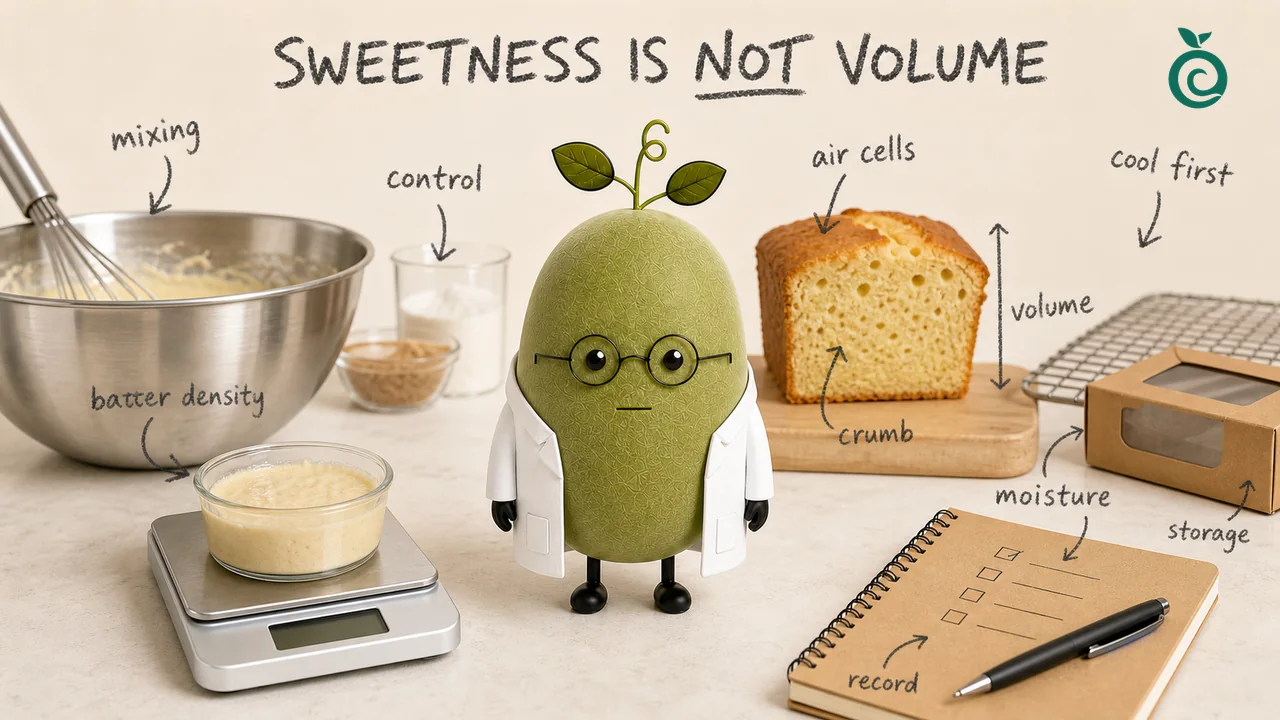
Name the cake type before choosing a sweetener
Foam, sponge, batter, pound and filled cakes do not ask sugar to do the same work. Record the exact product, flour and protein system, fat level, leavening, mixing method and whether the cake is sold plain, layered or filled. A result from a sponge cake model should not be treated as a release rule for a pound cake or a cream-filled snack cake. Record the batch size, pan dimensions, batter fill mass per pan, mixing sequence and time, oven settings, baking endpoint and cooling conditions. Keep these comparable across the first trial. If a candidate needs a different process, record that as a separate trial rather than quietly changing it.
Why sweetness and volume can move apart
In a 2023 cake study, sucrose and its substitutes changed the amount and mobility of the batter's aqueous phase, the air incorporated during mixing and the timing of starch gelatinization and protein denaturation during baking. That is why a high-intensity sweetener can close a sweetness gap while leaving a separate bulk, air-retention or structure question. The paper supports a test path, not a universal replacement percentage.
Measure the same part of the cake under the same conditions
A taller cake is not necessarily a better-performing formulation if its pan contained more batter. Compare cooled samples with the same measurement method and elapsed time after baking. Record moisture content and water activity separately: moisture describes the amount of water; water activity describes its availability. Neither result alone establishes product safety or shelf life.
| Check | Keep the comparison consistent | What to record |
|---|---|---|
| Batter density | Use the same container volume, filling method and stage after mixing. | Mass of batter in that volume; note temperature and elapsed time. |
| Cake height or volume | Use the same pan, batter fill mass and cooling time; keep the measurement method unchanged. | Height at defined positions or measured volume. If reporting specific volume, divide measured volume by cake mass and state units. |
| Crumb texture | Use the same cut position, sample dimensions and temperature. | Center and edge separately; describe firmness and springiness with an agreed method. |
| Moisture content and water activity | Use a defined sampling location and the appropriate method for each measurement. | Separate results, units where applicable, method and water-activity measurement temperature. |
| Packaged storage | Match packaging, storage conditions and elapsed time. | Changes in crumb, crust, aroma and visible condition; use the same criteria at each checkpoint. |
Treat storage as a second decision
A 2013 pound-cake study found that moisture migration contributed to crumb firming in its model; limited amylopectin retrogradation did not explain all of the change. That supports checking the cake over time, but it does not set a universal storage schedule. Establish a baseline after a defined cooling period, then choose checkpoints for the actual product, packaging, storage conditions and intended shelf life. A chilled cream-filled cake needs its own plan. Sensory checks should follow the project’s food-safety procedures; do not taste samples judged unsuitable for consumption.
Build a small, readable sample matrix
Start with a control and two clearly described directions. A sweetness-only trial helps reveal what is lost when sugar solids are removed; it is a diagnostic trial, not automatically a saleable recipe. A second direction can address bulk and structure. Where several ingredients must change together, treat that as a formulation package and do not attribute the outcome to one ingredient.
| Trial | Question it answers | Conditions and interpretation |
|---|---|---|
| Current or sucrose control | What does the accepted cake look and taste like under this test? | Run alongside candidates. Record the complete formula and process, not only the sugar amount. |
| Sweetness-focused candidate | Does the sweetener direction approach the desired sweetness and aftertaste? | Document removed sugar and replacement amounts. Keep pan fill and process comparable; note any resulting solids or water differences. |
| Bulk-and-structure candidate | Can the formulation recover volume and crumb as well as sweetness? | List every change to bulk ingredients, water, fat or other structure support. Compare with the control at the same cooling and storage checkpoints. |
Compare formula versions by mass as well as by taste. Do not use sweetness equivalence as a mass-replacement instruction. Agree what an acceptable result looks like before selecting the next sample; the same cake should not pass on sweetness while an unresolved collapse or storage defect is ignored.
Keep cake and filling separate before combining
For a filled cake, assess cake and filling separately, then test the assembled product in its intended package. Record the filling’s set or flow, component water activities and changes at the interface. A plain cake result does not approve the filled version. Use the linked cake-and-filling scorecard for the component record instead of duplicating it here.
What the research supports
Godefroidt and colleagues’ 2023 study explains why sucrose substitution changes the batter liquid phase, air incorporation and thermal setting in defined cake systems. Luyts and colleagues’ 2013 pound-cake study separates moisture migration from other contributions to crumb firming. These papers support the comparison method; neither supplies a universal replacement ratio, water-activity limit or Hengliyuan shelf-life result.
Turn the comparison into a useful sample request
Send the cake type, target market, current sugar system, process and the main defect you want to fix. A photograph of the cut crumb and matched control/candidate results are more useful than “the texture is wrong.” Add filling, packaging, estimated quantity and document requirements where known. We can then discuss a sweetener direction and the next sample question.
Record these fields before comparing cake samples
- Cake type and filling format
- Current or sucrose control
- Sweetness and aftertaste
- Batter density, volume and crumb texture
- Moisture or aw method and result
- Cake center, edge and filling interface
- Packaging, storage conditions and product-specific checkpoints
- One main variable changed
- Pan dimensions, batter fill mass, cooling time and measurement methods
Common questions
Can monk fruit or stevia replace sugar gram for gram in cake?
No. High-intensity sweeteners can supply sweetness at much smaller amounts, but they do not replace sugar’s mass or all of its functions in batter and crumb. Record the removed sugar and the full replacement system, then test against a control.
Discuss this requestWhy does a cake taste sweet enough but lose volume?
Sweetness and structure are separate outcomes. Sugar reduction can alter the liquid phase, air incorporation and thermal setting. Mixing, flour, fat, leavening and pan fill also affect the result; keep those conditions comparable before drawing a conclusion.
Discuss this requestShould I measure cake volume while it is warm?
Use a defined cooling period and apply it to every sample. Record any collapse during cooling. Comparing a warm candidate with a fully cooled control can hide the defect you are trying to understand.
Discuss this requestAre moisture content and water activity interchangeable?
No. They answer different questions and require their own measurement methods. Record both separately when relevant, including sampling position and measurement conditions. Do not convert one into the other or treat either alone as a shelf-life approval.
Discuss this requestMust every cake be tested on days 1, 3 and 7?
No. Choose checkpoints for the product, packaging, storage conditions and intended shelf life. Start from a defined cooled baseline. Filled or chilled products need a plan appropriate to those conditions, including the required food-safety assessment.
Discuss this requestWhat should I send for a cake sweetener sample discussion?
Send the cake type, target market, current sugar system and the defect to solve. Include the control and candidate formula changes, pan fill, baking and cooling conditions, filling and packaging if available. Add estimated quantity and document needs so the sourcing discussion matches the trial.
Discuss this request