
Read this guide in
YEAST BREAD SUGAR REDUCTION
Reduced-Sugar Yeast Bread Sweetener Guide
Plan reduced-sugar yeast bread trials for monk fruit, stevia, allulose and blends: check fermentation, loaf volume, crumb firmness, moisture and storage.
Reduced-sugar yeast bread cannot be planned by sweetness replacement alone. Sugar also changes yeast activity, dough expansion, crust color, crumb softness, moisture and how the loaf ages in the bag.
This guide helps bakery buyers brief Hengliyuan on monk fruit, stevia, allulose-supported and natural sweetener blend directions without treating one test loaf as a universal formula.
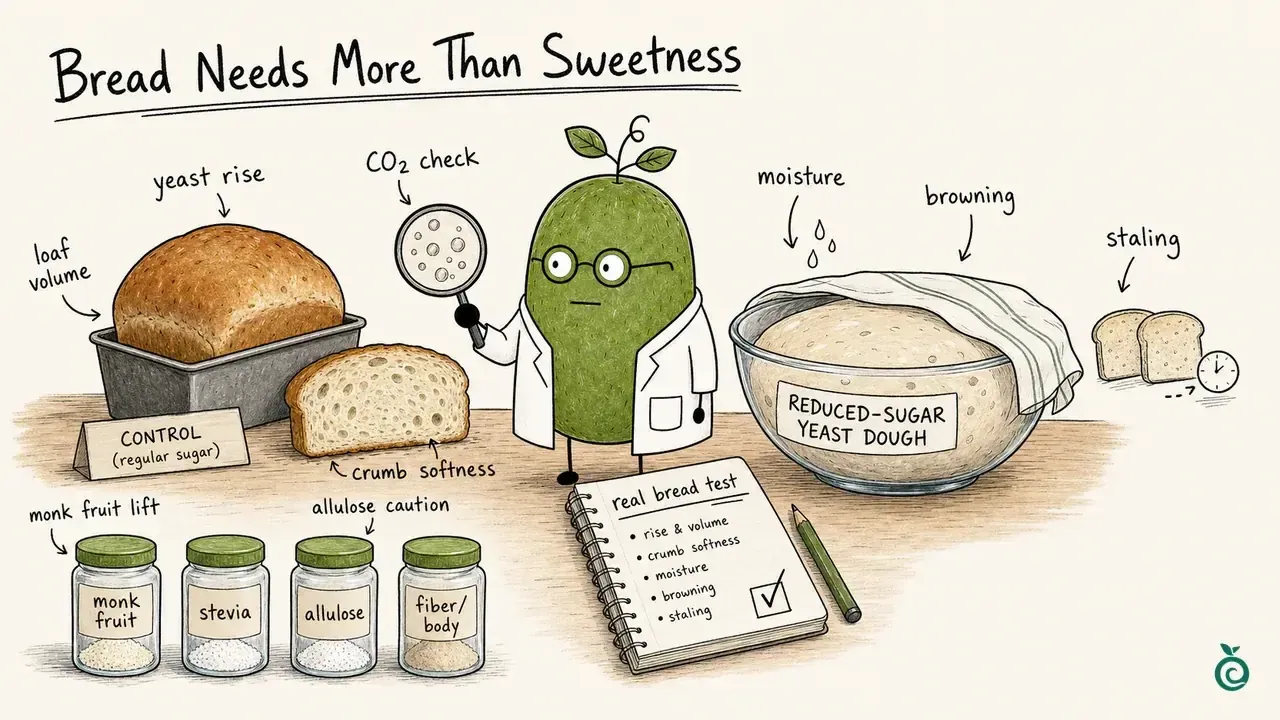
One loaf needs more than a sweetness result
Keep fermentation, loaf volume, crumb texture, moisture, browning and storage observations separate for the actual bread. The drawn bubbles, drops, clock and tick identify questions to check, not measured gas production, water content or an approved loaf. The ingredient jars illustrate sample directions and do not specify a formula, dose or shelf life.
Start with fermentation, not sweetness
In yeast bread, part of the sugar system supports fermentation and early dough expansion. Keep the actual flour, yeast, fermentable ingredients and supplied sweetener composition visible when selecting a trial. A small addition of a concentrated sweetener can change perceived sweetness without rebuilding the bulk and physical functions of the removed sugar. Keep a current-formula control. Record proofing time and temperature, dough height or the agreed proof endpoint, oven spring and loaf volume with the pan, dough-piece mass and process. Keep loaf volume and specific volume distinct: retain the actual measurement method and the mass basis when volume is reported per unit mass.
Why monk fruit and stevia need a complete bread system
Monk fruit and stevia can help sweetness lift, but a small concentrate addition does not replace sugar's bulk or restore the complete dough and crumb system. Choose the direction with the actual flour, hydration, process and any body or moisture adjustment in view. A water tasting is only a sweetness screen for this job. Check whether the supplied product is an extract, a grade with other components or a blend with a carrier or bulk ingredient. Those components can matter to the dough. Do not treat every product called monk fruit or stevia as the same fermentation or solids input.
Keep allulose fermentation and texture results distinct
In Sawettanun and Ogawa's 2022 model, the baker's yeast did not metabolise D-allulose, and the allulose condition reduced carbon dioxide generation and early dough expansion relative to the study's comparisons. The authors also reported a harder fresh bread texture alongside a lower hardening rate during storage. Those observations answer different questions; a storage-change benefit does not establish the preferred initial crumb. Use the study to identify what the controlled trial must check, not to select a universal addition or guarantee a loaf result. Keep the actual sweetener composition and fermentable ingredients identifiable in your own process.
Read initial firmness and later change separately
The following is a virtual numerical teaching example, not experimental or published study data. C0–C3 are invented, equally spaced checkpoints, not a recommended storage calendar; the values use illustrative units rather than a specified instrument scale. For a real trial, compare the actual baseline and later values under the same measurement and sample conditions.
| Illustrative checkpoint | Example A | Example B |
|---|---|---|
| C0 | 2 | 5 |
| C1 | 4 | 6 |
| C2 | 6 | 7 |
| C3 | 8 | 8 |
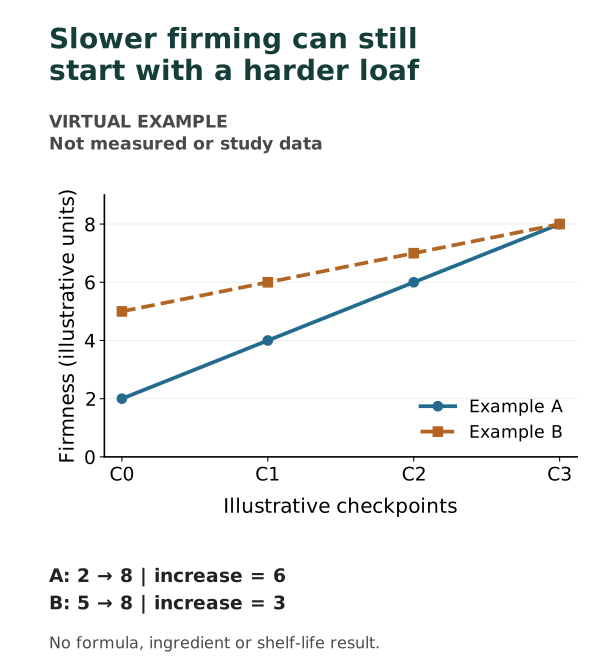
For your own record, define the first assessment after the agreed cooling or conditioning step. Keep the actual test method, specimen, temperature, compression or loading settings, slicing history and checkpoint with the result. A smaller rise in firmness and an acceptable firmness at serving are separate acceptance questions.
Rebuild body and moisture without attributing a combined result to one ingredient
When sugar is reduced, examine the complete solids, hydration, mixing, proofing, bake, cooling and pack system before choosing the next change. Track actual changes in water distribution, loaf structure and texture rather than calling every dry bite a sweetener problem. Moisture content and water activity are separate measurements; neither can be inferred from the drawn drops or a soft crumb. Xiao and colleagues' 2025 journal paper studied oligosaccharides, sodium carboxymethyl cellulose and D-allulose as a compound improver. Its reported bread-quality changes concern that combined intervention. They are not evidence that allulose alone will produce the same improvement, and the abstract does not supply a transferable factory recipe.
Use the existing bread scorecard for the real trial record
Use the bread softness and staling scorecard to keep fermentation, cooling, texture, moisture and storage observations under matched conditions. This guide helps select the formulation question; the scorecard holds the actual observations. Keep separate unopened or destructive-test units where the protocol requires them, and identify independent batches rather than counting repeated readings from one loaf as new batches.
Check the label for the actual market
Identify the ingredient, finished-food use, launch country and proposed claim before packaging is fixed. For a U.S. allulose project, include the main sales states and requested packaging wording in the review. FDA's October 2020 allulose guidance addresses Nutrition and Supplement Facts declarations and caloric content; it is not a blanket approval of a bread claim or a route for every market. Keep the formula result, nutrition calculation, ingredient/use review and proposed pack claim as separate decisions. Do not carry a U.S. label treatment into another country or treat a softer loaf as proof of a nutrition, safety or shelf-life claim.
Send a focused bread sample question
Start with the bread format, target market and the main problem: weak rise, dense crumb, dry bite, pale or dark crust, sticky dough or fast firming. Add the flour/base, current sugar level and its reporting basis, supplied sweetener grade and composition, actual addition, proof/bake process and observations you already have. State whether additions are based on flour mass or another formula basis; an unexplained percentage is an incomplete comparison. Packaging, estimated quantity, required documents and sample needs can follow as the direction becomes clearer. You can contact us before the technical or purchasing brief is complete.
Common questions
Can a concentrated monk fruit or stevia ingredient replace the complete sugar system?
It can address perceived sweetness at a small addition. Keep fermentable ingredients, solids, hydration, process and crumb requirements in the complete bread trial, and check the actual supplied composition or carrier.
Discuss this requestDoes allulose work better than sugar in yeast bread?
Define the result first. The 2022 model reported fermentation and initial-texture trade-offs alongside a lower hardening rate during storage. Those findings do not select a universal dose or establish the best loaf for another process.
Discuss this requestDoes a smaller firmness increase mean a softer loaf?
Compare the initial level and each later value as well as the change. In the clearly marked virtual example, B increases by 3 units and A by 6, but B starts harder and is never softer at the shown checkpoints. These are invented teaching values.
Discuss this requestCan compound-improver results be credited to allulose alone?
No. Keep the oligosaccharides, sodium carboxymethyl cellulose, allulose and process as the intervention actually studied. A combined result does not isolate one ingredient's effect or provide a transferable recipe.
Discuss this requestDoes a softer crumb establish moisture, water activity or shelf life?
No. Keep texture, moisture content, water activity, packaging and finished-product shelf-life work as separate records. A soft crumb or a photograph does not replace those measurements and reviews.
Discuss this requestDoes FDA allulose guidance approve the finished bread label?
The cited guidance concerns nutrition-label declarations and calories. The complete product, ingredient/use conditions and proposed packaging claim still need review for the actual market; include main sales states for a U.S. allulose project.
Discuss this requestWhat can we send before the bread brief is complete?
Start with the bread format, market and one problem. Add the flour/base, known sugar level and percentage basis, supplied sweetener, actual addition and process observations. Packaging, quantity, documents and sample needs can follow.
Discuss this request