
Read this guide in
BAKERY APPLICATION
Monk Fruit Sweetener for Bakery Products: Formulation Guide for Low-Sugar Brands
Using monk fruit sweetener in cakes, cookies and biscuits: sweetness, bulk, browning, moisture and sample-testing notes for bakery brands.
Bakery brands often look at monk fruit sweetener when they want lower-sugar cakes, cookies, biscuits, muffins or snack products. Monk fruit can help with sweetness, but bakery development needs more than a sugar-for-sweetener swap.
Sugar affects texture, browning, spread, moisture, shelf life and eating quality. A successful monk fruit bakery formula should treat sweetness, bulk and structure as separate formulation questions.
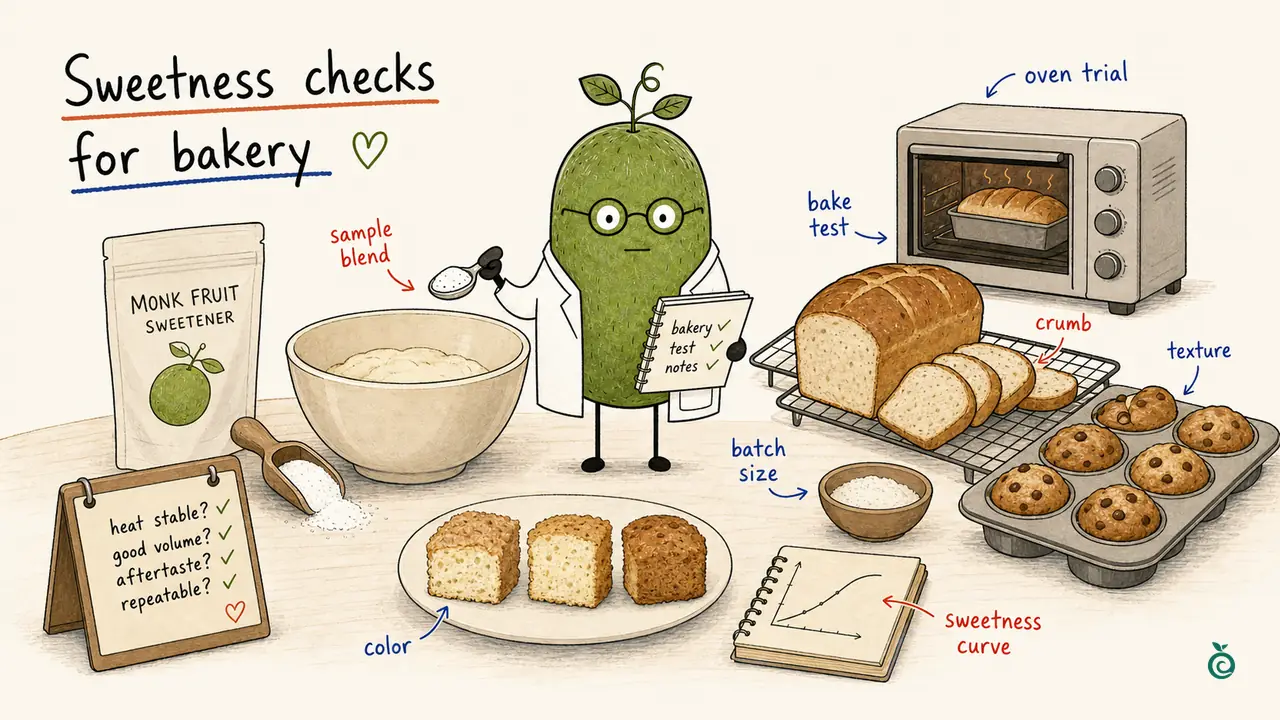
The Doctor illustration follows a blend through mixing, oven processing and a cooled-product check. Its ticks and sweetness sketch are illustrative, not measured baking results or proof of heat stability.
Monk fruit mainly solves the sweetness gap
Monk fruit extract can provide strong sweetness at a low usage level. It does not replace the full weight and physical function of sugar by itself, so bakery formulas often need a broader blend system.
Decide what sugar function must be replaced
In cakes and muffins, sugar affects volume, softness and moisture. In cookies and biscuits, it affects spread, crispness and browning. In filled products, it may also affect water activity and shelf-life direction.
| Bakery format | Compare in the finished product | Keep the comparison specific |
|---|---|---|
| Cake or muffin | Height or volume by the stated method, crumb and softness | Use the same portion and cooling checkpoint; keep sweetness separate |
| Cookie or biscuit | Diameter, thickness, spread and crispness | Record portion mass, pan and lining; judge against this recipe’s target |
| Brownie or snack bar | Cutting, crumbling, firmness and chewing texture | Compare equal portions at the same cooling and storage checkpoint |
| Bakery filling | Flow or set, separation and behaviour in its intended use | Identify baked or unbaked use and the actual pack and storage conditions |
Set acceptance criteria for the actual product. A soft cookie may be correct for one range and a failure for another; a darker or sweeter result does not establish better baking performance. Record measured values separately from descriptive observations.
Choose extract or blend based on product format
A bakery manufacturer may use monk fruit extract inside a larger formulation. A retail brand selling a baking sweetener usually needs a finished blend that is easier for consumers to measure and use. Confirm the model, carrier and sample lot. Replacing a commercial extract with a different grade, or changing the blend composition, creates a new material comparison rather than the same trial at a new brand name.
What does 1:1 replacement mean in a baking trial?
Confirm whether 1:1 means equal weight, equal volume or a sweetness target; it is not a monk fruit-to-carrier formula ratio. For a volume-based instruction, weigh the actual sugar and blend portions separately and record both masses. If the result is too sweet, change the sweetener level in a controlled comparison before changing water, flour or fat. Record both sweetness and the effect of any removed bulk. Approve cookies, brownies and cakes separately: acceptance in one recipe does not qualify the others.
Bakery trial checklist
Use the current sugar formula as a control. Record actual ingredient weights, flour and fat base, mixing, portion size, oven profile and cooling before tasting. For cookies, keep spread and crispness separate from sweetness; for cakes, record volume, crumb and moisture. A sweeter result can still miss the structure target. Repeat the promising direction after storage in the intended pack and connect the accepted material to its specification.
| Stage | Keep in the trial record | Use the result for |
|---|---|---|
| Recipe and portion | Actual ingredient masses, recipe version, sample lot and portion mass | Identify what changed and preserve the control |
| Mixing and rest | Addition order, mixing operation and dough/batter rest conditions | Separate handling changes from baking changes |
| Oven and pan | Oven profile, time, rack, pan, lining and loading pattern | Compare under a defined process |
| Cooling and measurement | Cooling time and conditions, measurement method and serving temperature | Compare like with like after baking |
| Pack and storage | Packaging, seal, storage condition and observation checkpoint | Check later eating quality in the intended pack |
| Decision and repeat | Sweetness and physical results separately, criterion, next variable and repeat result | Retain the accepted and rejected versions |
First compare the control and candidate under the planned, recorded process. If the candidate then needs a different bake profile or water adjustment, treat that as a separate optimization trial and keep the new recipe and process version with its results. Do not attribute every improvement in a changed process to the sweetener alone.
Keep the pan and bake conditions in the comparison
Pan preparation is part of the test. In King Arthur Baking’s own comparison, the same chocolate-chip-cookie recipe was baked with different pan linings or surface preparation while the baking time and oven rack were held constant; the resulting cookies differed. That is a practical reason to record the pan and liner when evaluating spread. It is not a monk fruit trial or a performance ranking of sweeteners.
How Hengliyuan supports bakery projects
Hengliyuan can discuss monk fruit extract and sweetener blend directions for bakery, snack and retail sweetener projects. Start with the bakery format, what sugar function or taste result you want to change, and any ingredient restrictions. An existing recipe, sample code or unsuccessful bake can make the first discussion more specific. For sample feedback, send the actual addition and the control-versus-candidate result under the recorded conditions. For a quotation or consumer baking instruction, then confirm the selected material, intended market, replacement basis, packaging and expected quantity. You can start a sample question before those commercial details are complete.
Common questions
Can pure monk fruit extract replace sugar by weight?
No. A concentrated extract supplies sweetness at a low addition; it does not replace the full mass or physical functions of sugar. Account for the remaining formulation changes in the actual bakery recipe.
Discuss a bakery blendDoes 1:1 mean the same thing for every baking blend?
Confirm the stated basis: equal mass, equal volume or a sweetness target. Weigh a volume-based portion and record its actual mass. Test each proposed recipe separately before using the replacement instruction across a product range.
Discuss a bakery blendShould I bake every sample until it looks equally brown?
Keep the planned process fixed for the first ingredient comparison and record colour as a result. If the new formula needs a process adjustment, log that as a separate trial. Similar browning alone does not establish that the two products received an equivalent thermal process.
Discuss a bakery blendWhy compare after cooling and again in the intended pack?
Warm eating quality and the later product are different observations. Use the same cooling checkpoint, then repeat the chosen measurements and tasting under the recorded storage and packaging conditions. One acceptable bake does not establish shelf life.
Discuss a bakery blendWhat should I send after an unsuccessful bakery trial?
Name the bakery format, sample and actual addition, then describe the control and the issue you want to change. Include relevant mixing, pan, baking, cooling or storage differences. Start with the information you can share; a complete proprietary recipe and settled packaging order are not required for a first question.
Discuss a bakery blend