
Read this guide in
FOAM BAKERY SUGAR REDUCTION
Low-Sugar Meringue and Foam Cake Sweetener Replacement Guide
Compare allulose, monk fruit and stevia in meringue and foam cakes. Check replacement basis, foam stability, baking loss, crispness and stored texture.
Replacing sugar in meringue or foam cake requires more than matching sweetness. Our starting point is the structure: can the candidate hold air through mixing, baking and cooling, then keep the texture the buyer wants?
Sugar affects foam stability, batter setting, moisture and browning. High-intensity sweeteners can restore sweetness with little bulk, while a bulk sweetener changes more of the recipe. Test the exact product: a crisp dried meringue and a soft angel food cake need different endpoints.
Start with the foam, not the sweetener
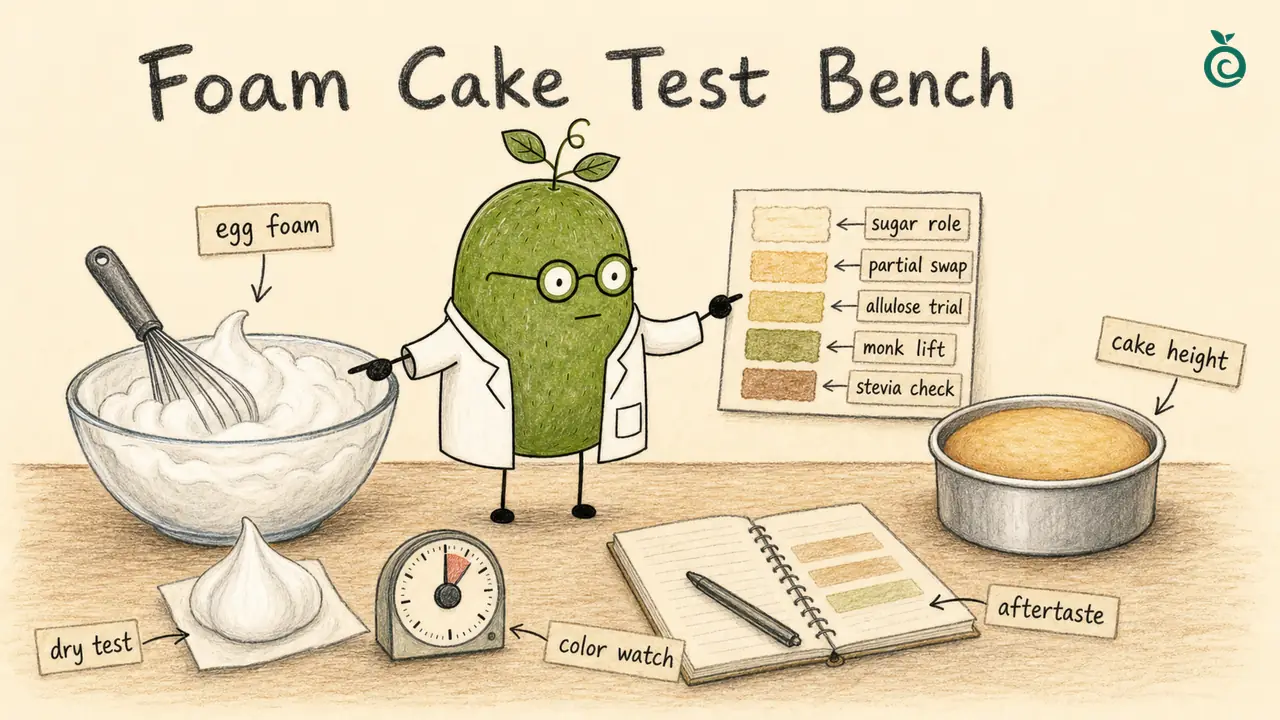
Keep the egg white or protein source, lot, temperature, bowl, whisk, batch size, addition order and mixing settings consistent in the first comparison. Record whipping time, foam appearance, density and any drainage during a defined holding period. If you then change the mixing process to improve a candidate, record it as a separate trial; otherwise the ingredient effect and process effect become inseparable.
Separate meringue from cake
A dried meringue, a soft sponge cake and an angel food cake do not ask sugar to do the same work. Dried meringue needs crispness and drying control. Angel food cake needs height and spring. Sponge cake often needs color, aroma and crumb softness. The sample plan should name the exact product before a supplier quotes a blend.
| Product | What to compare | What does not prove success |
|---|---|---|
| Dried meringue | Piece size, drying loss, colour, crisp break and softening after packaging | A crisp sample straight from the oven |
| Angel food cake | Batter density, cooled height/volume, shrinkage and crumb spring | A tall cake before cooling |
| Sponge cake | Batter aeration, cooled volume, crumb softness and storage texture | Sweetness matched in water |
Use allulose as a measured variable
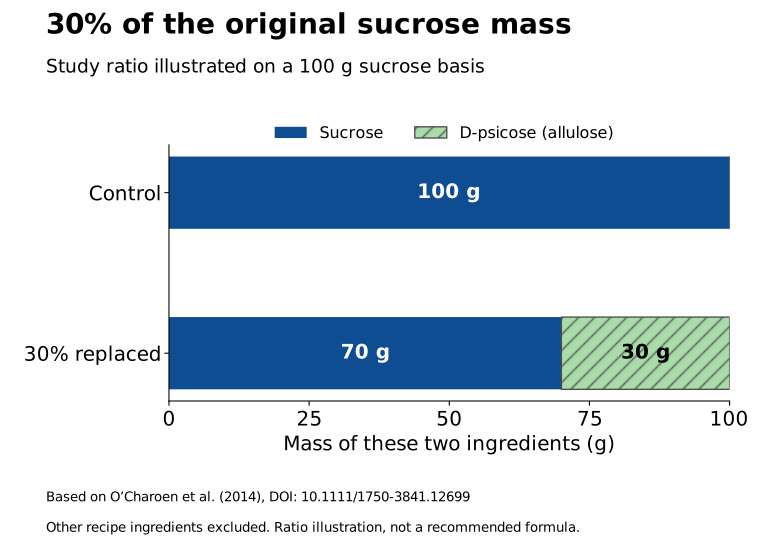
The 2014 meringue study replaced 30% of the original sucrose weight with d-psicose (allulose). That is not 30% of total batter weight and not a 30% change in perceived sweetness. The allulose treatment changed break and browning in that particular model. Use the paper to identify measurements, not to copy its ratio into every meringue or cake.
Use monk fruit or stevia for sweetness lift
Monk fruit and stevia can close a sweetness gap at low levels. They do not provide the same bulk, drying behavior or foam support as sugar. In foam bakery trials, they are usually better treated as sweetness lift inside a system that still manages solids, moisture and structure.
Measure structure before taste approval
Keep a sucrose control and compare candidates at the same defined stage. Record the process before interpreting a difference; darker colour alone does not show that drying is complete. A suitable taste result still needs the product’s separate process, packaging and shelf-life validation.
| Stage | Record consistently | How to interpret it |
|---|---|---|
| Before baking | Mass in the same known-volume cup; foam/batter temperature; hold time | Density = sample mass / cup volume. Use the same filling method without deliberately compressing the foam. |
| Baking and cooling | Deposit mass, shape or pan, oven settings, time and cooling conditions | Compare a fixed process first. If you tune the process for a candidate, label that as a separate comparison. |
| After defined cooling | Height/volume, mass loss, colour and break or crumb texture | Use the same measurement method. Specific volume is cooled volume divided by cooled mass; height alone is not volume. |
| After storage | Pack type/seal, storage time/temperature/humidity, texture and measured water activity where relevant | Keep retained control samples. Moisture content, water activity and package humidity are different measurements. |
Prepare the buyer brief
Send the exact product type, sales market, current sugar amount and its basis, reduction goal, egg white or protein source, mixing and baking process, packaging and the main defect to solve. Include available control results or photos taken under the same conditions. Quantity and document needs help with the supply discussion; start with the known details and we can clarify the rest.
What the published studies support
The meringue paper concerns one recipe and process, not a general replacement recommendation. A separate 2019 angel food cake study examined pasteurised shell eggs and mixing factors; it supports recording protein source and mixing conditions alongside cake results. Neither study establishes the shelf life or final formula of a Hengliyuan customer product.
Common questions
Can allulose replace sugar in meringue?
It is a candidate for partial replacement where the target market allows the intended use. Test foam stability, drying, browning, break and stored texture. The published 30% replacement refers to original sucrose weight, not total batter.
Discuss this requestCan monk fruit or stevia replace all the sugar in angel food cake?
They can supply sweetness but do not replace the bulk and physical roles of the removed sugar. A successful recipe must also manage solids, foam stability, batter setting and texture.
Discuss this requestWhy does a low-sugar foam cake collapse?
Compare the control and candidate before baking, during cooling and after storage. Protein source, whipping, folding, solids and baking conditions can all contribute. One collapsed cake does not identify the sweetener as the cause.
Discuss this requestShould every sample use the same whipping time?
Use a fixed method for the initial ingredient comparison. If a candidate needs a different whipping endpoint or mixing time, test that adjustment separately and record it; do not silently change the process between candidates.
Discuss this requestDoes a darker meringue mean it is fully dried?
No. Colour and drying are different outcomes. Compare mass loss and texture after consistent cooling, with relevant moisture or water-activity measurements. Do not use colour alone to set a drying or safety endpoint.
Discuss this requestWhat should I send for a foam bakery sample?
Start with the product, target market, current sugar amount and basis, protein source, process and main problem. Add packaging, quantity and required documents when known. Control measurements and comparable photos help us discuss the next blend direction.
Discuss this request