
Read this guide in
FORMULATION GUIDE
Monk Fruit Sweetener Without Erythritol: Formulation Guide for Brands
Monk fruit sweetener without erythritol: formulation routes, carrier options, taste and bulk trade-offs, plus sampling guidance.
Yes, monk fruit sweetener can be formulated without erythritol. For a new product, first choose concentrated extract for your own formula, an existing allulose and monk fruit blend to evaluate, a custom manufacturing blend or a finished private-label pack. That choice determines what you are buying and what the first sample should answer.
An erythritol-free brief does not define one formula. Compare sweetness, bulk, mouthfeel, cost in use, serving size, solubility, packaging and the final sales market before requesting samples. If you already sell or manufacture an erythritol-containing product, use the separate reformulation guide and bring the current formula as the control.
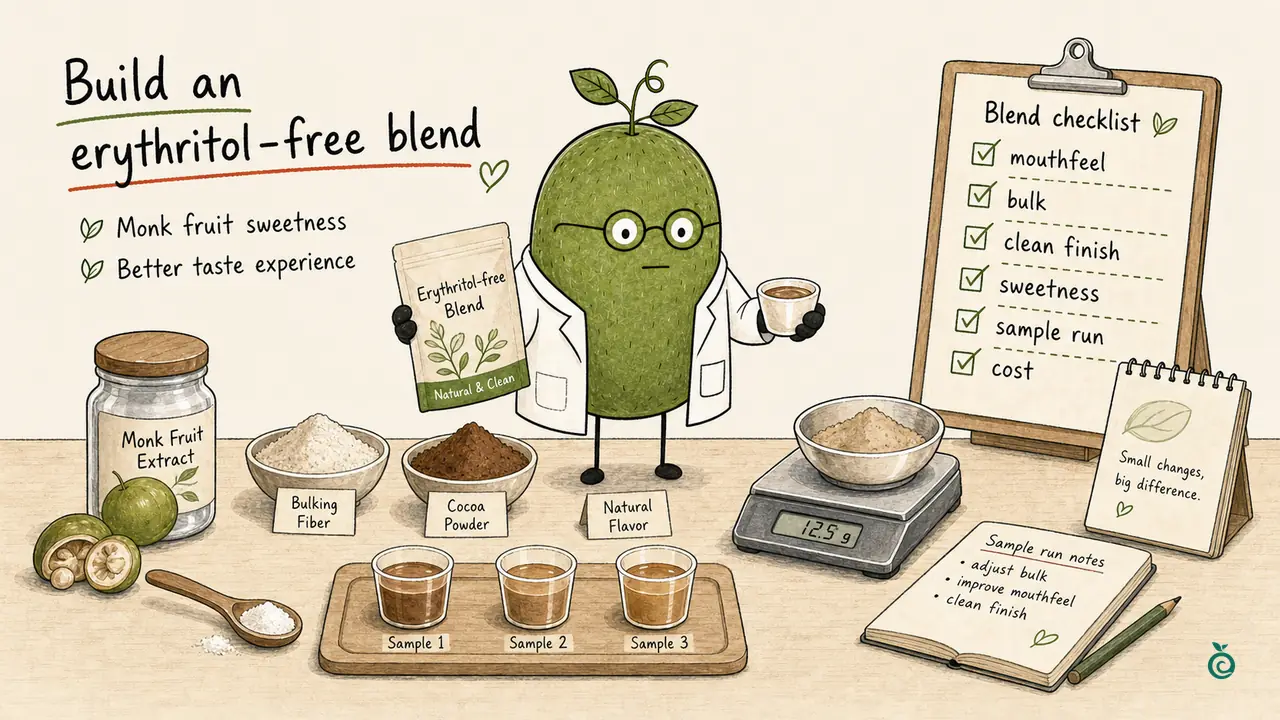
The Doctor illustration shows composition, bulk, taste and sample checks to consider together. Its ingredient bowls, pack wording, sample colours and 12.5 g scale reading are illustrative, not a Hengliyuan formula, recommended dose or measured result. An erythritol-free direction still needs evaluation in the intended food, drink and consumer use.
Choose the product route before asking for a sample
The right starting point depends on who will formulate the sweetener and whether the purchase is an ingredient, a prepared blend or a finished retail product.
- Review concentrated monk fruit extract
- Review the allulose and monk fruit option
- Discuss a custom sweetener blend
- Compare OEM and distribution routes
| Product route | Best fit | What to send first |
|---|---|---|
| Concentrated monk fruit extract | Manufacturers with their own formulation capability | Application, current control, requested assay if known and process conditions |
| Allulose and monk fruit catalog direction | Buyers who want an existing erythritol-free blend direction to evaluate | Application, destination market, ingredient restrictions and sample quantity |
| Custom erythritol-free blend | Manufacturers that want Hengliyuan to help develop the sweetening system | Product base, sweetness target, serving size, excluded ingredients and packaging needs |
| Private-label finished product | Brands that need a consumer-ready product under their own name | Final market, formula direction, unit pack, artwork status and expected quantity |
Specify extract or a finished sweetener blend
A request for monk fruit without erythritol can mean concentrated extract for a manufacturing formula, or a blend to be measured by the consumer. Name the material and request its full ingredient statement, including any carrier. The absence of erythritol alone does not identify the composition, sweetness or serving instructions. For each candidate, ask for the exact product name, specification revision and full composition that will accompany the sample. An ingredient list that omits erythritol is a composition statement; it is not a test result proving an agreed trace-level limit. If your requirement includes a limit or a particular declaration, explain it before choosing the material and confirm what supporting evidence is available.
Why buyers request erythritol-free options
Buyers often mention taste, cooling effect, digestive tolerance perceptions, label preference or market positioning when asking for formulas without erythritol. The best response is not to make broad health claims, but to design and test the formula around the target product. State the actual brief: an excluded ingredient, a sensory preference or a finished-pack claim. These are different requirements. The name of an excluded ingredient alone does not establish sugar content, energy, tolerance or a health advantage for the complete product.
Design sweetness and bulk as separate jobs
In a new erythritol-free concept, concentrated extract supplies sweetness without defining a consumer-sized portion or the rest of the formula. Decide which ingredients will supply the required bulk, mouthfeel and handling. An alternative blend changes the complete composition, so evaluate it as that named blend rather than treating all erythritol-free powders as interchangeable.
Application matters more than a single ingredient decision
A beverage powder, table-top sachet, syrup, bakery blend and coffee sweetener may need different erythritol-free designs. A formula that works in a stick pack may not work as a spoonable jar product or a baking replacement. Write the use instruction you want to test: grams added in manufacturing, a weighed consumer portion, a level spoon or a fixed sachet. A powder that tastes right when weighed by a technician still needs to work under the intended consumer preparation.
Define 1:1 before comparing a sample
A sugar-replacement statement needs a basis. Equal weight, equal volume, sweetness equivalence and a complete recipe substitution answer different questions. Keep the sugar reference and candidate identifiable so the result can be used in the next decision.
| Meaning of 1:1 | How to set the comparison | What remains to evaluate |
|---|---|---|
| Equal weight | Use the stated mass of sugar and candidate, each identified by product and formula version | Sweetness, aftertaste and every required function in the finished recipe |
| Equal volume | Name the utensil and how it is filled; weigh the actual portions of both materials | Serving consistency, powder handling and finished-product response |
| Matched sweetness | Record the actual addition of each material needed for the agreed sweetness target | Those additions can have different mass, volume and other functional effects |
| Recipe replacement | State which sugar portion is replaced, the rest of the recipe and permitted adjustments | The full food or drink under its actual preparation, processing and use |
A 1:1 use target is not a 1:1 ratio of monk fruit to another ingredient. Keep any formula adjustments visible. For a first concept screen, use a named sugar reference and record the intended use; confirm the accepted formula and serving instruction before specifying a retail pack.
Start with the product and ingredient restriction
Send the product you plan to make or sell, the excluded ingredients and final sales market. Say whether you need extract, a manufacturing blend or your own branded pack; if undecided, describe how the customer will use it. A final formula, artwork or order quantity is not needed to start that discussion. Separate the buyer or company location, ship-to country or port and final sales market; these may be three different places. Sugar-free, low-calorie or natural wording is a separate finished-product and market review. Confirm the selected ingredients and intended claim before treating a formula direction as a label-ready product.
How to evaluate samples
Compare sweetness onset, aftertaste, mouthfeel, measuring behavior, powder flow, solubility and performance in the actual food or drink. If the product is for retail, test how consumers will use it at home, not only how it tastes in a laboratory cup. Record the actual addition, preparation and serving condition alongside the sample code. Choose whether you are comparing a fixed addition or adjusting toward matched sweetness; do not mix those results without naming the difference. Keep the preferred candidate and unresolved issue together, then confirm that the proposed bulk or retail specification describes that accepted material.
How Hengliyuan can discuss erythritol-free options
Hengliyuan lists an allulose and monk fruit blend whose catalog ingredients do not include erythritol. This is one product direction to review, not a universal replacement. Confirm its current specification, market fit and sample conditions for the intended food or drink. For concentrated extract requests, use the extract specification and inquiry route. Bulk blend supply and a filled private-label pack are separate quotation scopes. After the sample direction is useful, confirm the formula reference, unit or receiving pack, quantity, requested documents, currency and delivery term for a comparable offer.
Common questions
Does monk fruit require erythritol?
No. Concentrated extract can be assessed in your own formula, or you can evaluate a blend whose selected ingredients exclude erythritol. Identify the actual material and complete composition; the ingredient restriction alone does not determine its sweetness, bulk or serving instruction.
Discuss an erythritol-free directionIs monk fruit without erythritol the same as pure monk fruit extract?
No. A product can exclude erythritol and still contain allulose or other ingredients. Distinguish concentrated extract from a prepared blend by its full product name, composition and specification, rather than by the front-of-pack phrase alone.
Discuss an erythritol-free directionIs an erythritol-free sweetener automatically sugar-free or low-calorie?
The absence of erythritol does not establish those properties for the complete product. Review its full composition, intended use, actual nutrition information and applicable market requirements before choosing finished-pack wording.
Discuss an erythritol-free directionCan I replace sugar with the same spoonful?
Only evaluate that claim on a defined volume basis: identify the spoon, filling method and actual portion masses. Equal volume and equal weight are different tests. A sweetness match also leaves texture, processing and other required recipe functions to assess.
Discuss an erythritol-free directionDoes 1:1 mean equal amounts of monk fruit and the carrier?
No. It can describe a target for using the finished sweetener against sugar. State whether the basis is weight, volume or matched sweetness; it does not reveal the ingredient ratio or establish a universal recipe substitution.
Discuss an erythritol-free directionHow do I confirm the sample meets my ingredient restriction?
Request the full composition and specification for the exact sample and proposed supply material. Explain any required declaration or trace-level limit in advance and confirm the supporting evidence available. An ingredient list is not a substitute for a test result against an agreed limit.
Discuss an erythritol-free directionWhat should I send to discuss an erythritol-free sample?
Start with the food, drink or retail product, excluded ingredients, final sales market and intended use. Say whether you need extract, a blend or private-label packaging, or describe the decision you need help making. Formula, pack, quantity and sample arrangements can then be clarified for the selected direction.
Discuss an erythritol-free direction