
Read this guide in
ERYTHRITOL-FREE TABLETOP SWEETENERS
Erythritol-Free Allulose Monk Fruit Tabletop Sweetener Guide
Plan an erythritol-free allulose–monk fruit tabletop sweetener: define 1:1 by weight or volume, compare jars and packets, and confirm the market and sample brief.
Our starting point for an erythritol-free tabletop blend is the serving instruction. Does the customer use the same spoonful as sugar, the same weight, or one packet for a stated amount of sugar? Those are different targets, even when every pack says “1:1.”
Allulose can provide bulk and part of the sweetness; monk fruit extract can supply additional sweetness. The blend still needs to pour, measure and taste right in its intended use. Decide the consumer format and market first, then compare the formula in that format.
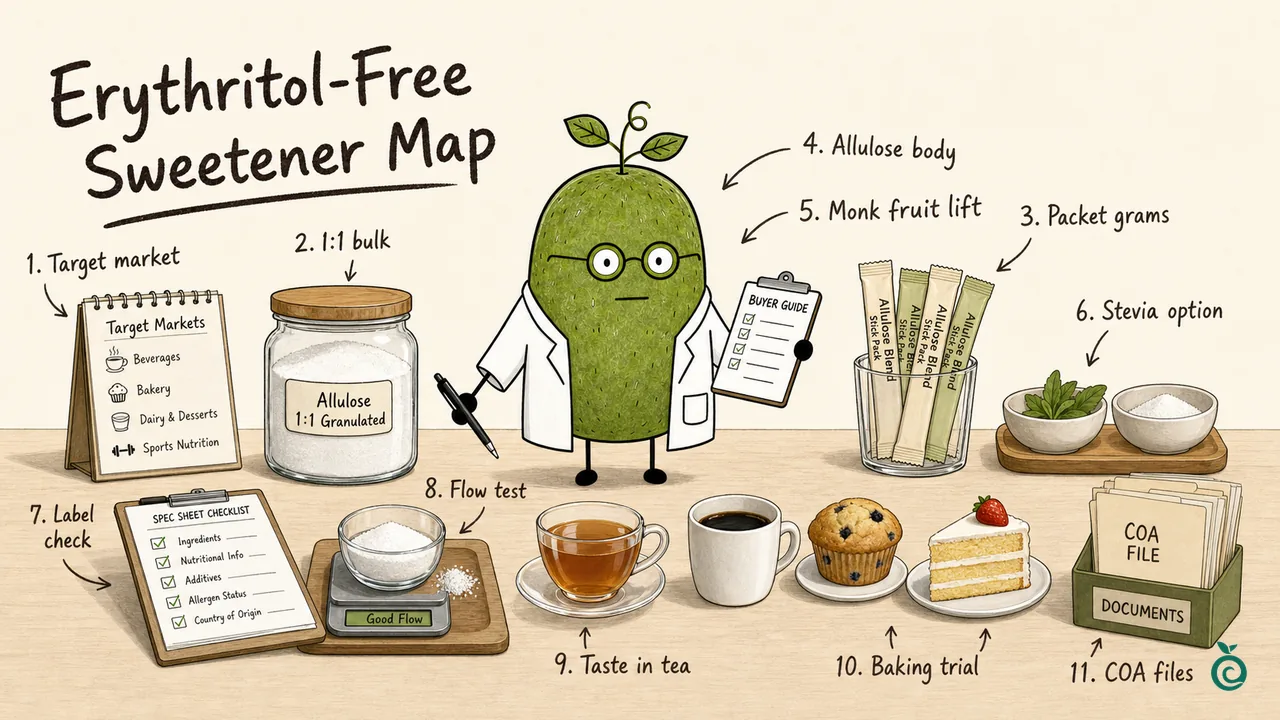
Define what 1:1 means before comparing samples
A sweetness target is not a complete dosing instruction. Equal sweetness by weight does not establish equal sweetness by spoonful: the mass held by a spoon depends on the powder’s bulk density and how it is filled. Record the basis on the sample brief and use it consistently in tasting and label development.
| Claim or instruction being developed | Comparison to make | What still needs checking |
|---|---|---|
| 1:1 by weight | The same mass of sugar and blend in the same base | Sweetness and aftertaste at that mass; this does not prove spoon-for-spoon equivalence |
| 1:1 by volume | The same defined level measure of sugar and blend; weigh both portions | Actual portion masses, repeatable scooping, sweetness and flow |
| One packet replaces a stated sugar serving | The planned packet mass against the stated sugar reference | Fill consistency, dissolution and taste in the stated drink or food |
These are comparison methods, not confirmed equivalence claims for a Hengliyuan formula. Keep one reference sugar, application and serving method throughout each trial.
Decide what each ingredient is doing
Allulose contributes bulk and sweetness where the target market permits the intended ingredient and use. Monk fruit extract supplies sweetness at a much lower dose. If stevia is acceptable in the ingredient list, a selected steviol glycoside can also be evaluated for sweetness and finish. Removing erythritol does not by itself define the rest of the formula. Clarify whether the requirement is only no erythritol, no sugar alcohols, no stevia, or a particular carrier list. These are separate specifications; do not substitute one for another.
How Hengliyuan makes the corresponding blend
Hengliyuan makes its allulose-based sweetener blends by high-speed powder mixing, which distributes the powdered ingredients in the selected formula. This is a common powder-mixing method. Confirm blend uniformity, particle size and application performance against the selected specification and sample.
Check the target market before label design
Review the actual ingredients, supply route, use and finished-product label before committing to printed packaging. FDA’s allulose guidance addresses US nutrition-label treatment; it is not a worldwide approval or a label approval for the complete blend. EFSA’s 2025 assessment of one D-allulose dossier found that safety could not be established from the submitted information. Do not interpret that dossier-specific opinion as authorization for an EU product. For Australia and New Zealand, check the specified enzymatic production route in FSANZ A1247 against the offered ingredient and applicable conditions.
Test the real serving situation
Start with the uses you intend to print on the pack. Compare the sugar control and candidate at the stated serving basis, in the same hot coffee, tea, iced drink or spoonable food. Keep temperature and preparation consistent. Score sweetness, bitterness, lingering sweetness and overall preference separately. Test baking separately if it will be claimed: matching sweetness in coffee does not establish the same recipe behavior. Assess flow, dust, clumping and moisture exposure in the planned package as well as taste. An unopened laboratory sample does not show how a jar will scoop after repeated opening.
Prepare the private-label packaging brief
Choose packaging around the intended consumer use. A jar sample does not establish packet filling performance, and a packet approval does not establish spoon-for-spoon dosing.
| Retail format | Practical sample check | Packaging brief |
|---|---|---|
| Spoonable jar | Repeated scooping, portion mass and flow after opening | Serving instruction, fill weight, closure and intended in-use conditions |
| Refill or retail pouch | Pouring, resealing and clumping observations | Retail weight, barrier requirement, seal and storage target |
| Stick or sachet | Planned portion, fill behavior, emptying and dissolution | Grams per packet, sugar-equivalence instruction, count per box and pack material |
Share the label language, carton plan and shelf-life target when known. Validate the selected blend in the actual package; a requested shelf life is a target, not a confirmed result.
Send a supplier-ready brief
For a first discussion, send the target market, intended use and format. State whether the replacement target is by weight, by volume or per packet, and which ingredients must be excluded. Add estimated quantity, packaging details and document needs if known. For a quotation, confirm the selected formula direction, specification, pack and order quantity. Keep the sample code and comparison notes with that brief so the quoted product corresponds to the sample you evaluated.
Technical references
FDA and FSANZ primary pages were rechecked for their specific scope. The EFSA dossier reference and its limits follow the verified allulose market review linked above. None of these references establishes that a particular Hengliyuan blend is authorized in every market.
Review note
Reviewed October 16, 2026. Tables describe sample-planning methods, not measured product results or approved consumer claims.
Common questions
Can an erythritol-free allulose–monk fruit blend be 1:1?
It can be developed toward a defined equivalence target. Specify whether 1:1 means equal weight or equal volume, then compare the samples in the intended use. A weight-based result does not establish spoon-for-spoon equivalence.
Discuss a tabletop sampleDoes erythritol-free also mean no stevia or no sugar alcohols?
No. These are separate ingredient requirements. State each exclusion explicitly and review the complete proposed ingredient list, including carriers, before approving the sample or label.
Discuss a tabletop sampleWhy use a blend instead of pure monk fruit extract?
Monk fruit extract is a high-intensity ingredient and is harder to measure directly for everyday tabletop use. A bulk blend can support a repeatable spoon or packet serving. Whole monk fruit powder is a different material and should not be confused with purified extract.
Discuss a tabletop sampleCan allulose, monk fruit and stevia be combined?
They can be considered together where the intended ingredients and uses fit the destination market. Stevia is optional in the brief, not an automatic ingredient. Compare the chosen system in the actual beverage or food rather than approving it only from water tasting.
Discuss a tabletop sampleCan one sample approve jars, packets and baking use?
No. Check scooping and flow for jars, the planned dose and filling behavior for packets, and recipe performance for any baking claim. Shared ingredients do not make those tests interchangeable.
Discuss a tabletop sampleWhat should I send to start a tabletop sample project?
Start with the market, product idea, retail format and dosing target. Share known ingredient exclusions, quantity and document needs. We can clarify the remaining details before selecting the next sample direction.
Discuss a tabletop sample