
Read this guide in
REFORMULATION GUIDE
Erythritol-Free Monk Fruit Sweetener Reformulation Guide
Remove erythritol from an existing monk fruit blend without overlooking bulk, dosing or filling. Define what must stay, run a controlled comparison, and specify the accepted sample.
Keep the current product as the control when removing erythritol from an existing monk fruit blend. Our first question is what must remain familiar to the customer: the sweetness, spoonful, packet dose, texture or preparation method. Define those requirements before choosing replacement ingredients.
Removing erythritol is more than an ingredient-list change. Bulk, serving weight, cooling sensation, mouthfeel, powder flow, filling and cost in use can all change. A candidate that tastes right in a cup still needs to work in the package and process used for the current product.
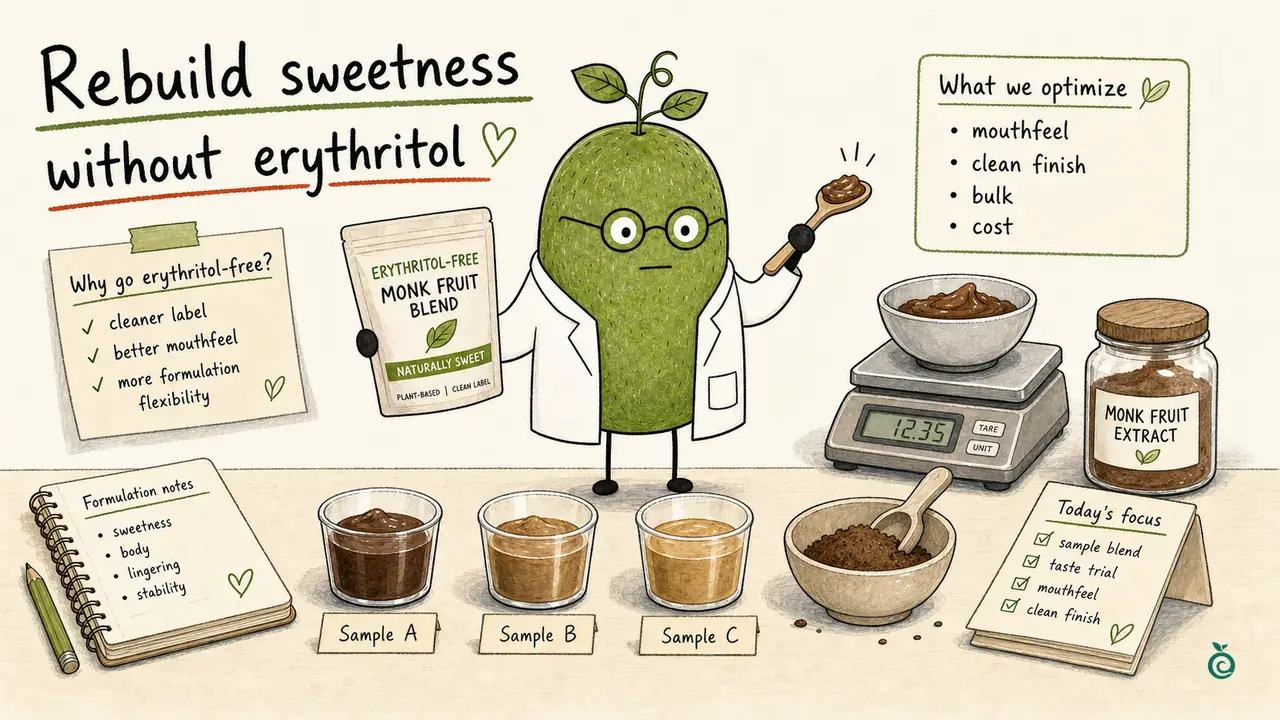
Identify what erythritol was doing
List the roles erythritol performs in this product: bulk, crystalline texture, sweetness, cooling sensation, flow or a repeatable consumer dose. Not every role has to be preserved. If less cooling is the purpose of the reformulation, keep that as an intended change rather than treating any difference from the old product as a failure.
Build the reformulation brief from the current product
Keep the current ingredient list, formula version, erythritol level, serving instruction, preparation method, process and packaging together. State the reason for removal and the final sales market. A tabletop jar, stick packet, beverage powder, bakery blend and syrup should not share an assumed replacement ratio. Separate three decisions: what must stay, what should improve, and what may change. For example, a project may require the same packet size while accepting a different cooling finish. If the serving instruction must stay, test that exact instruction; if it may change, write the new instruction before the comparison.
Replace functions, not only an ingredient name
Use the current product as the reference and decide which differences are acceptable before selecting a new formula.
| Current function | What may change without erythritol | What to compare |
|---|---|---|
| Bulk and serving weight | A high-intensity sweetener contributes much less mass | Dose, serving instructions and cost in use |
| Mouthfeel and cooling | Texture and cooling sensation may change | Side-by-side tasting in the actual product |
| Powder flow | The blend may fill, bridge or absorb moisture differently | Flow, clumping and filling trials |
| Sweetness profile | Onset, peak, finish and aftertaste may shift | Blind comparison against the current control |
| Package fill and use | Sachet weight, scoop size or jar dosing may no longer fit | Trial packs under the intended storage and use conditions |
Use this table to set project-specific acceptance criteria before tasting. It describes functions to check, not proof that one replacement ingredient can preserve all of them.
Run an A/B trial against the current product
Code the current product and each candidate, record the formula versions, and prepare them in the same base at the same temperature. Use the comparison basis agreed in the brief: unchanged consumer dose, or a deliberately revised dose. Do not compare different sweetness levels without recording that difference. If the aim is to isolate an ingredient change, hold the other conditions steady. If formula, dose and process all change, describe the result as a comparison of two complete systems. Record differences rather than assigning every result to the absence of erythritol.
| Comparison stage | Keep or record | Decision before moving on |
|---|---|---|
| Current-product baseline | Formula version, actual dose, preparation and package | Which properties must remain and which may change |
| Coded sensory comparison | Same base and serving temperature; agreed dose basis | Sweetness, cooling, texture and finish each meet the project brief |
| Process and trial packs | Mixing/filling conditions, actual fill and consumer dosing | Candidate works in the intended line and package |
| Repeat and purchasing handoff | Selected sample code, repeat preparation, specification and storage plan | Record exactly what was accepted and what remains unverified |
A tasting pass does not establish storage performance. Keep the required storage and package checks open until they have been completed for the chosen formula.
Review packaging before final quotation
Trial the planned sachet, jar or pouch before confirming the production specification. Check actual fill weight, emptying or scooping, sealing and clumping under the intended storage and use conditions. A package that worked for the old blend is a starting point, not proof of suitability for the new one. Compare cost at the accepted consumer dose or finished-product usage level, not only ingredient price per kilogram. Confirm the selected formula, pack and quantity before the final quotation; log any remaining production or storage checks separately.
Confirm local label and claim rules
Review the complete new ingredient list and intended claims for the final sales market before artwork. Removing erythritol does not by itself establish a no-added-sugar, keto or natural claim, and does not mean all other sugar alcohols or stevia have been excluded. Specify each ingredient restriction separately.
How Hengliyuan can help
Start by sharing the existing product, the reason for removing erythritol and the result you want to preserve. Add the intended market, current dose, package and ingredient restrictions if known. You can begin the discussion without sending a fully resolved formula or complete test dossier. Hengliyuan can discuss the next blend direction and sample comparison from that brief. For cross-border projects, distinguish the buyer location, ship-to country or port and final sales market, and identify bulk ingredient, private label or Hengliyuan brand distribution. Before ordering, link the accepted sample code and comparison record to the agreed specification and packaging.
Review note
Reviewed October 16, 2026. This guide describes a reformulation workflow; it does not establish a universal replacement ratio or a finished-product performance guarantee.
Common questions
Can erythritol be removed from an existing monk fruit sweetener?
An erythritol-free direction can be developed, but the replacement must address the roles erythritol played in that product. Keep the current product as the control and define which differences are acceptable before selecting the next sample.
Discuss the current-product reformulationCan I replace erythritol with more monk fruit extract?
Monk fruit extract can contribute sweetness at low use levels, but it does not replace erythritol’s bulk by itself. Review serving mass, flow, filling and consumer dosing as part of the replacement system.
Discuss the current-product reformulationWhat should stay fixed in the A/B trial?
Use the same application base, preparation and serving temperature, and record the formula versions. Agree whether the comparison keeps the old consumer dose or tests a revised dose. If several conditions change, evaluate the complete systems instead of attributing the result to one ingredient.
Discuss the current-product reformulationWill the new blend taste exactly like the old one?
Not automatically. Cooling, sweetness onset, finish and mouthfeel can change. Decide which differences are acceptable and score those observations separately; a preferred new taste does not necessarily need to copy every feature of the old product.
Discuss the current-product reformulationCan the old packet size and serving instruction stay?
They can remain targets, but must be tested. Compare sweetness at the stated dose, actual fill behavior and consumer preparation. If the candidate requires another dose, revise and validate the serving instruction before approving the packaging.
Discuss the current-product reformulationWhat should be confirmed after selecting a sample?
Repeat the chosen direction, record its sample code and specification, and check the intended process and pack. Keep sensory approval separate from any unfinished storage or claim review. The quotation and production specification should refer to the accepted version.
Discuss the current-product reformulation