
Read this guide in
CEREAL CRISPNESS AND STORAGE
Water Activity Guide for Crisp Breakfast Cereal: Moisture, Packaging and Storage
Compare cereal crispness with moisture, water activity and package performance. Use a storage scorecard before approving a reduced-sugar cereal or granola blend.
A cereal that tastes sweet enough can still soften, crumble or lose its clean fracture in storage. Our factory view: choose the sweetener, binder and packaging against separate test results, then confirm that the complete product works together.
Start with your current cereal as the control. Compare the reduced-sugar trial at the same cooling point, in the intended package and at the same storage checkpoints. No single water-activity number or fresh tasting can answer all those questions.
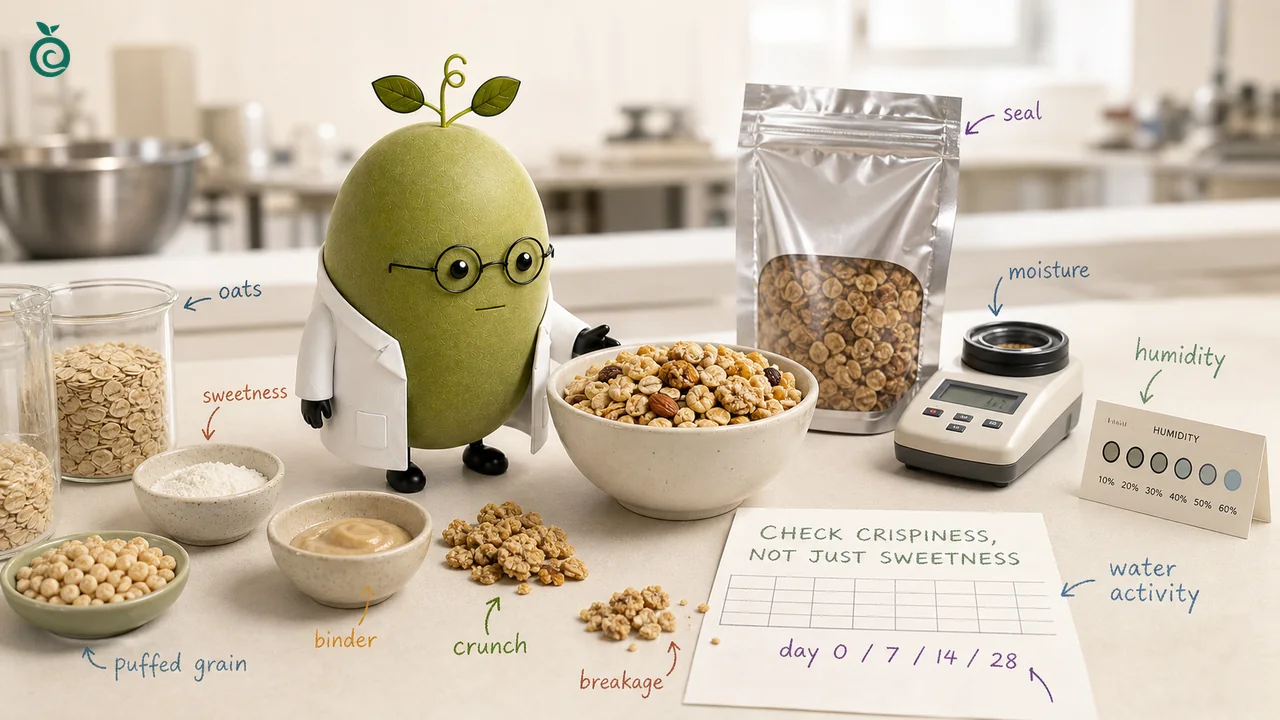
Sweetness does not measure crispness
Monk fruit and stevia can help with sweetness, but a sweet tasting sample does not tell you whether the cereal will bind, break cleanly or stay crisp after storage. Keep taste, structure and moisture as different release questions.
Use moisture and water activity for different questions
Moisture content tells you how much water is in the product. Water activity describes how available that water is for movement and reactions. Pair both with a crunch or fracture check instead of treating one number as a universal pass line. A 2025 Foods study of puffed brown rice, barley, adlay and amaranth found brittle-to-ductile changes around its own moisture conditions and a glass-transition observation near 40 °C at about 8% moisture; those values belong to that study's materials and conditions, not every cereal.
Keep the binder trial separate from the sweetener trial
A high-intensity sweetener may add little mass, so it cannot automatically replace syrup's binding or coating work. In a 2026 granola-bar study, FOS replacement of glucose syrup was tested at several levels while the researchers measured water activity, texture, colour and sensory response. The study supports a comparison matrix, not a commercial replacement percentage for another cereal or cluster.
Test the package under real humidity
Granola packaging research connected film permeability, storage temperature, relative humidity and moisture gain in one product model. A practical screen should keep the cereal, package format, seal and headspace consistent, then compare normal storage with a warmer or more humid condition that reflects distribution risk. Do not copy another product's package or shelf-life number without testing the actual food. Record the actual temperature and humidity, package size, fill weight, film structure and seal condition. Keep unopened packs separate from an opened-pack trial. If a package comparison also changes the cereal recipe, record that change rather than attributing the result to the film alone.
Use a cereal storage record, not a universal timetable
Day 0, 7, 14 and 28 can be a starting schedule for an early screening trial. Adjust the points to the product, distribution conditions and intended shelf life. Keep the control and candidates on the same schedule; passing four weeks does not establish a longer commercial shelf life.
| Record at each checkpoint | What to capture | Keep comparable |
|---|---|---|
| Sample and storage | Code, date, elapsed time, pack and actual storage conditions. | Control and candidate checked together. |
| Moisture and water activity | Measured moisture and aw, with method and test temperature where applicable. | Same sampling and measurement procedure. |
| Crispness and structure | First-bite crunch, fracture or hardness, cluster integrity and breakage. | Piece size and test or tasting method. |
| Taste and coating | Sweetness, finish, binder coverage and visible surface changes. | Same serving conditions. |
| Package and opening | Seal condition, visible moisture and change after opening. | Unopened and opened-pack results recorded separately. |
Leave unmeasured values blank. Agree on acceptable texture and breakage for your product before comparing samples; a softer result can come from changes in the binder, moisture or process as well as the sweetener direction.
Send the result that the next sample needs to improve
Tell us whether the issue is weak clusters, too much breakage, softening in the sealed pack or loss of crunch after opening. Include the cereal format, control and candidate codes, sweetener or binder changes, process and storage notes. Add the market, pack format, estimated quantity and required documents where known. We can then discuss a focused sample direction instead of changing the entire system at once.
Technical references
The puffed-cereal study reports material-specific moisture and thermal behaviour. The packaging study links film performance and storage conditions in its granola model. The FOS study compares a defined granola-bar formulation series. These sources help choose what to measure; none supplies a universal aw threshold, recipe, package or shelf life for your product.
Review note
Reviewed October 16, 2026. Confirm selected ingredient documents and target-market requirements before purchase. The scorecard is a screening aid, not finished-product safety or shelf-life validation.
Common questions
Is water activity the same as moisture content?
No. Moisture is the amount of water in a food; water activity describes how available that water is. Use the measure that answers the project question and pair it with texture and storage observations.
Discuss this requestWhat water activity should a crisp cereal reach?
Set the target for the actual cereal, binder and package using measured texture and storage results. Do not copy a threshold from a different product. Crispness acceptance and food-safety requirements are separate questions.
Discuss this requestCan a low-sugar cereal be approved from one tasting?
No. Taste the real product, then check binding, moisture, water activity, crispness, breakage, packaging and storage changes against a control.
Discuss this requestDoes monk fruit replace the binder in granola?
Usually not by itself. Monk fruit can support sweetness, while a separate bulk or binder system may be needed for cluster formation, coating and texture.
Discuss this requestWhat should buyers send for a cereal sample?
Start with your target market and product idea. Share any known packaging specification, estimated quantity, required certificates/documents and whether samples are needed; we can clarify the remaining details together. Add cereal format, process, moisture or aw target and storage conditions if known.
Discuss this request