
Read this guide in
Hengliyuan applications and selection
Erythritol–Stevia Blend Samples: Particle Size, Specifications, and COA Review
Check an erythritol–stevia blend sample against its formula, particle-size specification and batch COA. Resolve document gaps before approving the purchase.
A good-tasting sample is not a complete purchasing specification. Match the erythritol–stevia blend in your hands to its formula version, particle-size requirements and batch documents, then test it in the operation that matters: mixing, filling or dissolution.
Hengliyuan provides customers purchasing finished blends with complete ingredient names, exact proportions, target sweetness and finished-product specifications. State equipment or particle-size requirements before sampling and include the final agreed requirements in the order specification.
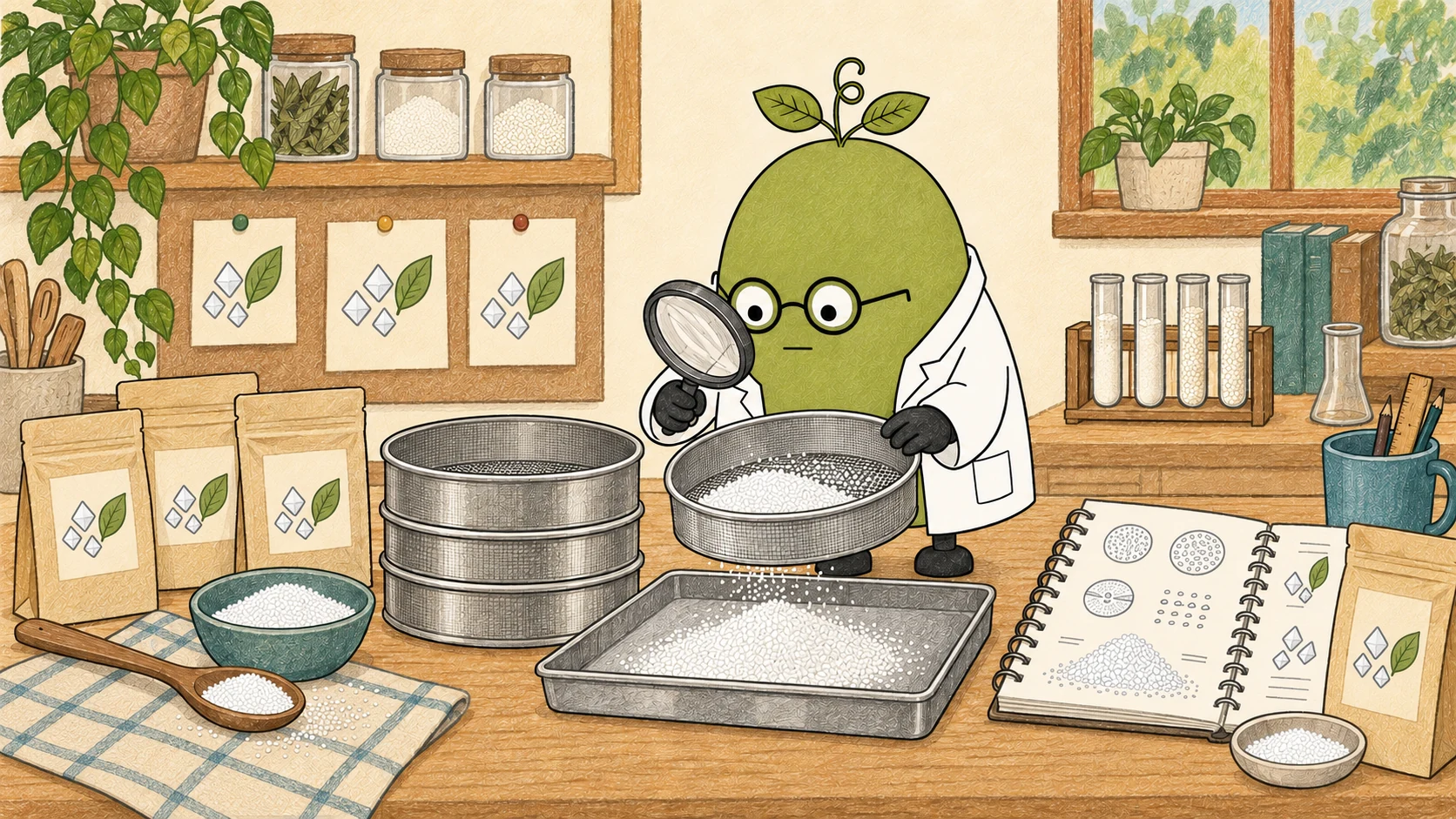
Check the formula, particle specification and sample condition
Products called erythritol–stevia blends may differ in formula, sweetness and particle specification. Check each item on arrival:
| Item | What to confirm |
|---|---|
| Ingredients and proportions | Match to the selected formula; no unacceptable ingredients |
| Target sweetness | Development target and how to establish dosage |
| Powder form | Fine powder, granules or mixed form |
| Mesh or particle-size range | Sieve standard and requirements for percentage passing or particle-size distribution |
| Sample condition | Label and sample identification, visible particle condition and any caking |
| Packaging and storage | Clear packaging specification, storage conditions and shelf life |
A mesh number alone is insufficient: define what it requires. Must a specified proportion pass a particular sieve, or must particles fall within an agreed size range? A shared standard supports later acceptance checks. Inspect coarseness and caking first. To confirm the agreed size, use the sieving or particle-size test method accepted by both parties. Record the sample identifier as received, including the batch or lot where supplied. Ask which formula and specification revision it represents. Do not assign a missing batch number yourself or assume two similarly named samples are identical.
Test the particle specification in your process
Choose particle size for the application. In dry mixing, check ease of uniform blending; in stick packs or jars, assess feeding and dosing; in beverages, observe dissolution at actual water temperature, dosage and stirring conditions. Use production ingredients and equipment conditions as closely as possible, noting what works and what needs adjustment. Mesh specification is one selection and acceptance criterion; process results establish practical suitability. If particle specifications change later, reconfirm mixing, feeding or dissolution even if ingredient ratios remain unchanged, and update samples and specification documents. Record the material dose, equipment, operating conditions and observed result together. A passing particle-size result does not demonstrate blend uniformity or filling accuracy by itself. If the small trial cannot reproduce your line, note that limitation before approving production use.
Distinguish ingredient documents, finished specifications and batch reports
Documents describe different objects. Separate them into three categories:
| Document | Purpose | Key checks |
|---|---|---|
| Erythritol or stevia ingredient documents | Understand the ingredients used | Ingredient name, grade and relevant parameters |
| Finished blend specification | Define agreed requirements for the whole product | Ingredient proportions, target sweetness, particle specification and other quality requirements |
| Batch certificate of analysis (COA) or test report | Read results for the batch or submitted sample | Product name, batch, test object, test items and results |
If a blend sample comes with only an erythritol report, that report describes the ingredient, not the whole finished blend. The stevia ingredient’s assay value is not its inclusion percentage in the blend. Read results together with units, methods and scope. An unlisted test item does not mean a zero result; “not detected” must be interpreted against the stated detection limit. Raise specific test requirements early and confirm document coverage. State local regulatory and certification requirements before sample selection. Check the certificate’s covered entity, products or activities and validity period to establish relevance to this purchase. A specification states the agreed limits; the batch report records the reported results for its identified material. Read them side by side. A result marked “conforms” is useful only when you know which requirement it was assessed against. Where a report gives a numerical result, check the unit and method before comparing it with the limit.
Resolve document mismatches before approving the sample
If the product name, sample code, batch or formula version does not line up, ask the supplier to explain the connection and provide the corresponding document or correction. Keep the unresolved item with the sample record; do not mark the finished blend approved using an ingredient-only report. For a missing test, distinguish “not reported” from a result that meets the requirement. Agree whether the item needs testing, which method and limit apply, and what evidence will be provided. Do not fill the blank with zero or copy a result from another batch. Trial and production batches can have different lot numbers. What must stay clear is the link from the accepted sample to the agreed finished specification, and from the delivered lot to its own batch documents. If the formula or particle specification changes, identify the new version and reconfirm the affected process performance.
Turn the accepted sample into a clear order
Keep the selected sample code, final formula version, target sweetness, particle specification, packaging and agreed test requirements together in the order confirmation. Identify the agreed specification revision so a later document cannot silently replace it. Taste acceptance and document acceptance answer different questions. Compare sweetness, aftertaste and original flavor in the actual application, while checking that the material and paperwork describe the same selected blend. When requesting Hengliyuan samples, send the application, destination country, target sweetness, excluded ingredients and any known equipment, particle-size or document requirements. If you have not selected a mesh requirement, describe the mixing, packing or reconstitution step first. We can use that brief to discuss the sample direction.
Review note
Reviewed October 16, 2026. This checklist helps match samples, specifications and documents. It does not set universal test limits, replace the agreed product specification or establish approval for every destination market.
How Hengliyuan makes the corresponding blend
Hengliyuan makes its erythritol-based sweetener blends by fluid-bed granulation. In this common food-powder process, airflow fluidizes the powders as particles agglomerate. Confirm the particle specification, dissolution and application performance against the selected formula and sample.
Common questions
Can an erythritol COA establish the quality of the finished blend?
No. It describes the erythritol identified in that report. Ask for documents that correspond to the finished blend and its batch or submitted sample, and compare their scope with the agreed finished-product requirements.
Discuss blend samples and documentsIs the stevia assay the same as its percentage in the blend?
No. An assay describes a property of the stevia ingredient; the inclusion percentage describes how much of that ingredient goes into the blend. Check the formula proportions and ingredient specification separately.
Discuss blend samples and documentsWhat if the supplier gives only a mesh number?
Ask for the sieve or measurement standard, the required passing proportion or size range, and the test method. Keep that agreement with the sample and order. Visual inspection alone cannot confirm a particle-size distribution.
Discuss blend samples and documentsDoes a missing test result mean zero or not detected?
No. It means the result is not reported in that document. Confirm whether the test was performed and whether it is required for your purchase. Interpret “not detected” against the stated detection limit and method.
Discuss blend samples and documentsMust the production lot have the same number as the trial sample?
Not necessarily. Trial and production lots can differ, but each needs traceable identification and corresponding documents. The delivered product must match the agreed specification; changes to the formula or particle requirements need explicit review.
Discuss blend samples and documentsDoes Hengliyuan provide the blend formula and specification?
For customers purchasing finished blends, Hengliyuan provides complete ingredient names, exact proportions, target sweetness and finished-product specifications. State equipment, particle-size and document requirements before sampling, then include the final agreement in the order.
Discuss blend samples and documents