
Read this guide in
Hengliyuan Applications and Selection
Monk Fruit Juice Concentrate Packaging, Storage, and Shipping Guide
Choose monk fruit concentrate packs by daily use, confirm unopened and opened storage separately, and check shipping records and seals on arrival.
When selecting packaging for monk fruit juice concentrate, first confirm the customer’s actual daily use and aim to finish each opened pack that day, then consider dispensing method and storage conditions. Hengliyuan recommends 1 kg or 5 kg packs for tea and coffee outlets, and 25 kg packs for food and beverage factories; other pack sizes can be discussed as required.
Once packaging is selected, arrange delivery around the selected product’s storage requirements and the actual transport route. Confirm package net weight, container type, storage conditions, and use method together so the ingredient can fit the customer’s daily operation after arrival.
Choose pack size from actual daily use, then confirm the container, seal, storage and route together. The illustration uses 1 kg, 5 kg and 25 kg containers to show that sequence; their shapes are examples rather than the order’s confirmed packaging.
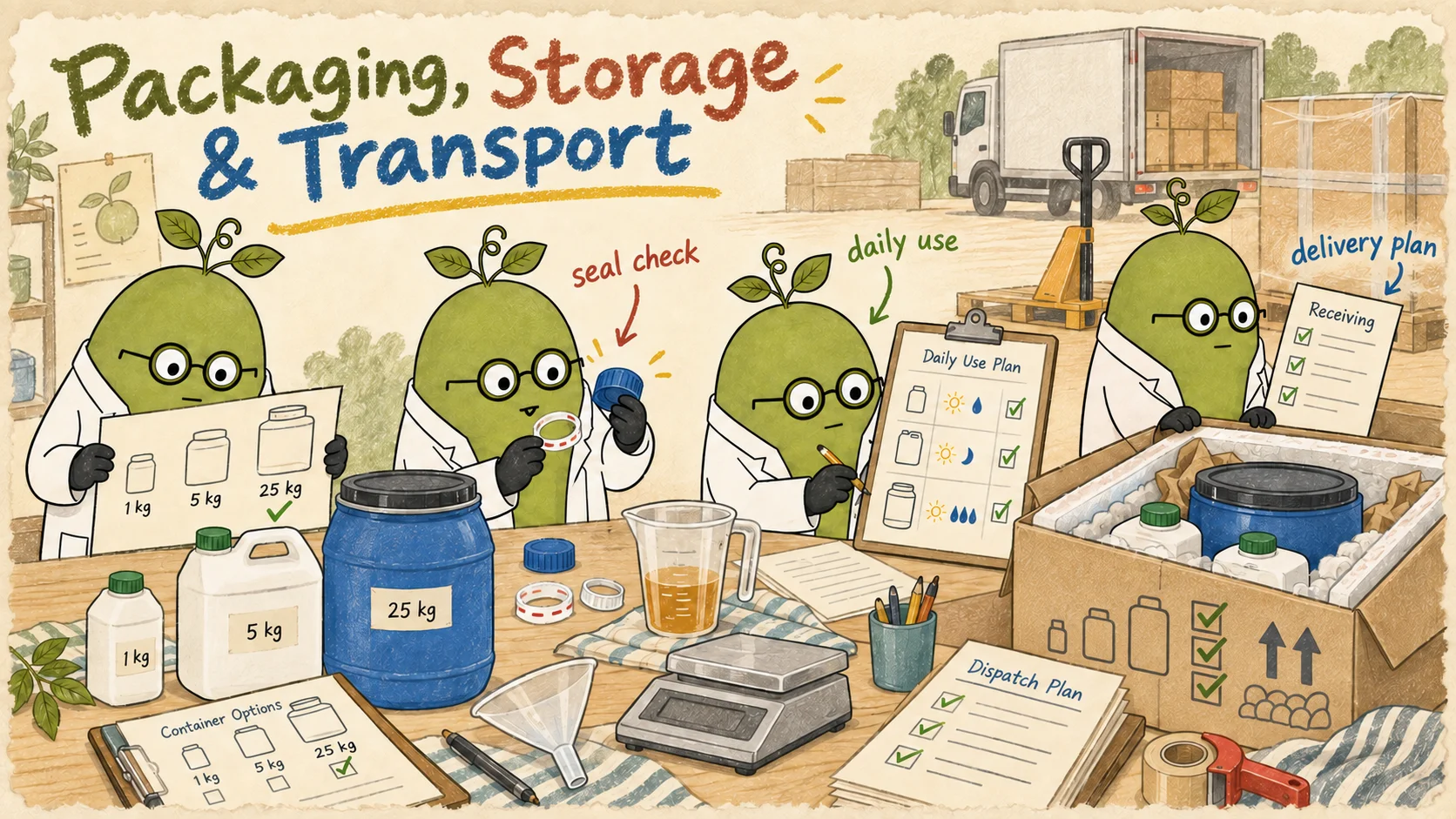
Choose a pack size around daily use
Hengliyuan recommends the following starting points for packaging discussions:
| Use case | Suggested net weight | What to confirm |
|---|---|---|
| Tea and coffee outlets | 1 kg or 5 kg | Daily use, dispensing frequency, opened-pack handling and storage space. |
| Food and beverage factories | 25 kg | Batch consumption, weighing and dispensing, handling and storage. |
| Other operating requirements | Discuss a custom pack | Required net weight, container form and on-site handling. |
Select from the amount the customer can actually use in a day, including quieter days. A 25 kg pack should fit the factory’s consumption after opening; a larger pack is not automatically the better choice. If the starting sizes do not fit, discuss a suitable custom specification. Confirm the container, closure and supply conditions with the order. Net weight alone does not define the packaging.
Fit the pack to the dispensing method
Hengliyuan can customize packaging to customer requirements. Before confirming a specification, establish daily concentrate use, the quantity dispensed each time, and on-site storage and handling. Customers with variable demand should also describe use on low-volume days, rather than selecting packaging only from peak demand. The objective is to use each pack on the day it is opened. A customer may use one pack per day or divide the day’s use into several smaller packs. Where material is dispensed several times in a day, confirm dispensing, resealing, and storage requirements at the same time. Customers with fixed metering equipment or dispensing methods can provide those requirements. Hengliyuan can then discuss packaging compatibility for the specific product, with the aim of fitting existing operating practice and production arrangements as closely as possible. State pack format, net weight, quantity, and sealing requirements clearly in the formal order. Samples confirm the ingredient; bulk packaging is confirmed separately under the formal supply plan.
Keep unopened storage time with its temperature
The confirmed LHX-N02 model information gives these unopened storage conditions and periods:
| Storage conditions | Period in the model information |
|---|---|
| 0–4℃ | 24 months |
| Ambient temperature | 12 months |
A 24-month inventory plan requires the stated 0–4℃ conditions; do not carry over the longer period while dropping the temperature requirement. The ambient-temperature entry does not specify an upper limit here, so it does not establish suitability for any hot environment. Use the selected model’s actual supply documents for the order and packaging. Describe the available storage and expected consumption period before setting purchase quantity and replenishment timing. These unopened periods do not define the conditions or period after opening.
Plan for same-day use after opening
Hengliyuan selects packaging around actual daily use and recommends finishing each pack on the day it is opened. This reduces storage across days and repeated dispensing, helping retain the concentrate’s flavour and condition. An outlet using about 1 kg per day can consider a 1 kg pack. At about 5 kg per day, compare a 5 kg pack with several smaller packs according to the dispensing routine. Before choosing 25 kg, a factory should confirm that its production can consume the opened material that day. Hengliyuan states a 3-day post-opening period, subject to the corresponding product’s storage and handling requirements. Confirm those requirements before relying on that period; the unopened storage table does not establish the post-opening temperature. The same-day recommendation remains the basis for pack selection. Record the pack’s lot, opening date and time, and the applicable storage and dispensing instructions. If packs regularly remain unfinished, review smaller packs or the number opened each day rather than planning from peak demand alone.
Confirm transport conditions for the actual route
The transportation conditions for Monk Fruit Juice Concentrate should be determined based on the selected model, packaging and actual route. It cannot be determined that all orders require cold chain or are suitable for normal temperature transportation based on the product name alone. Customers can inform Hengliyuan of the receiving location, expected transportation method and storage conditions after arrival. For routes involving high temperature seasons, transfers or waiting at the port, corresponding arrangements should also be communicated in advance. If the order stipulates temperature control or temperature recording, the implementation method and delivery records should be clearly stated. The storage period is not equal to the length of time allowed to deviate from the specified conditions during transportation, and the delivery experience of small samples cannot directly replace the confirmation of the transportation conditions of large shipments.
Keep a receiving and exception record
On receipt, match the order, product and lot before using the material. Record the arrival condition and the documents agreed for that delivery; the table provides a practical way to keep the observations together.
| Check | Keep with the delivery record | If something does not match |
|---|---|---|
| Material identity | Order reference, product/model and lot codes; matching batch documents. | Clarify the identity or document mismatch before using the affected material. |
| Pack and quantity | Container count, net-weight marking, agreed pack and closure. | Record the difference against the order; do not treat a gross shipping weight as ingredient net weight. |
| Seal and condition | Arrival date, photographs of containers, seals, leakage or damage. | Keep affected containers from use and retain the evidence for review. |
| Agreed transport controls | Available temperature or handling records when the order requires them. | Flag missing records or departures for assessment; do not reconstruct an unrecorded temperature history. |
| Disposition | Affected lot and container references, who reviewed the issue and the agreed handling. | Keep the decision traceable to the material; follow the factory’s incoming-control requirements. |
If there is damage, leakage or a document inconsistency, retain the records and confirm handling with Hengliyuan before using the affected goods. Any incoming-material tests follow the factory’s standard and the parties’ agreement; this checklist does not supply test limits or release a batch. For an initial packaging enquiry, start with daily use and destination. Add the per-use quantity, pack preference, order quantity and any storage or route requirement when known; the remaining details can be clarified before the quotation and delivery conditions are confirmed.
Common questions
Which pack sizes does Hengliyuan recommend?
For selection discussions, Hengliyuan recommends 1 kg or 5 kg for tea and coffee outlets and 25 kg for food and beverage factories. Choose against actual daily consumption and dispensing; other sizes can be discussed. Confirm the container, closure and supply conditions with the order.
Discuss this requestShould I choose a pack from peak daily use?
Include quieter days and the amount used each time. The goal is to finish a pack on the day it is opened. Several smaller packs may fit the operation better than opening one large pack that remains unfinished.
Discuss this requestIs the concentrate suitable for 24 months at any temperature?
No. The LHX-N02 example gives 24 months at 0–4℃ and 12 months at ambient temperature. Keep the period with its conditions and use the selected supply documents. The ambient entry does not establish an unrestricted high-temperature allowance.
Discuss this requestHow do same-day use and the 3-day opened period differ?
Hengliyuan recommends pack sizes for same-day use. Its stated post-opening period is 3 days under the corresponding product’s storage and handling requirements. Confirm those requirements; do not infer a post-opening temperature from the unopened table or treat the 3-day period as permission for uncontrolled handling.
Discuss this requestDoes every shipment need refrigerated transport?
The selected product, packaging and route determine the agreed conditions. Confirm the destination, season, transfers and any waiting periods before dispatch. Neither the product name nor a small sample’s journey establishes the conditions for every bulk delivery.
Discuss this requestWhat if a seal leaks or the transport records are missing?
Keep the affected material from use, identify the lot and containers, retain photographs and the available records, and confirm handling with Hengliyuan. Follow the factory’s incoming-control process; a visual check alone does not resolve every quality question.
Discuss this requestDoes a sample pack confirm the bulk packaging?
No. A sample helps evaluate the ingredient. Confirm the bulk container, net weight, closure, quantity and agreed storage or transport requirements separately in the supply plan.
Discuss this request