
Read this guide in
CONFECTIONERY SWEETENER TESTING
Can Allulose Make Hard Candy? Sugar-Free Candy Formulation Guide
Evaluate allulose for hard candy: cooking endpoint, snap, moisture, water activity and package stability. Keep gummy and chocolate evidence separate.
Allulose can be considered as part of a hard-candy trial, but we would not treat it as a drop-in sucrose replacement. Our recommendation is to qualify the complete candy system through cooking, cooling, packing and storage before choosing the ingredient or promising a production result.
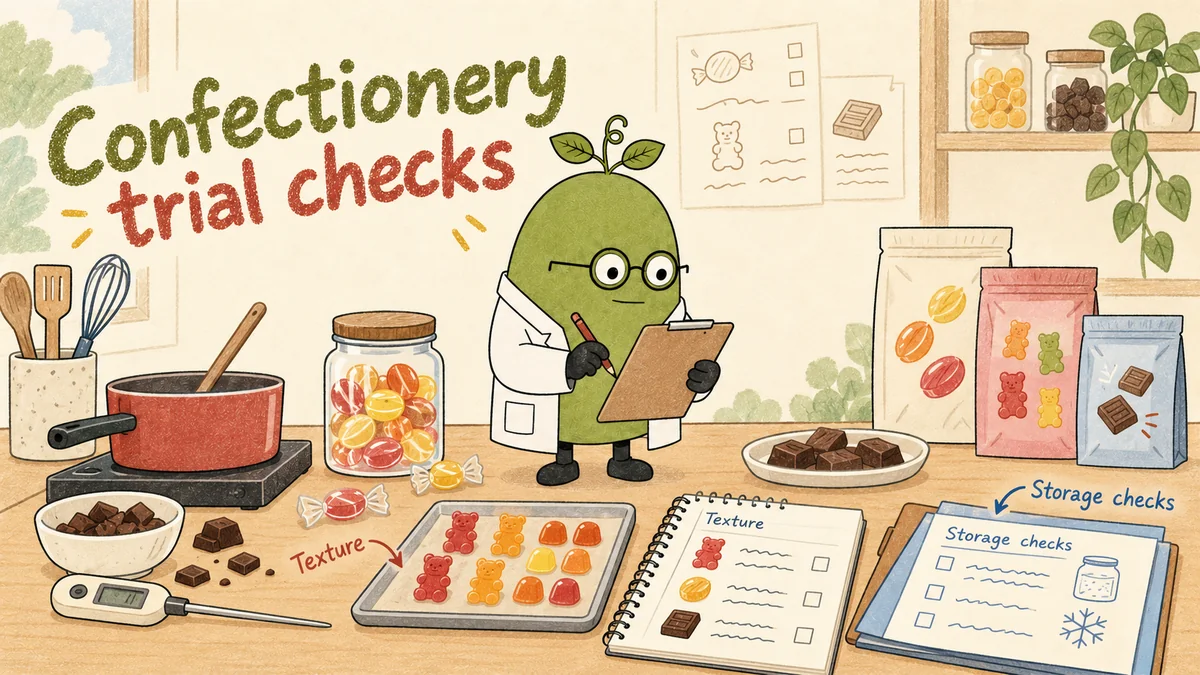
A hard piece on the first day is not the whole test. Record whether it keeps its snap, shape and package release under the intended conditions. Gummies and chocolate need their own trial routes; success in either does not establish a hard-candy formula.
Define the candy structure first
Hard candy, deposited candy, gummies, jelly candy, chocolate, coating and fillings need different sample routes. A hard candy project should start with cook window, solids, moisture, glass snap and packaging barrier. A gummy project needs gel system, acid timing, drying, coating and chew target.
Allulose is functional but not a universal sugar copy
Allulose can be useful for sweetness curve, browning and body in suitable markets, but it will not replace every physical job of sucrose by itself. In some candy systems, the formula may still need fiber, polyol, hydrocolloid, starch, fat-phase adjustment or partial sugar depending on the product goal.
Watch water activity, moisture and texture
Keep moisture content, water activity and texture as separate measurements. Test the finished product in its intended package, with the control under the same conditions. Record when a defect first appears and which process or storage conditions changed. Use the observation to choose the next controlled comparison, not to diagnose the cause from appearance alone.
| Observed result | Record before changing the formula | Next comparison |
|---|---|---|
| Hard at first, sticky after storage | Endpoint measurements, cooling history, humidity, package and elapsed time | Compare the same batch under defined packaging/storage conditions |
| Soft or deformed after cooling | Actual product temperature curve, endpoint and cooling conditions | Repeat with one documented process or formula change |
| Darker color or cooked flavor | Temperature/time history and full composition | Compare a controlled cook change against the original sample |
| Grainy texture | When particles appear and the sample’s storage history | Identify the particles before assigning a crystallization cause |
This is a troubleshooting record, not a set of guaranteed fixes. A lower water-activity reading does not by itself establish acceptable snap, non-stick behavior or shelf life.
Keep high-intensity sweeteners in a supporting role
Stevia and monk fruit can help close the sweetness gap at low use levels, but overuse can make bitterness, licorice-like notes or lingering sweetness louder. They should be tested inside the candy matrix, not only in water or syrup.
Match the formula to market and label rules
Confirm the destination, food category, ingredient identity, labeling and document requirements before commercial launch. Allulose, steviol glycosides, monk fruit ingredients and polyols are not treated identically across markets. Check any required polyol warning for the specific formula and market rather than assuming one rule applies everywhere.
Prepare samples before quotation
Start with the destination market, candy format and the texture problem you want to solve. Add the cooking and cooling process, packaging, desired sweetness and ingredient restrictions if known. Quantity and document requirements can follow as the sample direction becomes clearer. A complete proprietary recipe is not required for the first discussion.
Technical references
Use each source for the question it actually studies. Doğdu’s METU thesis examines isomalt-based hard candy, not an allulose production formula. The ACS rare-sugar study examines thermal properties and moisture sorption, supporting the need to assess allulose separately from sucrose. FDA’s final allulose labeling guidance is dated October 2020 and concerns U.S. nutrition labeling; it is not a global ingredient approval or proof that a finished candy qualifies for a claim.
Hard candy key parameters at a glance
Set the cooking endpoint from the selected complete candy system. An oven or kettle temperature is not a transferable allulose specification. Record the temperature curve, hold time, measured endpoint solids and water activity after cooling, then compare stickiness and package behavior at the intended storage condition. A number from a sucrose hard-candy recipe does not validate an allulose recipe. Ask the application team to define the acceptable window from actual trials before using it for production.
| Parameter | Record in the trial | Acceptance decision |
|---|---|---|
| Cooking temperature and hold | Measured product temperature, time and heating rate | Validate for this candy base |
| Endpoint solids | Method, reading and sampling temperature | Agree with formulation team |
| Water activity | Measured value and temperature after equilibration | Set with safety and shelf-life validation |
| Cooling and packing | Cooling history, ambient humidity and barrier film | Compare sticking, deformation and storage |
A reference formula is not an allulose operating window
Doğdu’s METU thesis studies isomalt-based formulations and assesses properties including water activity, crystallinity and glass transition. It is useful background for choosing measurements, but its formulation or cooking schedule cannot validate an allulose system. The ACS study reports different thermal and phase behavior for sucrose, allulose and isomaltulose, including different moisture-sorption behavior. Establish the endpoint, cooling and packing acceptance for the complete trial formula rather than transferring a number from a different sweetener system.
Review note
Reviewed October 16, 2026. The table lists trial observations, not measured Hengliyuan results. Confirm the actual material, process, package and destination-market requirements before a commercial decision.
Common questions
Can allulose be used in hard candy?
It can be tested for suitable markets, but hard candy needs checks for cooking behavior, moisture, water activity, glass structure, stickiness and packaging.
Discuss a confectionery trialCan I use a standard sugar-candy cooking temperature for allulose?
Do not treat it as a validated endpoint. Record product temperature and time, measure the relevant endpoint properties, and evaluate cooling, package release and storage for the complete formula. A kettle setting alone does not establish the product condition.
Discuss a confectionery trialIs allulose enough to replace sugar in confectionery?
Do not assume it is. The structure needed by hard candy differs from a gummy, coating or filling. Define the missing function first, then test any additional bulk ingredient, gel system, fat-phase or process adjustment in the actual product.
Discuss a confectionery trialCan monk fruit or stevia be used in candy blends?
Yes, they can support sweetness, but they should be used carefully and tested for bitterness, lingering sweetness and flavor fit in the finished candy.
Discuss a confectionery trialWhat should buyers send before samples?
Start with your target market and product idea. Share any known packaging specification, estimated quantity, required certificates/documents and whether samples are needed; we can clarify the remaining details together.
Discuss a confectionery trialDoes a successful allulose gummy or chocolate trial prove hard-candy suitability?
No. The structure and processing differ. Use such studies to generate questions for the relevant product, then run a separate hard-candy trial with its own endpoint, cooling and packaged-storage checks.
Discuss a confectionery trial