
Read this guide in
CHOCOLATE BEVERAGE SAMPLE CHECKLIST
Sugar-Free Chocolate Milk Sweetener Guide: Stability & Sensory Checklist
Compare chocolate milk sweetener samples for sweetness, cocoa character, sediment, viscosity and re-dispersion. Record control and trial results during storage.
A chocolate beverage can pass a sweetness match and still fail as a product. Cocoa particles may settle, viscosity may feel thin, and a bitter or dry finish may appear only after swallowing.
Use this checklist when a buyer needs a small, interpretable sample matrix for chocolate milk, cocoa drinks or a plant-based chocolate beverage. It keeps sensory, physical and market checks in separate lanes so the next sample has a clear question.
Lock the finished product format
Write down dairy or plant-based, RTD or powder, chilled or ambient, serving size, cocoa source and whether the product is chocolate milk, cocoa beverage, protein drink or another format. Similar names can hide different solids, heat and suspension problems.
Build the matrix around a control
Keep an existing formula or sucrose control. Add the smallest number of comparison directions needed to answer the brief: partial sugar reduction, a high-intensity sweetness lift, an allulose-supported body route or a monk fruit and stevia blend. Do not use a published study as a ready-made commercial formula.
Use a short sensory timeline
Record entry sweetness, peak sweetness, cocoa intensity and the finish after swallowing. A 30- or 60-second check is a useful example, not a universal sensory protocol; use the same timing, serving temperature and sip size across comparisons. Add bitterness, metallic or licorice-like notes, dryness, thickness, aroma and milk or plant-base character. Keep intensity and liking separate: stronger cocoa is not automatically better-liked cocoa.
Keep physical checks separate
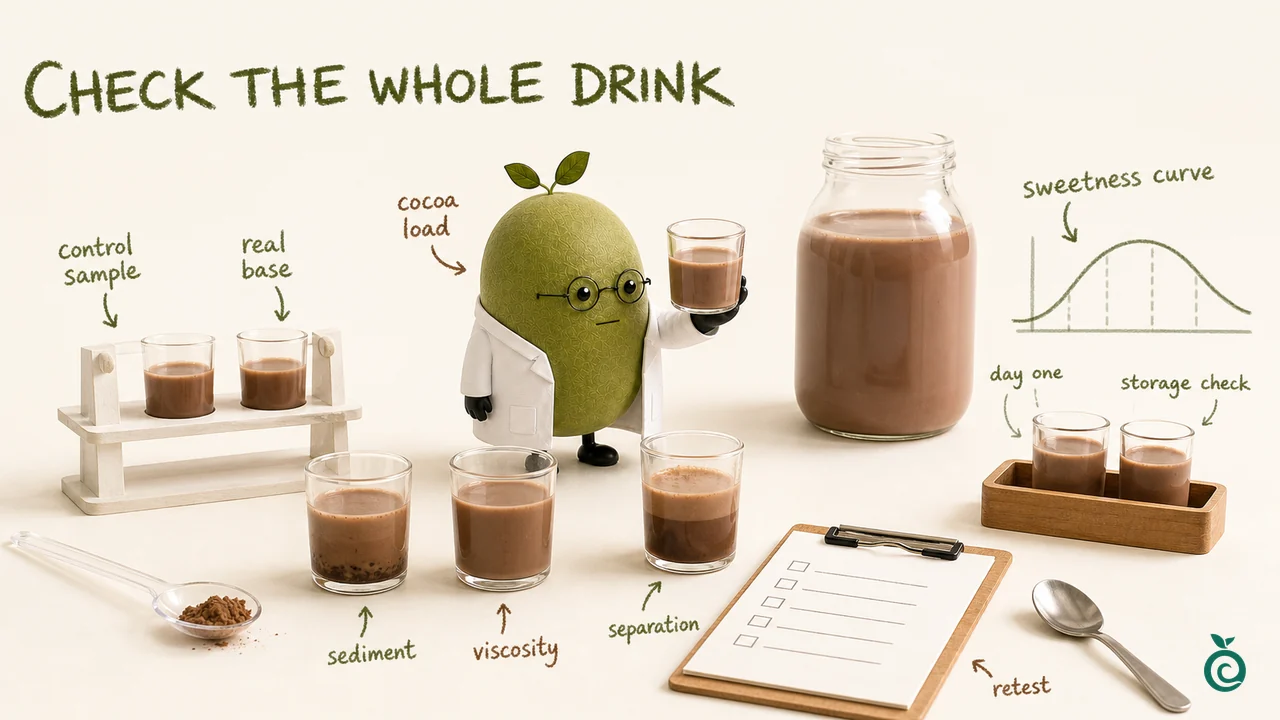
Record viscosity or thickness, sediment, visible separation, re-dispersion and any powder wetting issue where relevant. A sweetener can be acceptable for taste but unsuitable for the drink's physical system. Keep cocoa, stabilizer, homogenization and heat history in the same sample record.
Plan storage observations
Use the intended packaging and storage conditions. Day 0 followed by days 7, 14 and 21 is an example screen, not a schedule suitable for every chilled or ambient drink. Agree checkpoints for the actual product and use matched unopened packs for destructive checks. Record temperature history and any opening or shaking before measurement. Physical and sensory observations do not establish microbiological safety or commercial shelf life.
Use one stability record for each sample and checkpoint
Keep the control and trial side by side. Record sample and batch IDs, formulation difference, package, process and elapsed storage time before completing the rows below. Use the same measurement method throughout.
| Observation | Record for control and trial | Keep comparable |
|---|---|---|
| Sweetness and cocoa | Entry, peak and finish; cocoa aroma and flavor; bitterness and dryness. | Serving temperature, sip size, timing and rating scale. |
| Viscosity or thickness | Instrument reading with units, or a defined sensory comparison. | Measurement temperature, instrument settings and preparation. |
| Sediment and separation | Layer position and height or another agreed method; photograph before shaking. | Container geometry, fill level, storage time and sample handling. |
| Re-dispersion | Mixing method and effort; visible particles or sediment remaining afterwards. | Same inversion, shaking or stirring procedure. |
| Powder reconstitution, if applicable | Wetting, floating powder, lumps and time to disperse. | Water temperature, powder-to-water ratio and mixing method. |
| Decision | What changed from day zero and from the control; next variable to investigate. | Separate taste, physical stability and safety decisions. |
If sediment appears, investigate cocoa, stabilizer, solids and processing alongside the sweetener. A change in one row helps choose the next test; it does not by itself identify the cause.
Close the label and document loop
Before quotation, confirm target market, final food category, ingredient naming, claim direction and required certificates or export documents. The 2020 RATA study found that sweetener profiles changed across food matrices, while China's GB 2760-2024 is an official regulatory starting point rather than a global approval statement.
Turn the observed defect into a sample request
Start with the beverage type and the main problem: for example, acceptable sweetness but persistent sediment, or stable appearance with a bitter finish. Add the base, cocoa system, process and storage conditions you know. Quantity, packaging, market and document requirements can be clarified together; you do not need every field settled to contact us.
What the sensory research adds
A 2025 chocolate milk ballot study evaluated 18 commercial products. A subset of six was assessed after storage at 3 °C and at 8 °C for five days; the warmer condition represented accelerated storage in that study. Chocolate aroma and flavor weakened and atypical notes increased under the accelerated conditions. That is a reason to record chocolate character as well as defects, not a recommended storage condition or a shelf-life prediction for your product. The study did not establish the performance of a Hengliyuan sweetener. The 2020 RATA study compared sweeteners in black tea, chocolate milk and yogurt, showing that the food matrix changes the sensory profile. The 2026 chocolate milk research also supports testing time-dependent sensations in the real base. Use those studies to choose observations, not to copy a universal formula.
Review note
Reviewed October 16, 2026. Study conditions and example checkpoints are identified separately from buyer test requirements. For a China-market project, use the official GB 2760-2024 notice as an entry point to the relevant category and additive provisions; it is not a global approval statement.
Common questions
What should a chocolate beverage sweetness scorecard include?
Record entry sweetness, peak, cocoa intensity, bitterness, dryness, thickness, aroma and the milk or plant-base character. Define a repeatable finish check, such as 30 or 60 seconds, and keep its timing consistent. Record intensity separately from liking.
Discuss this requestWhy should sedimentation be tested separately from sweetness?
Sweetness and physical suspension are different acceptance questions. Cocoa, stabilizer, homogenization, solids, heat and storage can change sediment or separation without changing the first sweetness score.
Discuss this requestCan one chocolate milk study define a universal blend?
No. Studies are tied to their base, cocoa, sweetener grade, process, panel and storage conditions. They can suggest variables for a sample matrix, not a guaranteed commercial formula.
Discuss this requestWhat information should go into a sample request?
Start with your target market and product idea. Share any known packaging specification, estimated quantity, required certificates/documents and whether samples are needed; we can clarify the remaining details together. Add the real base, process and main defect or target.
Discuss this requestDoes easy re-dispersion mean the beverage is storage-stable?
No. Re-dispersion describes what happens after the defined mixing procedure. Record the sediment before mixing, remaining particles afterwards, taste changes and the storage conditions separately. It does not establish safety or the intended shelf life.
Discuss this request