
Read this guide in
DAIRY SWEETENER TESTING
Sugar-Free Chocolate Milk Sweetener Guide: Real-Base Sensory Testing
Compare chocolate milk sweeteners in the actual base: control cocoa, processing and serving conditions, then judge sweetness, aftertaste and stability separately.
A chocolate milk sample can match the control’s sweetness and still taste bitter, dry or thin. Our view is that the real drink must decide the sweetener choice: the milk base, cocoa, processing and serving conditions belong in the comparison, not just the sweetener name.
Start with a matched control, define one main trial question and record the finish as well as the first sip. This guide covers how to set up that comparison. The linked aftertaste guide and stability checklist cover the follow-up work, so the same tests do not need to be rebuilt here.
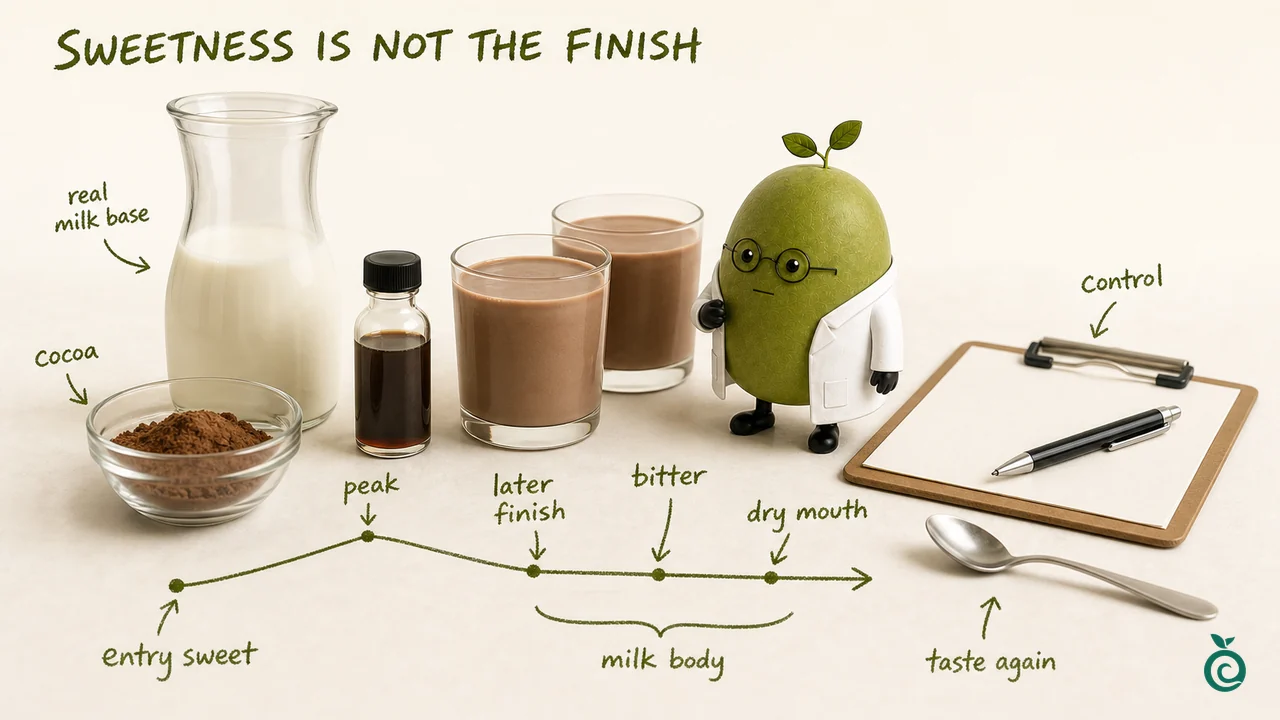
Name the real milk base first
Record whether the base is standard milk, lactose-hydrolyzed milk, recombined dairy or plant-based. Keep the protein, fat, cocoa identity and dose, stabilizer and batch preparation visible. State the heat treatment and homogenization route where applicable. If the base changes along with the sweetener, you have changed two parts of the product and cannot assign the result to the sweetener alone.
Build a comparison that can answer one question
Retain the current formula or a defined sucrose control. A partial-reduction sample can show whether the main defect appears before full replacement; it is an optional diagnostic step, not a required commercial formula. First compare sweetener directions in a fixed base. Test a different milk treatment or body adjustment in a separately identified round.
| Trial decision | Keep consistent | Record the difference |
|---|---|---|
| Sweetener direction | Milk base, cocoa, fat/protein system and preparation route. | Sweetener identity, actual use level and all accompanying carrier or bulk ingredients. |
| Partial versus full replacement | A named control and a clearly stated sweetness target. | Sugar removed and every compensating formula change; do not assume equal ingredient mass means equal sweetness. |
| Milk treatment or base change | Compare within the same base before comparing across bases. | Lactose treatment, base composition and any change in required sweetener dose. |
| Sensory session | Serving volume, temperature, sample age and time after swallowing. | Coded sample identity, serving order, observations and assessor; keep the order from favoring one sample. |
| Process and storage check | Intended thermal process, package and defined storage conditions. | Processed batch, elapsed time, temperature history and any change in taste, sediment or separation. |
Score the first sip and the finish
Use the same serving temperature and volume, and compare coded samples in a varied order. Agree the observation points and descriptors before tasting; allow a consistent pause and palate rinse between samples. Record initial sweetness, peak impression and the finish separately. Checks at 30 or 60 seconds are possible observation points, not a mandatory research protocol or pass limit. A simple bench comparison should not be presented as a trained-panel temporal sensory study.
Separate sweetness from cocoa and mouthfeel
Write down sweetness, cocoa intensity, milk character, bitterness, dryness and thickness as separate observations. Do not average them into one score that hides a failure. If sweetness matches but body is thin, the next trial should address body rather than simply raising the sweetener dose. If sweetness matches but the finish is bitter, compare that finish before changing cocoa and sweetener together.
Check physical stability in the finished drink
Evaluate the processed finished drink, not only an unheated bench mixture. Record viscosity or an agreed thickness assessment, sediment, visible separation and re-dispersion where relevant. Use the same method and sampling conditions for control and candidates. Sensory acceptance and physical stability are separate decisions: a good first sip does not establish suspension stability.
Choose storage checkpoints for the actual drink
Set the schedule from the intended product, package, distribution conditions and shelf-life plan. Chilled and shelf-stable drinks need different plans; a fixed day 7/14/21 sequence is not a universal requirement. Define the initial sampling point after processing and cooling, then compare matched samples at the agreed times. Follow the project’s food-safety procedures when deciding which stored samples may be tasted.
Keep lactose status separate from sugar claims
Lactase breaks lactose into glucose and galactose; hydrolysis does not remove those sugars from the drink. “Lactose-free,” “no added sugar” and “sugar-free” therefore describe different questions. The 2026 chocolate-milk study found that lactose hydrolysis reduced the sweetener concentration needed under its test conditions, but that is not proof of a sugar-free finished product. Review ingredient eligibility, nutrition information and any claim for the actual formula and target market before using it commercially.
What the chocolate-milk research tells us
Nakamura and colleagues’ 2026 study compared sweetener systems in milk with and without lactose hydrolysis, using sweetness matching, descriptive and temporal sensory methods, and consumer testing. Its results support treating the milk base and sweetener system together. They do not establish a dose, acceptance result or school-market approval for a different formula. See the companion aftertaste guide for the already reviewed study comparison rather than treating this article as a second set of trial results.
Send the result that should guide the next sample
Tell us the target market, milk base, cocoa system and main defect first. If you have a control and candidate, send the formula differences and matched tasting conditions, along with the process and packaging. Add estimated quantity and document requirements where known. You can begin the discussion before every detail is available; the aim is to identify a useful next comparison.
Common questions
Why can two equally sweet chocolate milks taste different?
Matching sweetness does not match cocoa character, bitterness, dryness, body or aftertaste. Compare those observations separately in the same base and at the same serving temperature.
Discuss this requestIs water screening enough to select the finished-drink sweetener?
No. It can narrow candidates, but the decision needs the actual milk or plant base, cocoa system, process and intended storage conditions.
Discuss this requestShould I change the milk base and sweetener in the same trial?
You can evaluate a combined formulation, but you cannot then assign the difference to the sweetener alone. To understand the cause, compare sweetener directions within a fixed base and identify a separate round for base changes.
Discuss this requestDoes lactose-free chocolate milk automatically mean sugar-free?
No. Lactose hydrolysis produces glucose and galactose rather than removing sugar. Check the final composition and the applicable claim requirements separately from lactose status.
Discuss this requestAre 30 and 60 seconds mandatory tasting checkpoints?
No. They are possible bench observation points. Choose a consistent timing plan for the comparison, document it and apply it to the control and candidates. Do not present that simple exercise as a validated temporal-panel study.
Discuss this requestWhat information makes a sample discussion useful?
Send the main defect, actual base and cocoa system, control/candidate differences, process and tasting conditions. Add the market, packaging, quantity and required documents where available.
Discuss this request