
Read this guide in
COATING VALIDATION SCORECARD
Compound Chocolate Coating Scorecard: Flow, Bloom & Storage for Sugar-Free Trials
Scorecard for sugar-free compound chocolate coating trials: flow, fineness, melt, mouthfeel, gloss, bloom and storage changes.
A coating sample needs more than a sweetness score. The same chocolate can flow well in one use and fail in another if the temperature, substrate, solids or storage condition changes.
Use this scorecard for low-sugar chocolate, compound coating and bakery enrobing projects. It keeps process, rheology, sensory and storage observations in one record without pretending that one number clears every application.
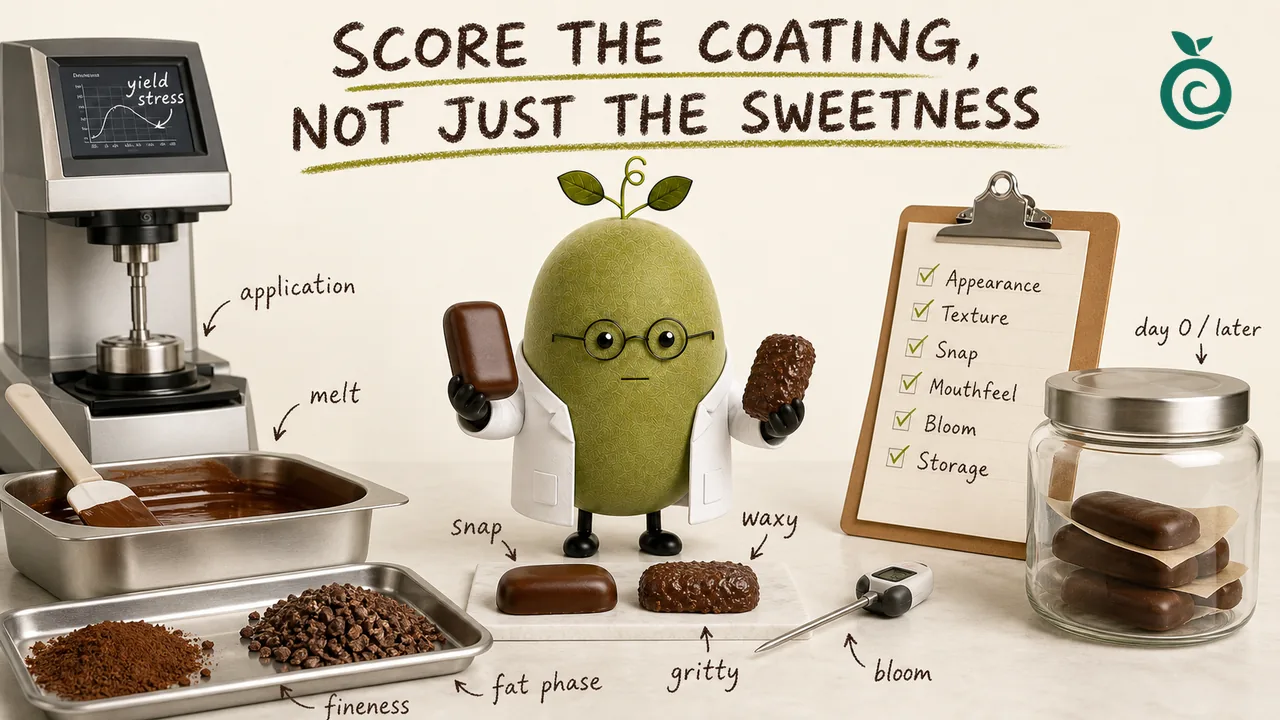
Start with the application line
Record the product, substrate, coating thickness, equipment, use temperature and whether the process is enrobing, dipping, moulding or another operation. A flow result without this line is hard to compare.
Record viscosity with the method
Write down the instrument, temperature, shear condition and whether the report uses apparent viscosity, yield stress or a plastic-flow model. Do not compare unlabelled viscosity numbers from different methods.
Keep fineness and particle distribution visible
Record the measurement method and the reported fineness or distribution when available. Pair the number with a gritty or rough-mouthfeel note, because a particle result is a process clue rather than a complete sensory judgement.
Score the melt and coating feel
Use the same tasting order for snap, melt speed, mouthcoating or waxy feel, grit, sweetness, bitterness and aftertaste. Keep the chocolate matrix and serving condition fixed when comparing sweetener directions.
Match tempering and cooling to the fat system
Identify the fat system first. Cocoa-butter chocolate and a non-tempering vegetable-fat compound do not follow the same route. Many compound coatings do not need conventional chocolate tempering; use the coating supplier’s melting, application and cooling instructions for the actual fat system. Record heat history, temper state where applicable, cooling conditions, gloss, cracks and visible bloom. A pale or waxy coating is not enough to diagnose a tempering failure.
Repeat at agreed storage nodes
Compare day 0 with later checks under the intended package, temperature and humidity. Capture photos and notes for gloss, bloom, snap, melt, mouthfeel, adhesion and package condition. A short bench check does not establish commercial shelf life.
Use one scorecard for the control and each trial
Record sample and batch IDs, the formulation change, substrate, package and storage checkpoint. Agree acceptance criteria before comparing samples. Keep measured values and sensory observations separate; a combined average can hide a failed coating requirement.
| Check | Record for control and trial | Keep comparable |
|---|---|---|
| Application and coverage | Coating thickness or pickup, exposed areas, tails and adhesion. | Substrate, equipment, application temperature and line settings. |
| Flow or rheology | Value and units; apparent viscosity or fitted model and parameters. | Instrument, geometry, temperature, shear protocol and sample preparation. |
| Fineness and grit | Particle-size result with method; separate mouthfeel observation. | Measurement method and sensory serving conditions. |
| Melt and flavor | Snap, melt, waxy feel, sweetness, bitterness and lingering aftertaste. | Sample size, serving temperature, tasting sequence and rating scale. |
| Setting and appearance | Fat system, heat and cooling history; gloss, cracks and visible bloom. | Applicable supplier process and observation time after setting. |
| Storage change | Day-zero comparison: appearance, adhesion, texture and package condition. | Package, elapsed time, temperature and humidity history. |
| Decision | Pass, hold or retest for each requirement; next variable to investigate. | Pre-agreed application criteria; do not average away a critical failure. |
Use defined anchors if you assign sensory scores, and record the underlying observation. Higher intensity is not always better: a stronger waxy sensation and stronger cocoa flavor mean different things. This is a trial record, not a universal specification or shelf-life approval.
Use the result to choose the next sample
If flow fails, inspect fat, emulsifier, particles and process together. If melt fails, inspect the fat phase, crystallization or tempering where applicable, and serving temperature. If aftertaste fails, isolate the sweetener while holding the matrix steady. These observations choose the next test; they do not establish a single cause.
Technical references and their limits
Toker et al. (2023) review how composition and processing affect chocolate flow. Glicerina et al. (2014) examine particle structure through dark-chocolate processing. These sources support recording the method and process history; they do not supply a universal viscosity target for every coating. Blommer’s application notes are supplier guidance on fat systems, cooling and coating use, not independent validation of a Hengliyuan formula.
Bring the main coating problem to the sample discussion
Tell us whether you are dipping, enrobing or moulding, and what fails first: flow, coverage, grit, melt, aftertaste or storage appearance. Add the fat system, substrate and process details you know. Market, quantity, packaging and document needs can be clarified together.
Common questions
What is the most useful first coating measurement?
Start with the application, method and temperature, then record flow or viscosity alongside fineness and sensory notes. One unlabelled number is not enough.
Discuss this requestCan a coating be approved from day-zero taste?
No. Compare the control and sample at agreed storage points, with gloss, bloom, melt, mouthfeel, adhesion and package condition recorded.
Discuss this requestDoes lower viscosity always mean better coating performance?
No. The useful flow depends on equipment, substrate, coating thickness, temperature and desired coverage. Use the application line with the measurement.
Discuss this requestWhat should buyers send before a scorecard-based sample request?
Start with the application and main defect or target. Share the fat system, substrate and process conditions you know, then add your market, likely quantity, packaging and document needs when available. You do not need a completed laboratory scorecard to contact us.
Discuss this requestDoes every compound coating need tempering?
No. Many vegetable-fat compounds do not need conventional cocoa-butter tempering. Identify the actual fat system and follow its supplier’s melting, application and cooling instructions. Record temper state only where it applies.
Discuss this request