
Read this guide in
CHOCOLATE COATING FORMULATION
Sugar-Free Chocolate Coating Guide: Particle, Fat and Tempering
Fix the right coating problem: separate sweetener bulk, particle measurements, fat-specific tempering or cooling, and storage tests before choosing a sample.
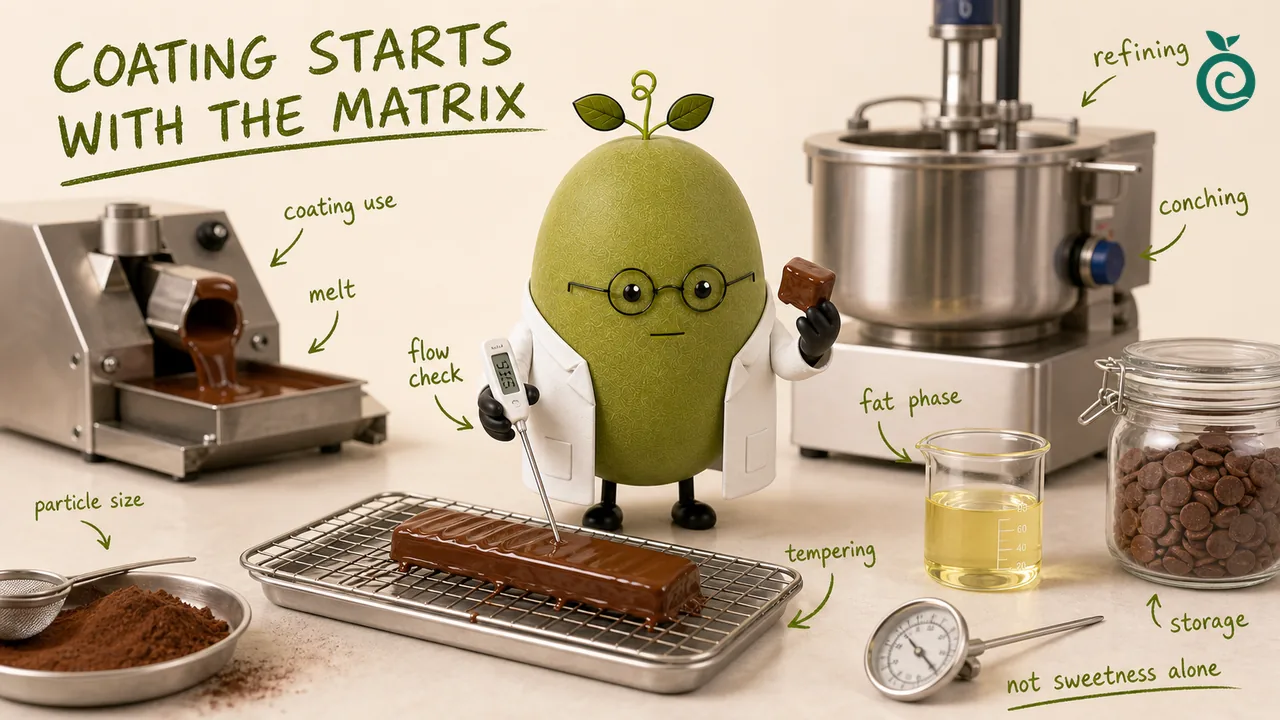
A low-sugar chocolate coating can be sweet enough and still fail at the enrober, on the biscuit or after storage. The missing piece is often the matrix: particles, fat phase, emulsification, process and cooling work together.
Our first question is not which sweetener tastes closest to sugar. It is which coating system you are using and where the sample fails. Keep sweetness, solids, flow and setting as separate decisions; otherwise a sweeter sample can still be unusable on the line. This guide helps buyers narrow the next trial, with a separate scorecard linked below for recording results.
Name the coating job before changing the sweetener
State whether the material is cocoa-butter chocolate or a compound coating, then name the application: enrobing, moulding, dipping, chips or bakery coating. Record the substrate, target coating thickness, working temperature and desired snap or melt. A coating that works on a biscuit may not give the same coverage or bite on a chilled product.
Split sweetness, bulk and flow
Monk fruit and stevia can lift sweetness at low use levels, but they do not supply the same solids or particle role as sugar. Allulose, polyols, fibers or other carriers may change bulk, moisture, cooling and flow, and their market fit must be checked. Keep sweetness direction separate from the physical bulk system in the brief.
Treat particle size as a flow and mouthfeel variable
Ask what “particle size” means on the report before comparing numbers. A Sauter mean diameter D[3,2], a D90 percentile and a fineness-gauge reading are different measurements, not interchangeable specifications. Record the method, sample preparation and processing stage. Smaller is not automatically better: particle distribution, solids loading and fat all contribute to the coating’s behavior.
![Published dark-chocolate study: Sauter mean diameter D[3,2] was 5.44 micrometres after mixing and 3.83 after refining; these are not coating targets.](/images/articles/chocolate-particle-study-29750388629c.svg)
Record the fat phase and emulsifier route
Record the fat identity and total fat alongside emulsifier identity, dose and addition stage. Compare flow only at a defined temperature using the same test method and sample conditioning. A single “viscosity” number without those conditions cannot settle whether two coatings will apply the same way. Keep moisture and accidental water exposure in the investigation as well.
Choose tempering or cooling from the fat system
Refining changes the solid particles; conching and tempering are different operations. Do not ask tempering to correct coarse particles or missing bulk. Cocoa-butter chocolate requires an appropriate crystallization route, while non-tempering compound coatings follow their specified melting, application and cooling instructions. Confirm the actual fat system with its supplier before borrowing a temperature curve.
| Coating system | Process decision | What to confirm before testing |
|---|---|---|
| Cocoa-butter chocolate | Use the appropriate tempering and cooling route. | The chocolate-specific procedure, working conditions and method for checking temper. |
| Compound coating specified as non-tempering | Follow its melting, application and cooling instructions. | Fat identity, supplier instructions and compatibility with the substrate and any other fats. |
| Unknown or mixed fat system | Resolve the fat identity and compatibility before choosing a route. | The complete fat system and supplier guidance; do not infer the process from the word “chocolate.” |
Use storage as part of the coating brief
Keep a matched control and inspect the coated product after setting, then at agreed checkpoints under the intended package and storage conditions. Track gloss, surface change, snap, melt, adhesion and coating integrity. Record temperature history and when the defect first appears. A white surface alone does not identify its cause, and a short bench check does not establish shelf life.
Use the defect to choose the next check
These checks narrow the investigation; they do not diagnose a cause from appearance alone. Change one main variable where practical. If a new bulk system requires several linked changes, record them as a formulation package rather than claiming that one ingredient caused the result.
| Observed problem | Check next | Avoid this shortcut |
|---|---|---|
| Too thick or uneven during coating | Working temperature, method-specific flow, solids loading, fat and emulsifier record. | Adding more sweetener or fat without recording the resulting formula change. |
| Gritty bite | Particle measurement and preparation method; coarse material or agglomerates; the stage at which grit appears. | Treating a smaller mean diameter as proof that every coarse particle is gone. |
| Waxy melt or weak snap | Fat identity, coating thickness, setting route and eating temperature. | Assuming tempering can correct every fat system. |
| Dullness or white surface after storage | Timing, temperature and humidity history, substrate interaction, package and matched control. | Calling every white surface a sweetener failure or prescribing one universal tempering curve. |
| Poor adhesion or cracking | Substrate condition, coating thickness, cooling and handling conditions. | Approving a free-standing coating sample without testing it on the actual product. |
Prepare a focused sample question
Start with the application and the most important defect. Send the fat system, current sugar or bulk direction and any available particle or flow results with their methods. Include process, substrate, packaging and storage conditions, then the target market and quantity where known. You can contact us before every field is available; the first discussion should identify the next useful sample comparison.
Sources and interpretation
The 2014 dark-chocolate paper reports changes in particle measurements and microstructure during processing; it is not a sugar-free coating performance trial. Barry Callebaut’s compound-coating guidance provides a manufacturer example of systems designed without tempering, not a rule for every possible fat blend. Our tables organize the trial discussion. Ingredient suitability and any “sugar-free” claim still need review for the actual formula and target market.
Common questions
Can monk fruit or stevia replace sugar gram for gram in a coating?
No. They can provide sweetness at low use levels, but they do not replace the removed sugar’s mass or its role among the solid particles. Record the full bulk system and test flow, setting and eating texture separately.
Discuss this requestDoes every chocolate coating need tempering?
No. Match the route to the fat system. Cocoa-butter chocolate and a compound coating specified as non-tempering do not use the same process. Follow the instructions for the actual coating rather than a generic chocolate temperature curve.
Discuss this requestIs D[3,2] the same as D90 or a fineness reading?
No. D[3,2] is a surface-area-related mean diameter; D90 is a percentile whose distribution basis must be stated. A fineness-gauge result uses another method. Compare the same metric, preparation method and processing stage rather than treating these numbers as equivalent.
Discuss this requestWill finer particles always improve flow?
No. Particle distribution, surface area, fat, solids loading, emulsifier and test conditions interact. Verify the flow and application result in the actual formula; a smaller reported mean diameter is not a flow guarantee.
Discuss this requestDoes a white coating surface prove the sweetener is unsuitable?
No. Record when it appears and examine the fat system, processing, storage and substrate conditions alongside a control. Appearance alone does not identify the cause.
Discuss this requestWhat is the most useful information for a sample request?
Name the application, fat system and main failure first. Add the current sweetener and bulk system, process, measurement methods, packaging and storage conditions where known, plus target market, quantity and document needs.
Discuss this request