
Read this guide in
Hengliyuan applications and selection
How to Test Dried Monk Fruit for Tea: Sweetness, Flavor, and Dosage
Compare dried monk fruit by weight, brewing conditions and recovered infusion volume. Record hot and iced drink results with a free editable Excel trial sheet.
Weigh dried monk fruit before comparing samples. Brew each under the same conditions, record the infusion recovered after filtering, and then test the preferred samples in your actual drink. At Hengliyuan, we use the first comparison to understand ingredient differences and the application trial to decide how much to use.
Hengliyuan recommends the following trial stages, with records for each:
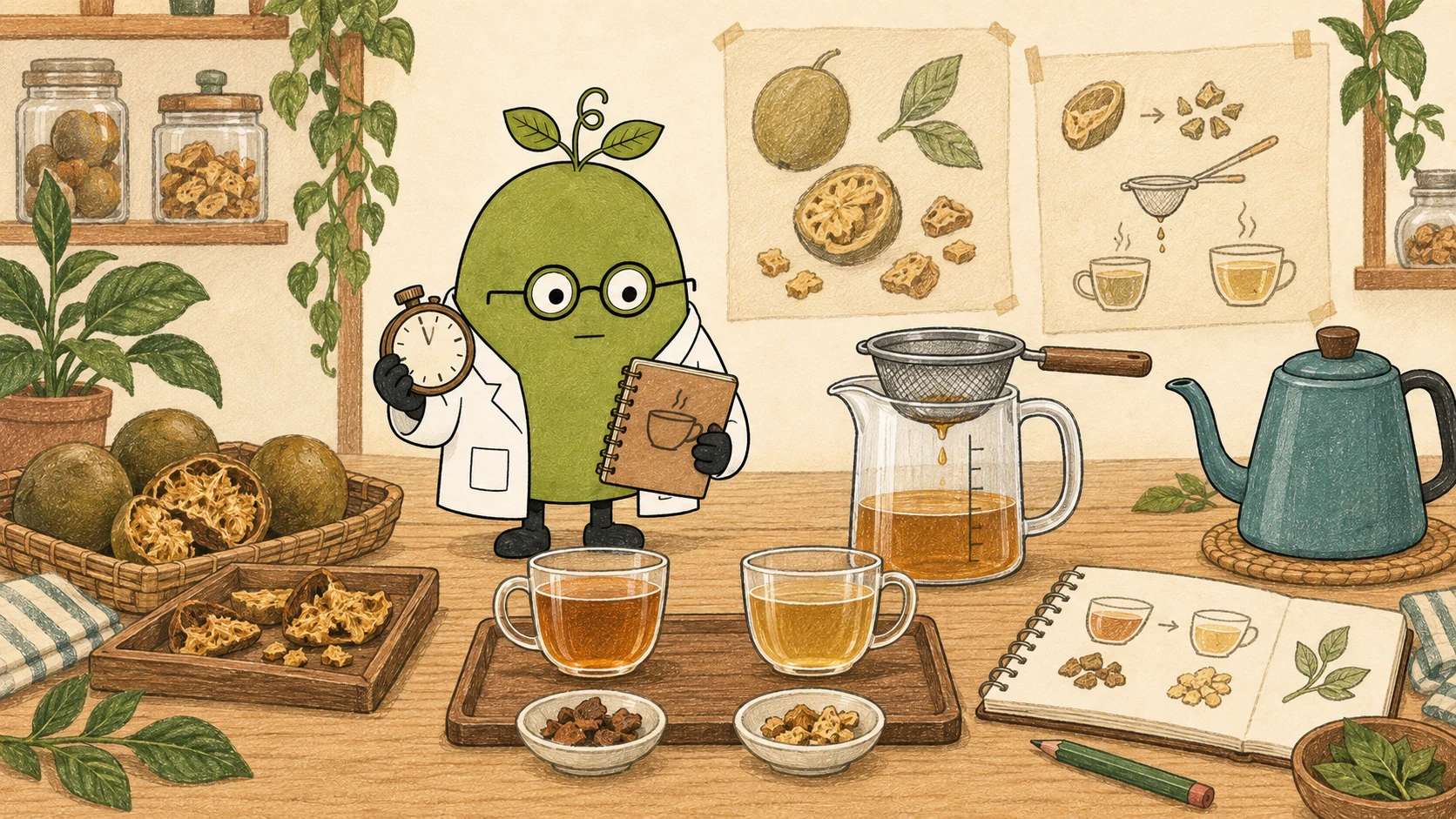
Stages of sample comparison
| Stage | Method | Question to answer |
|---|---|---|
| Initial screening under equal conditions | Use the same fruit weight, water quantity and preparation method | Which flavor fits best, and how do samples differ? |
| Trials in the actual formula | Combine with the intended tea base, juice or other ingredients; compare with the original formula | Is target sweetness met, and is the original flavor affected? |
| Testing as served | Taste as a hot or iced drink | Are sweetness and aftertaste still balanced at serving temperature and with ice? |
| Retesting after adjustment | Change dosage or preparation to address the concern | Has it improved, and can the preferred taste be reproduced? |
Weigh first, then brew the same way
Monk fruits vary in size and weight. Brewing “one fruit” from each sample in equal water may appear fair but can mean different ingredient weights. Start with weighed portions and record whether, and how finely, the fruit is broken. Use the same water source, quantity, temperature, steeping or simmering time and filtration method. Record any added water and measure the actual infusion volume after filtration. Several samples can be compared together. Number the cups, temporarily hide product names and prices, and taste at similar temperatures to focus on the infusion itself. If consumers will use “one fruit” per serving, also test whole-fruit dosing to confirm the relevant specification and package instructions.
Keep initial water and recovered infusion separate
The water added at the start is not necessarily the amount of infusion available after brewing and filtration. Record any top-up water and the recovered liquid volume at a stated measurement temperature. A difference in recovered volume can change the comparison even when the original fruit and water quantities match. Use a consistent method for the first screening. If you later top up to a fixed final volume, record that as a separate preparation condition. These records describe preparation; they do not measure extraction yield or mogroside concentration.
| Record | Keep comparable | Why it matters |
|---|---|---|
| Fruit mass and breaking method | Same weighed portion and preparation | A fruit count alone can hide size differences |
| Initial water, temperature and brewing time | Same water source and method | Different preparation can mask ingredient differences |
| Top-up water and recovered volume | Measure after the same filtration method | Starting water is not the final infusion quantity |
| Infusion dose and final drink volume | Use the same finished-drink basis | Changing dilution changes the tasting comparison |
| Ice, serving temperature and elapsed time | Taste at equivalent serving conditions | Ice melt and cooling can change the result |
Assess sweetness from the first sip to after swallowing
Follow three stages: how promptly sweetness appears, whether it is sufficient mid-sip, and how long it takes to fade after swallowing. “Little initial sweetness but a long sweet finish” differs from “not sweet enough throughout.” The former calls for attention to onset and persistence; the latter is a reason to try a higher dose. Record sweetness separately from other lingering flavors. Is the finish sweet, bitter or grassy? Which notes belong in the target drink, and which should be reduced? If an original sugar formula exists, retain it as a control and compare sweetness from entry through the finish. Specific feedback makes the next adjustment easier.
Test in the actual drink to assess the original flavor
After comparing plain infusions, add the selected one to the actual product. For fruit tea, use the intended tea base and juice; for herbal drinks, prepare it with the relevant ingredients. Check target sweetness first, then whether tea, fruit or herbal notes remain as expected and the monk fruit flavor fits. For partial sugar replacement, record the original sugar amount, retained sugar and monk fruit infusion dose, keeping final drink volumes comparable. This makes the reformulation’s effects easier to identify. Test hot and iced drinks as actually served. Record ice quantity and compare at similar stages of melting. Taste hot drinks at normal drinking temperature and again after some cooling to check sweetness and aftertaste.
Once the issue is clear, adjust ingredient, dosage or brewing
Compare several samples initially; when investigating a particular issue, change one variable at a time where possible. If overall sweetness is weak, adjust dosage first. If sweetness is right but monk fruit flavor dominates, compare other processing categories. Record separate changes to crushing, brewing time or filtration and observe their effects. Dried monk fruit is steeped or simmered to make an infusion. Check ease of filtration, visible particles or sediment, and whether these meet finished-product requirements. Once a formula is satisfactory, repeat it from your records. Reproducible taste makes it easier to hand the method to shop or production staff.
Specific feedback improves the next sampling round
When replying to Hengliyuan, provide the sample number, fruit and water quantities, brewing method and inclusion ratio in the actual drink, then explain the improvement needed. For example: “This sample is not very sweet initially, but sweetness lasts after swallowing. We want a fuller onset and a shorter sweet finish.” Or: “Sweetness is right, but monk fruit masks the tea aroma in our tea base. We want to retain the original tea aroma.” Such feedback helps both parties prioritize ingredient, dosage or preparation changes. Keep the selected sample information and brewing records so future deliveries can be checked under the same conditions.
Download a brewing record for the next sample round
The editable Excel sheet provides side-by-side control and candidate fields for fruit weight, breaking method, water, brewing, filtration, recovered volume, actual drink composition and hot or iced serving conditions. Record sweetness onset and finish separately from bitterness, aroma and visible sediment. Inputs are blank so you can enter your own observations. Duplicate the sheet for more samples or repeat runs; keep the sample code and batch identity with each record. Download it directly without an email address or registration.
Review note
Reviewed October 16, 2026.
Common questions
Should dried-fruit samples be brewed by count or by weight?
Use weighed portions for the first comparison and record how the fruit is broken. Fruit count can hide size differences. If the intended customer instructions use one whole fruit, run that serving test separately with the chosen fruit specification.
Discuss this requestWhy record the infusion volume after filtering?
Initial water and recovered infusion are different measurements. Record any added water, the filtration method and the recovered volume at a stated temperature. Otherwise, a preparation difference may be mistaken for a difference between fruit samples.
Discuss this requestHow should iced monk fruit tea be tested?
Use the intended tea base and infusion dose. Record the drink volume before ice, ice mass, serving temperature and elapsed time after adding ice. Compare at similar stages of melting and keep hot-drink observations separate.
Discuss this requestShould I increase the dose if sweetness starts weak but lingers?
Not automatically. A weak onset with a long sweet finish differs from a drink that is weak throughout. Compare the onset, mid-sip sweetness and finish first, then test one preparation or ingredient change at a time.
Discuss this requestWhat feedback helps the next sampling round?
Share the sample code, fruit and water quantities, brewing and filtration method, recovered infusion volume and actual drink dose. Describe the specific improvement you want, such as a shorter sweet finish or better retention of tea aroma. The downloadable sheet keeps these details together.
Discuss this request