
Read this guide in
Whole-fruit sourcing
Dried Monk Fruit Types: Processing Methods, Color, and Tea Applications
Compare four dried monk fruit types by flavour and use, confirm size and packaging, and calculate fruit cost per accepted litre with a free Excel sheet.
First identify the processing type when buying dried monk fruit. The four types covered here are high-temperature roasted, electrically roasted, low-temperature dehydrated and freeze-dried, typically dark brown, brown, golden yellow and green, respectively.
Processing type, fruit size and retail packaging are separate purchasing details. Choose the type, then compare size, brewing performance and use. Do not quote all dried monk fruit as a single product.
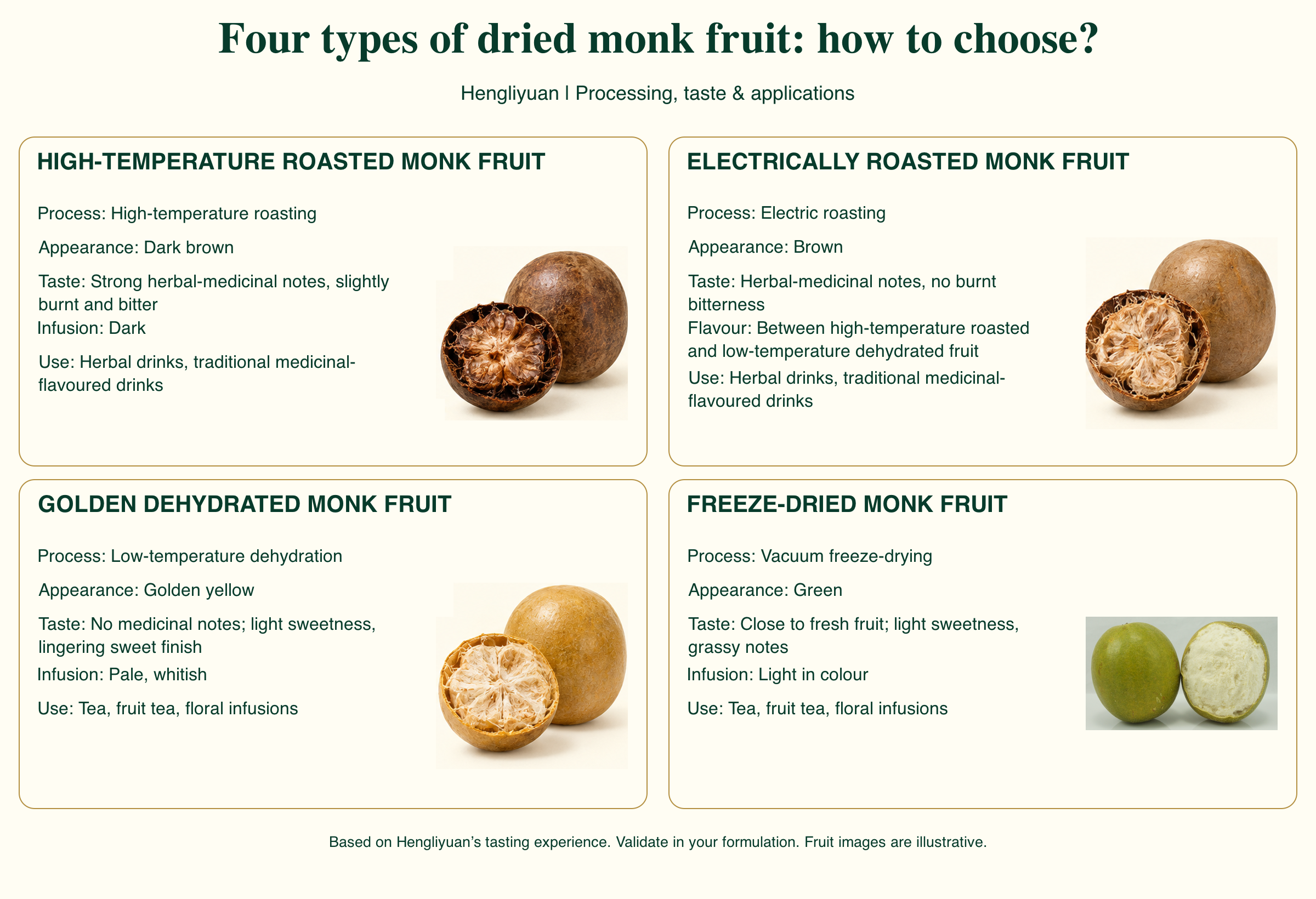
Comparing four dried monk fruit processes and tastes
| Type | Processing method | Dried-fruit colour | Hengliyuan's tasting observations | Application direction |
|---|---|---|---|---|
| High-temperature roasted monk fruit | Drying by high-temperature roasting | Dark brown | Strong Chinese medicinal-herb flavour, slight burnt bitterness; dark infusion | Herbal beverages and traditional foods and drinks with Chinese medicinal-herb flavour |
| Electrically roasted monk fruit | Drying by electrically heated roasting | Brown | Chinese medicinal-herb flavour without burnt bitterness; flavour between high-temperature roasted and low-temperature dehydrated fruit | Herbal beverages and traditional foods and drinks with Chinese medicinal-herb flavour |
| Low-temperature dehydrated monk fruit | Low-temperature dehydration | Golden yellow | No Chinese medicinal-herb flavour; clean, lingering sweetness; whitish infusion | Tea beverages, flower-and-fruit infusions, fruit teas and floral teas |
| Freeze-dried monk fruit | Freezing, then vacuum freeze-drying | Green | Close to fresh-fruit flavour, clean sweetness with grassy notes; lightly coloured infusion | Tea beverages, flower-and-fruit infusions, fruit teas and floral teas |
These descriptions reflect Hengliyuan's practical tasting experience and guide sample selection. Compare samples under identical preparation conditions. Electrically roasted describes the heating method; temperature depends on the process. Colour alone cannot establish component content or quality.
High-temperature roasted monk fruit: strong herbal flavour and slight burnt bitterness
High-temperature roasting removes moisture, producing dark-brown dried fruit. In Hengliyuan's tasting experience, it has a pronounced Chinese medicinal-herb flavour, slight burnt bitterness and a dark infusion. These flavour and appearance traits deserve particular attention in sample comparisons. For tea formulations, first confirm acceptance of this herbal flavour, burnt bitterness and darker infusion. Then compare other processing types rather than considering only fruit size and price.
Electrically roasted monk fruit: herbal flavour without burnt bitterness
Electrically heated roasting dries the fruit to a brown appearance. The name describes the heating method; temperature and time depend on the actual process. In Hengliyuan's tasting experience, the overall flavour falls between high-temperature roasted and low-temperature dehydrated fruit: it retains Chinese medicinal-herb flavour without the former's burnt bitterness. Customers who accept herbal flavour but want to avoid burnt bitterness can include electrically roasted fruit in trials, then check its fit with the actual tea formulation.
Low-temperature dehydrated monk fruit: clean, lasting sweetness and a whitish infusion
Low-temperature dehydration removes moisture and produces golden-yellow fruit, also called golden dehydrated monk fruit. In Hengliyuan's tasting experience, it has no Chinese medicinal-herb flavour, tastes clean and sweet, has a lingering sweet finish and brews a whitish infusion. This offers a different flavour direction from high-temperature and electrically roasted fruit. Customers avoiding medicinal-herb flavour can prioritise golden dehydrated samples and check whether the lingering sweetness suits the finished tea beverage.
Freeze-dried monk fruit: fresh-fruit-like flavour with grassy notes
Freeze-drying first freezes the fruit, then removes moisture by ice sublimation under vacuum. The dried fruit is green. In Hengliyuan's tasting experience, it tastes close to fresh fruit, with clean sweetness but grassy notes, and yields a lightly coloured infusion. Besides clean sweetness, check acceptance of grassy notes. Freeze-dried and golden dehydrated fruit both taste clean and sweet, but are not ingredients with identical flavours.
Hengliyuan's advice: choose for the beverage's flavour direction
High-temperature and electrically roasted monk fruit suit herbal beverages and traditional foods and drinks with Chinese medicinal-herb flavours. The flavour directions of guilinggao herbal jelly and banlangen herbal drinks familiar to Chinese consumers can guide sampling. These examples concern flavour pairing. Both types have herbal notes that can fit those products' overall taste. When choosing between them, high-temperature roasted fruit has slight burnt bitterness and a dark infusion; electrically roasted fruit retains herbal flavour without burnt bitterness. Golden dehydrated and freeze-dried fruit suit tea beverages and flower-and-fruit infusions, including fruit and floral teas. Golden dehydrated fruit has no medicinal-herb flavour, with clean, lingering sweetness. Freeze-dried fruit tastes closer to fresh fruit, with clean sweetness, grassy notes and a lightly coloured infusion. Hengliyuan recommends actual-formulation trials: check the balance of golden fruit's sweet finish, or how freeze-dried fruit's grassy notes fit tea, flowers or fruit. Then adjust dosage.
Beverage ingredients and retail fruit have different selection priorities
| Purchasing use | What to compare first | What the quotation should specify |
|---|---|---|
| Tea shops preparing infusions | Aroma, sweetness, aftertaste, colour and filtration in the actual recipe | Dosage by weight, fruit condition and supply packaging |
| Food and beverage manufacturing | Batch performance, ingredient preparation and fit with production processes | Acceptance specifications, sampling, packaging and batch documents |
| Retail of intact whole fruit | Size consistency, intactness, appearance and consumer use | Sale by count or net weight, quantity per pack and protection |
| Gift boxes | Fruit specification, uniformity and presentation | Fruit grade, quantity per box and transit protection |
For infusions, evaluate intact appearance and brewing performance separately. If fruit will be broken up anyway, the value of paying more for larger fruit depends on dosage and finished-product performance. Breakage must also be distinguished from mould, foreign matter and other quality problems.
Medium, large and extra-large fruit: names are not enough
Hengliyuan's product records include medium, large and extra-large fruit and packaging such as packs of six, packs of two and gift boxes of 12. Size and retail packaging need separate confirmation. Large is not a universal diameter standard. Compare agreed diameter ranges, individual weights or fruit counts per kilogram, plus size consistency, rather than grade names alone. Compare beverage samples by weight first. Brewing one fruit of each of two different sizes in equal water volumes also changes dosage, making fruit and dosage effects difficult to separate. If consumers will use one whole fruit, add brewing tests by fruit count and confirm the packaging instructions.
Put the same specification behind each quotation
Ask suppliers to quote the same selected processing type and intended use. Keep size, fruit condition and packaging as separate lines so a cheaper quotation is not simply a different grade or pack. Confirm the offered batch and sample options before treating a product-record example as current availability.
| Quotation item | Specify or confirm | Keep with the order |
|---|---|---|
| Processing type | Selected type and sample code | The agreed sample and brewing record |
| Size basis | Diameter range, individual mass or count per kg | Method used to check the grade |
| Fruit condition | Intactness and agreed breakage criteria | Acceptance criteria and receiving observations |
| Packaging | Net weight or fruit count, units per pack and outer protection | Confirmed packing specification |
| Documents and delivery | Required batch documents, destination, quantity and delivery basis | Current quotation and agreed terms |
Two comparisons when brewing samples
First, compare infusions at equal fruit weights, water volumes and preparation conditions. Record breakage, water temperature, steeping or boiling time and filtration, then evaluate colour, aroma, sweetness and aftertaste. Second, adjust dosage to the target beverage and compare ingredient consumption when each option meets requirements. Step one identifies sample differences; step two establishes production use and cost. If a shop mixes the infusion with tea, juice or other ingredients, test that actual recipe. Good taste in water alone does not guarantee the same overall taste with other ingredients.
Calculate fruit cost per litre of infusion meeting the target
Price per kilogram alone does not fully describe beverage ingredient costs. After setting the infusion target, calculate: Fruit cost per acceptable litre = delivered fruit price (CNY/kg) × fruit quantity used (kg) ÷ filtered infusion volume meeting the target (litres). Compare quantities and yields needed to meet the same finished-product requirements even when prices per kilogram differ. No litres-per-fruit yield is assumed here; use trial records under the customer's preparation conditions. Add labour, energy and other ingredients for full production cost. Fruit cost is not the entire cost. The downloadable calculator converts fruit input from grams to kilograms and divides by the measured recovered volume. It shows a result only after you confirm that the trial meets the same target; it does not decide acceptance for you. Missing inputs stay blank, and non-positive fruit quantity or volume is flagged rather than producing a misleading cost.
- Download dried monk fruit cost-per-litre calculator (.xlsx)
- Download the brewing comparison record (.xlsx)
Both files are editable and download directly without an email address or registration. Keep one brewing record for each candidate and repeat.
Check deliveries against the selected sample
On receipt, check grade, measurement basis, count or net weight and packaging integrity. Then check agreed fruit condition, including breakage, foreign matter and unusual odours. For beverage use, sample the delivery, brew by the agreed method and compare with retained-sample records. This checks both the fruit received and performance in use. Hengliyuan can discuss fruit selection, samples, packaging and supply requirements by use. After the customer identifies tea-shop, factory or whole-fruit retail use, confirm specification and delivery terms.
Review note
Reviewed October 16, 2026.
Common questions
Does larger fruit always brew sweeter tea?
Size alone cannot establish this. Compare equal fruit weights under the same preparation conditions, then test the dose each candidate needs for your target drink. A one-fruit comparison also changes ingredient weight unless the fruits weigh the same.
Discuss this requestMust beverage buyers choose extra-large fruit?
No. If the fruit will be broken and filtered, compare flavour, usable infusion and cost at the accepted dose. Intact appearance and size uniformity can carry more weight for whole-fruit retail or gift boxes.
Discuss this requestHow can large fruit from different suppliers be compared?
Agree on a measurable size basis such as diameter range, individual mass or count per kilogram. Confirm processing type, condition and packaging separately, then check actual samples against those descriptions.
Discuss this requestDoes electrically roasted mean low-temperature dried?
No. Electrically roasted describes the heat source, not a fixed temperature. Ask about the offered process and compare its sample with the selected reference rather than assuming the names describe the same fruit.
Discuss this requestCan an online litres-per-fruit recommendation set production cost?
Use it only as a trial starting point. Weigh your fruit, record preparation and measure the filtered volume that meets your target. Enter that trial result and a current delivered price in the calculator; no standard yield or price is assumed.
Discuss this requestWhat should I send to discuss dried monk fruit samples?
Start with tea-shop, manufacturing or retail use, your target market and the flavour direction you want. If available, add the preferred processing type, size basis, packaging and quantity. We can clarify undecided details before confirming samples and a quotation.
Discuss this request