
Read this guide in
Hengliyuan Applications and Selection
Food-Grade Sucralose Buying Guide: Assay, Particle Size, Batch COA, and Price
Compare food-grade sucralose powder by assay, particle size, batch COA and process fit. Check sample-to-delivery traceability and 25 kg bag quotation terms.
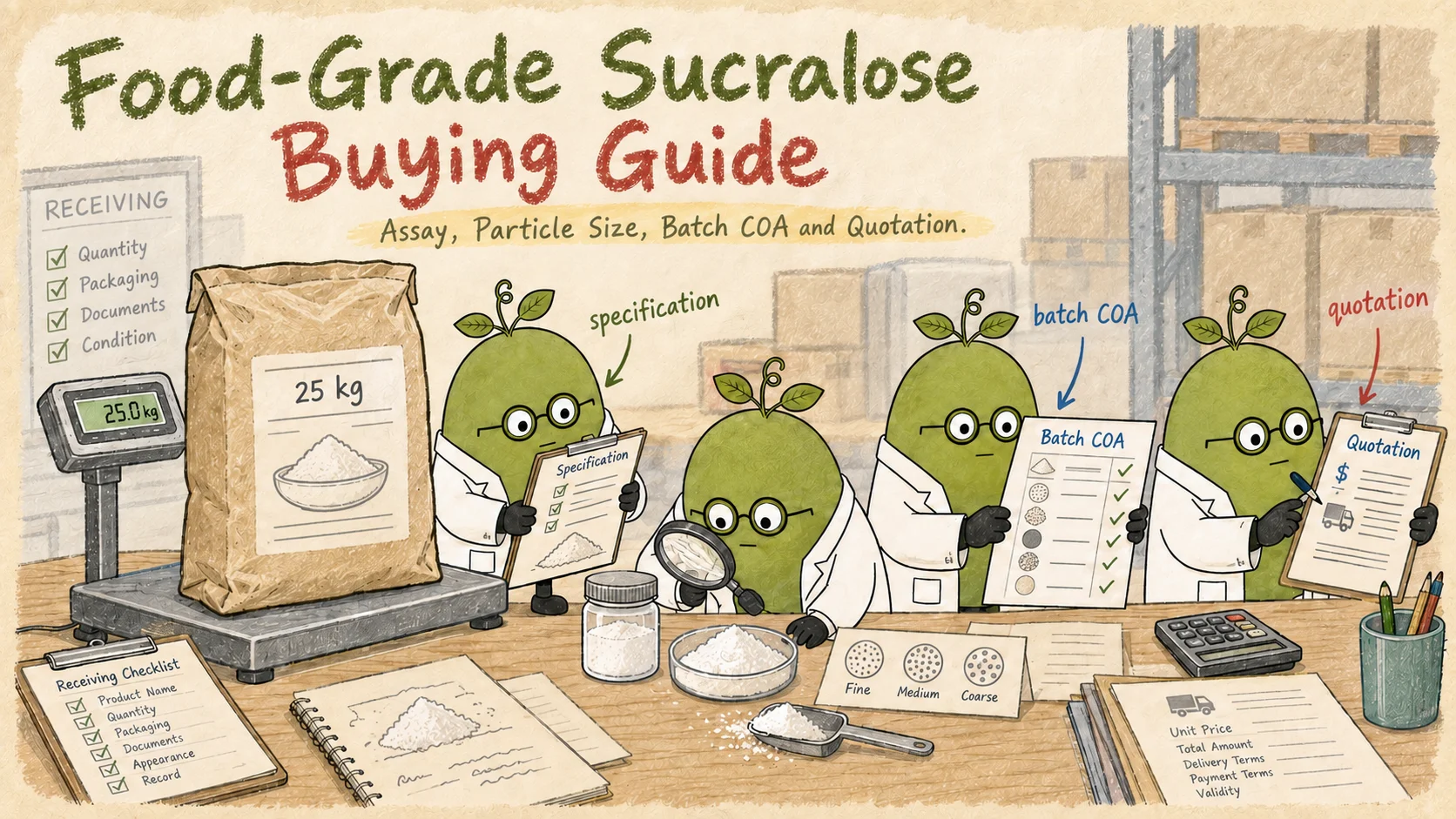
Hengliyuan supplies food-grade sucralose powder in 25 kg bags, with one product specification currently offered. Compare that specification with your purchasing requirements, then test the sample in your formula and dosing process.
Send your acceptance standard, intended application, sales market and purchase quantity. We can check the available product information against those requirements before confirming samples and a quotation.
Specify sucralose powder or a complete blend
Sucralose powder and an erythritol–sucralose blend have different compositions and use levels. State which material you want before comparing quotations. A lower price per kilogram is not a useful comparison if the products perform different jobs. Choose the raw-material discussion when you already control the individual ingredient doses in your formula. If you also want to change sweetness strength or the way the sweetener is handled, discuss a complete blend separately, including its composition and target sweetness. This guide covers sucralose powder. For a blend comparison, use the separate dose-and-cost guide.
Check more than the assay result
Assay is one acceptance item. Compare the complete agreed specification with the relevant test results and your process requirements. Do not fill a missing item with a value from another product or an unrelated batch.
| Acceptance item | What to match |
|---|---|
| Identity and assay | Product identity, agreed range, test method, units and reporting basis |
| Moisture-related result | The exact test item, method and limit; distinguish moisture from loss on drying |
| Particle specification | Available mesh or particle-size information, method and relevance to your handling process |
| Other required quality items | Your acceptance requirements and the corresponding specification or test data |
| Product and batch identity | Sample label, product specification, packaging label and batch COA identifiers |
Match the item, method, units and reporting basis before comparing results. Moisture and loss on drying are not automatically interchangeable just because their values look similar. If a required item is absent, agree what document or additional test is needed before ordering. Keep that item open until the missing information has been reviewed; a blank field is not a pass.
Match the specification, sample and delivery batch
The specification defines the agreed acceptance requirements. A batch COA reports results for an identified batch. Read them together, and confirm which batch supplied the sample used in your trial.
| Stage | Record to check | Decision it supports |
|---|---|---|
| Before sampling | Current product specification and your acceptance standard | Whether the offered product is a candidate for the project |
| Sample evaluation | Sample identity, batch documents and trial record | Whether that identified sample meets the document and application checks |
| Bulk delivery | Delivery labels, batch number, matching COA and agreed specification | Whether the delivered lot meets the agreed incoming acceptance requirements |
A sample COA does not represent every future delivery. If the batch number, item or method does not match, ask for clarification and the correct record before acceptance. Carry out the incoming inspections required by your own quality system and the supply agreement.
Test the offered powder in your dosing process
Hengliyuan currently offers one sucralose product specification. Check the available particle information against your weighing, screening, mixing and dosing method before assuming another mesh option is available. For dry blending, test the sample through the relevant mixing, transfer and filling steps. Assess uniformity separately: meeting a particle-size requirement does not prove that a low-dose ingredient is evenly distributed. For liquid preparation, record the actual dose, water or base, temperature and mixing conditions. Confirm dissolution and handling under those conditions rather than approving the material from its appearance alone.
Compare a new source in the current formula
Keep the current ingredient as the control when changing suppliers. Compare the candidate at the intended dose with the other ingredients and process held constant where practical. Record sweetness, aftertaste, overall flavor and dosing or preparation performance. If the material itself changes—for example, from a complete blend to sucralose powder—recalculate and retest the dose. Do not carry over the blend’s addition rate. Record any other formula or process change so the comparison remains interpretable. After the laboratory comparison, complete the production checks needed for the actual equipment and batch size. Document acceptance, sensory fit and process fit are separate decisions; keep unresolved items visible before placing the production order.
Compare quotations on the same 25 kg bag basis
Hengliyuan’s stated pack is a 25 kg bag. Give the number of bags or total mass required and ask the quotation to identify: - The product specification and order quantity. - Currency, price per kilogram, price per 25 kg bag and total amount. - Delivery basis, destination and whether tax or freight is included. - Required documents and any separately agreed testing charges. - Lead time, payment terms and quotation validity. Check the arithmetic on the same price basis: one 25 kg bag contains 25 times the quoted kilogram quantity. Add separately charged items explicitly rather than comparing a delivered price with an ingredient-only price. For cost in use, multiply the accepted dose by the purchase unit price and include relevant formula or process changes. No current price is established by this guide.
Request a specification check and sample
Send your acceptance standard, expected quantity, target market and intended application. Include a required particle specification or special document item at the start so it can be checked against the offered product. If the formula is still in development, describe the product and dosing method. A sample trial can help establish whether the material fits the intended process. Before ordering, connect the accepted sample and specification to the quotation, packaging and delivery-batch documentation. That gives purchasing and production the same reference.
How should sucralose safety and side-effect claims be read?
Safety conclusions apply to defined uses and exposure. FDA permits sucralose under specified conditions. EFSA’s 2026 re-evaluation retained its acceptable daily intake of 15 milligrams per kilogram of body weight per day and found no safety concern at the reported authorised uses and levels, but could not establish safety for the proposed extension to further fine-bakery uses. A compliant assay or an acceptable taste test does not resolve those processing and market questions. FDA’s published US acceptable daily intake (ADI) for sucralose is 5 milligrams per kilogram of body weight per day. Keep the authority and units attached to each value; an ADI is not a recommended product dose or a per-serving limit. Neither assessment promises absence of every individual reaction. Record the ingredient, complete formula, intended use and exposure before a commercial decision, and refer an individual symptom or health question to an appropriate healthcare professional.
Review note
Reviewed October 16, 2026. FDA and EFSA sources were rechecked for the assessment summary. Match the current product documentation and intended use to the destination market; this guide does not set a batch specification or a formulation dose.
Common questions
What is the current sucralose price per kilogram?
Request a current quotation for the offered product specification and quantity. Confirm currency, price per kg and per 25 kg bag, delivery basis, taxes, freight, document scope and quotation validity. This guide does not publish a standing price.
Discuss sucralose samplesIs a specification the same as a batch COA?
No. The specification defines agreed acceptance requirements; the COA reports results for an identified batch. Match the product, batch, test items, methods and reporting basis before judging acceptance.
Discuss sucralose samplesCan the sample COA cover later bulk deliveries?
No. Match each delivery to its batch labels and documents. Keep the approved specification and sample trial as references, but review the delivered lot against the agreed incoming requirements.
Discuss sucralose samplesDoes Hengliyuan offer several sucralose mesh grades?
This guide describes one currently offered product specification. Send your particle-size and handling requirements so the available data can be checked; do not assume an alternative grade is available.
Discuss sucralose samplesCan sucralose powder replace a blend at the same dose?
No. Their compositions and sweetness strengths differ. Recalculate and confirm the dose in the complete formula, then assess sensory performance, handling and uniformity.
Discuss sucralose samplesDoes a compliant assay approve every food use?
No. Ingredient acceptance, permitted use, exposure and processing conditions require separate review. The cited 2026 EFSA assessment retained its conclusion for authorised uses but could not conclude on the proposed wider fine-bakery extension. An ADI is not a recipe dose or per-serving limit.
Discuss sucralose samples