
Read this guide in
Hengliyuan Applications and Selection
Erythritol–Sucralose Blends for Sugar Reduction: Sweetness, Taste, and Cost
Compare 5× and 10× erythritol–sucralose blends by dose and cost in use. See a worked example and download a free Excel calculator for your prices and trial doses.
For food and beverage companies seeking to reduce added sugar, develop lower-calorie products, and control ingredient costs, Hengliyuan recommends considering high-intensity erythritol–sucralose blended sweetener options.
Based on Hengliyuan’s formulation experience, this combination is well suited to sweeteners with sweetness at 5× that of sucrose or higher. It can lower the cost in use and has relatively little effect on the finished product’s original flavor.
Calculate changes in finished-product sugar and calories from the complete formulation, or confirm them by testing. A lower sweetener addition level alone does not establish a nutrition claim.
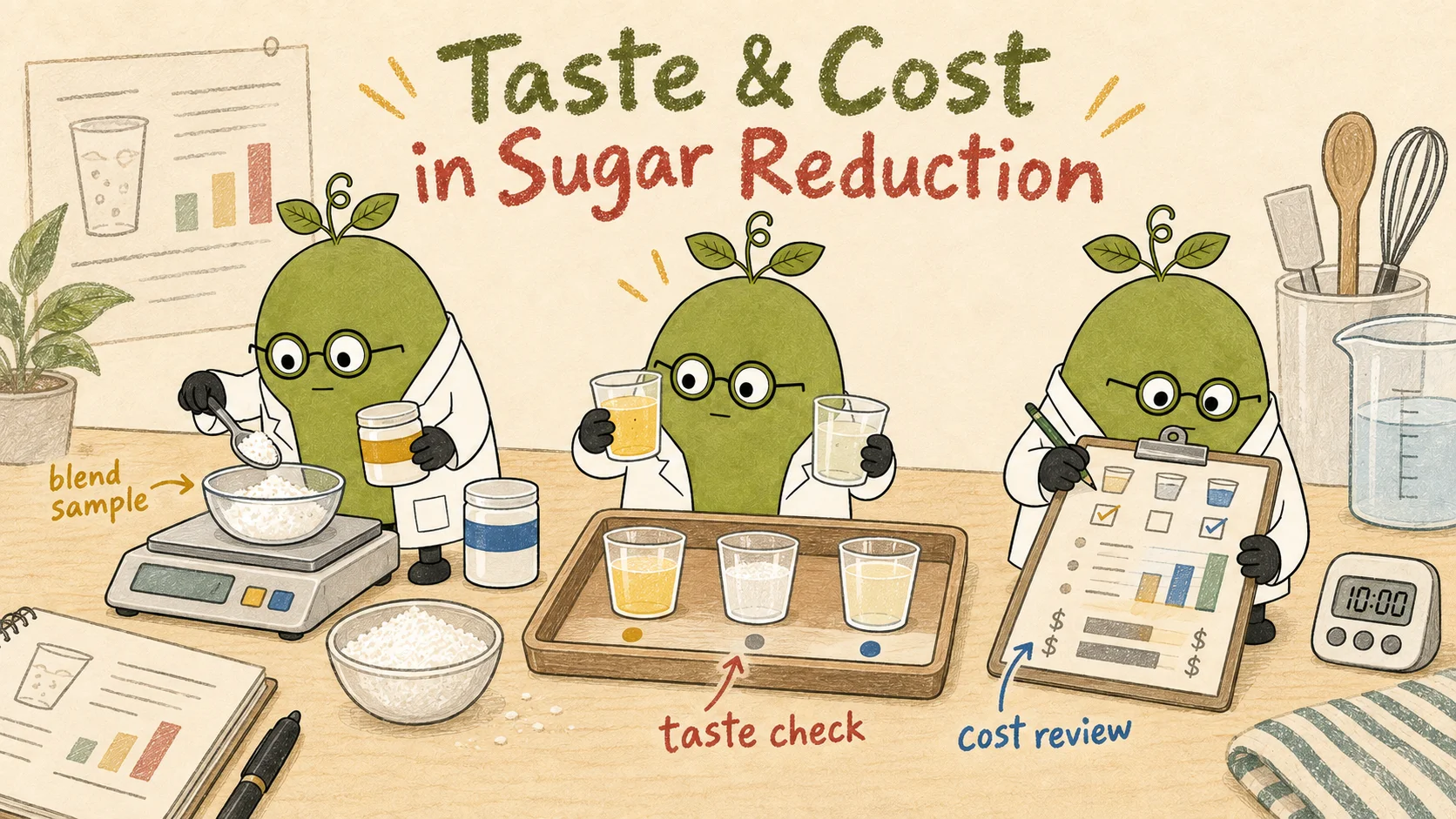
5× sweetness or higher can reduce the actual addition level
An erythritol–sucralose blended sweetener can be formulated to the required target sweetness. Hengliyuan considers this combination particularly suitable for options at 5× sweetness or higher.
Using sucrose sweetness of 1 as the reference, under comparable conditions:
- 5× sweetness: 1 kg of blended sweetener provides approximately the same sweetness as 5 kg of sucrose.
- 10× sweetness: 1 kg of blended sweetener provides approximately the same sweetness as 10 kg of sucrose.
On an equal-sweetness basis, the theoretical weight required is approximately one-fifth or one-tenth of the sucrose weight, respectively. This can give buyers an opportunity to lower sweetener-ingredient cost by reducing the addition level.
Use this conversion only to set a sampling starting point; final addition levels must be based on performance in the actual food. When reducing sucrose weight, also consider the total weight of the original formula and any other functions that must be retained.
Compare the accepted dose, not just the price per kilogram
A more expensive powder can cost less in use if you need less of it. Start with the nominal sweetness multiple, then replace that estimate with the dose accepted in your food trial.
Estimated blend dose (kg) = reference sucrose mass (kg) ÷ sweetness multiple.
Sweetener cost = dose (kg) × price per kg.
The worked example below reuses CNY 5.20/kg sugar, CNY 17/kg for a 5× blend and CNY 22/kg for a 10× blend. These are illustrative calculation inputs, not current market prices or a Hengliyuan quotation. The reference target is the sweetness of 100 kg of sucrose.
| Calculation item | Sucrose control | 5× blend example | 10× blend example |
|---|---|---|---|
| Price per kg | CNY 5.20 | CNY 17.00 | CNY 22.00 |
| Nominal sweetness multiple | 1× | 5× | 10× |
| Estimated dose for the reference target | 100 kg | 20 kg | 10 kg |
| Sweetener cost | CNY 520 | CNY 340 | CNY 220 |
| Cost per kg sucrose-equivalent sweetness | CNY 5.20 | CNY 3.40 | CNY 2.20 |
| Saving against the control | — | CNY 180 / 34.6% | CNY 300 / 57.7% |
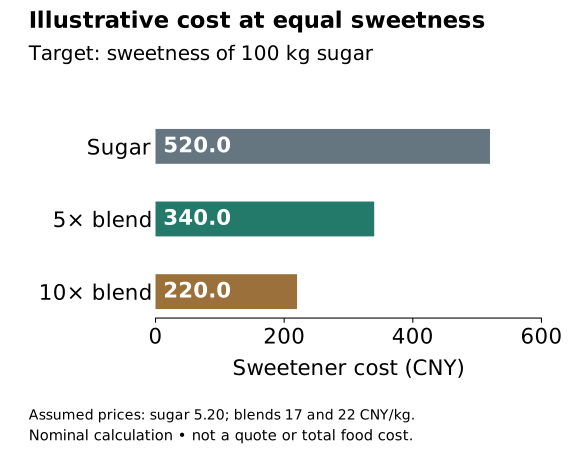
At these inputs, estimated sweetener cost falls by CNY 180 (34.6%) with the 5× blend or CNY 300 (57.7%) with the 10× blend. These percentages apply only to the sweetener costs shown, not to the total cost of the finished food. A trial dose above the nominal estimate changes the result. For example, 25 kg at CNY 17/kg costs CNY 425 before any other adjustments, rather than CNY 340 at 20 kg. Include the cost of restoring solids or texture, and any relevant process, packaging or delivery differences.
Retain the product’s original flavor
In Hengliyuan’s application experience, erythritol–sucralose blends have relatively little effect on the finished product’s original flavor. For an established recipe, that is a practical advantage alongside cost in use. Test the blend in your own product at the target sweetness. Compare sweetness onset, finish and the flavor you want to retain against the original recipe. Relatively little impact does not mean identical sensory results in every food; approve the specific formula and dose you tasted.
Other sweeteners can be added to adjust the taste for different applications
Erythritol and sucralose can form the base of a blend, with other sweeteners added to adjust taste for the application. Tell us whether the priority is sweetness onset, aftertaste, mouthfeel or preserving a particular flavor. Hengliyuan can discuss ingredient combinations against those requirements and your cost target. Confirm the selected ingredients, proportions and result in the product trial; the example prices above do not automatically apply to a revised blend.
Set the serving and formula requirements before sampling
If your recipe allows a lower ingredient addition level, a blend at 5× sweetness or higher is a useful starting point for discussion. If you must keep the original input weight, serving weight or consumer directions, state that first: equal sweetness does not replace the missing mass or its functions. Send the target food, current sweetener dose, batch or serving size, intended market, flavor target and cost target. Hengliyuan can discuss customization and provide the complete ingredient names, specific ingredient proportions, target sweetness and finished-product specifications to the blending customer. After tasting, keep the accepted sample code and actual dose linked to the formula and quotation. That is the basis for a useful purchasing comparison.
Use your tested dose and quote currency
Download the Excel calculator without leaving an email address. Replace the yellow input cells with your own prices, reference sugar mass and sweetness multiples. Leave the tested-dose field blank for a nominal estimate, or enter a positive trial dose to override it. Use one currency and the same reference batch throughout. The sheet does not fetch prices or exchange rates. Its additional-cost fields let you include relevant differences, but it does not calculate a complete food formulation, nutrition declaration or sensory result.
| Input to confirm | Use in the comparison |
|---|---|
| Reference batch | Use the same sucrose mass and product output for every option. |
| Price and delivery basis | Enter comparable prices in one currency, with matching tax and delivery treatment. |
| Accepted blend dose | Use the trial dose once taste and application performance pass. |
| Other comparison costs | Include replacement ingredients and relevant process, packaging or delivery differences without counting them twice. |
| Approval record | Keep the sample code, formula version and acceptance observations with the calculation. |
Review note
Reviewed October 16, 2026. Prices, nominal doses and savings on this page are worked examples. The downloadable calculator uses the same starting values and allows your actual prices and tested doses to replace them.
How Hengliyuan makes the corresponding blend
Hengliyuan makes its erythritol-based sweetener blends by fluid-bed granulation. In this common food-powder process, airflow fluidizes the powders as particles agglomerate. Confirm the particle specification, dissolution and application performance against the selected formula and sample.
Common questions
What does 5× sweetness mean?
It is an approximate sweetness multiple against sucrose under comparable conditions. One-fifth of the sucrose mass is the nominal starting dose, not an automatic final dose for every food. Confirm sweetness and other application requirements in your recipe.
Discuss blend samples and cost in useDoes the 10× blend always cost less?
No. It costs less in this worked example because 10 kg at CNY 22/kg is less than 20 kg at CNY 17/kg. Your accepted dose, actual quotation and other formulation or production costs determine your result.
Discuss blend samples and cost in useAre the prices on this page current quotations?
No. CNY 5.20, 17 and 22 per kg are illustrative inputs retained for the calculation. Request a current quotation for the selected composition, pack size, quantity and delivery basis.
Discuss blend samples and cost in useHow do I use the Excel calculator after a food trial?
Enter your actual prices and reference batch, then put the accepted positive blend dose in the tested-dose field. That overrides the nominal sweetness calculation. Add relevant comparison costs and keep the sample and formula version with the result. No email is required to download it.
Discuss blend samples and cost in useCan I keep the same packet or serving weight?
State that requirement before selecting the blend. A lower dose can match sweetness while leaving less mass in the serving. The complete formula must address that difference and preserve the intended consumer directions.
Discuss blend samples and cost in useDo the example savings establish lower calories or a finished-food cost saving?
No. The percentages compare only the illustrated sweetener costs. Assess total cost using the complete accepted formula and process, and calculate or test sugar and calories for the finished product separately.
Discuss blend samples and cost in use