
Read this guide in
PROCESS VALIDATION GUIDE
Sweetener Heat Stability in Beverages and Bakery
Are stevia, sucralose and monk fruit heat stable? Separate beverage vs bakery validation checks before scale-up.
A sweetener that looks fine after a hot-fill beverage trial has not automatically passed a bakery trial. The two products put the ingredient through different conditions and ask it to do different jobs.
This guide is for food and beverage teams comparing monk fruit, stevia, sucralose, allulose-supported or erythritol-free sweetener directions. Use it to plan separate application trials and identify the process, storage and market questions to discuss with Hengliyuan.
Heat stability is an application question
The useful question is not simply whether a sweetener is heat stable. Ask whether it performs in your product, under your process and through your intended storage period. A beverage can be acidic, clear or cloudy, hot-filled or aseptically processed. A baked product has a changing water environment, a hot surface, a cooler core and a structure that sugar normally helps build.
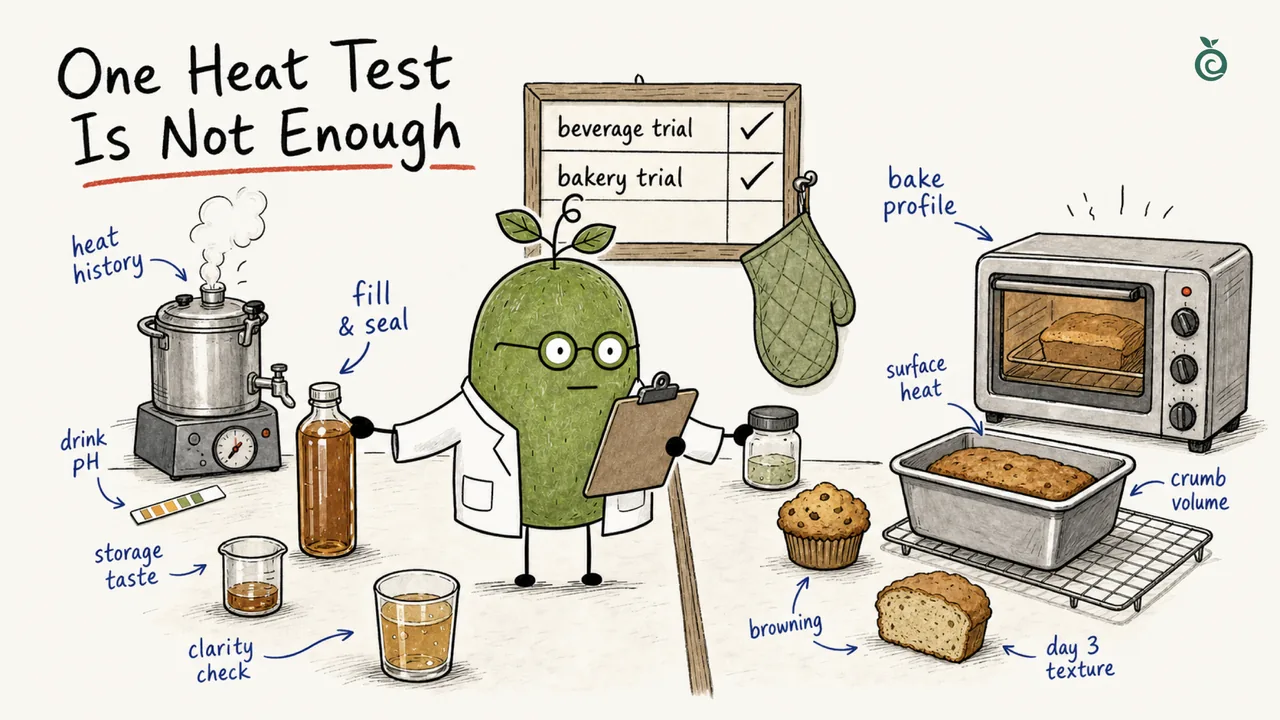
What changes in a beverage trial
For a beverage, start with the real base rather than plain water. Record pH, acid system, flavor, minerals or protein if present, heat treatment, filling method, package, light exposure and target storage window. Check color, clarity or sediment, first sweetness, aftertaste and whether the taste shifts after the product has been stored. Tsoubeli and Labuza’s 1991 study used phosphate-buffered aspartame solutions to estimate losses relevant to aseptic milk-based drinks. It was a solution model, not a finished-milk trial. Its temperature, pH and buffer findings support product-specific testing, not a forecast for every sweetener.
| Beverage check | Record for each material and trial |
|---|---|
| Material and base | Commercial material and formula version, actual dose and batch-mass basis, drink recipe, pH and acid system. |
| Heat and filling | Measured product temperature and time, measurement location, heat and cooling history, filling method and package; distinguish these from equipment settings. |
| Comparison and method | An appropriate analytical baseline and a safely prepared taste reference; record assay method and units separately from sensory and physical observations. |
| After packing | Actual storage conditions and elapsed time, package identity, color, clarity or sediment, sweetness and aftertaste under the stated serving conditions. |
What changes in a bakery trial
Bakery adds variables that a drink does not have. Use the actual dough or batter and compare the intended bake profile. Record surface and core temperature where available, batter or dough handling, color development, volume, crumb or bite, moisture, water activity where available, sweetness and day-zero versus stored texture. High-intensity sweeteners can supply sweetness at low use levels, but they do not automatically replace sugar's bulk, moisture or browning roles.
| Bakery check | Record for each control and candidate |
|---|---|
| Recipe and material | Commercial sweetener and formula version, actual dose, original sugar control or current formula, and other ingredient or water changes. |
| Bake profile | Oven setting separately from measured product surface/core temperature and time, with measurement positions and the actual dough or batter. |
| Cooled product | Color, browning, volume, crumb or bite, sweetness, moisture and water activity where measured; keep the method and units with each value. |
| Packaged storage | Actual package, storage conditions and elapsed time, then the same defined texture and taste checks; a fresh result alone is not a shelf-life result. |
Why a cross-over result can mislead a team
A beverage test may show clean sweetness after processing while a cake, cookie or bread still browns differently, loses volume or becomes dry during storage. The reverse can also happen: a blend that behaves acceptably in a baked product may leave a different aftertaste in an acidic drink. A 2024 Journal of Agricultural and Food Chemistry study on heated sucralose in model systems and food reinforces the need to look at specific high-temperature food conditions. It does not describe monk fruit, stevia or allulose performance.
Use two decision paths, not one pass or fail label
For beverages, use an appropriate pre-process analytical baseline and a safely prepared finished-product taste reference, then compare the intended thermal process and defined storage checkpoints. An unprocessed analytical sample must not be used as a tasting control when it has not undergone the required food-safety process. For bakery, compare a full-sugar or current-formula control against the candidate direction, then review the product after cooling and through its expected storage window. Keep a shared brief for the project, but score each application with its own checkpoints. Keep the analytical basis clear. Evaporation or dilution can change a concentration per unit of product, so a before/after concentration alone may not describe the amount of sweetener retained. State the measured analyte, dose, actual batch basis and analytical method rather than treating the mass of a commercial blend as the amount of one active sweetening compound.
| Question | Evidence that answers it |
|---|---|
| Does the finished product taste and look right? | Application-specific sensory and physical checks under matched preparation and serving conditions. |
| What happened to the measured sweetener or other analyte? | An appropriate analytical method, sampling basis and reported sensitivity; acceptable taste does not demonstrate the absence of degradation products. |
| Can this use and label be marketed? | A separate review of the actual material, food category, use conditions and current target-market requirements. |
Keep market review separate from process testing
A successful pilot tells you only that the sample worked under the tested conditions. It does not confirm ingredient permission, nutrition treatment, a sugar claim or final label wording in the target market. Confirm those items separately with the relevant market requirements and qualified reviewer before launch.
Technical references
These references explain why the material, food matrix and test conditions matter. The aspartame paper is a solution-model study; Hellwig’s paper concerns sucralose under selected heating conditions; the review discusses sensory and structural roles across food applications. They do not set a universal safe temperature or establish the performance of every commercial grade.
Published heat examples are context, not a process specification
FDA’s juice HACCP questions and answers give 161°F (about 72°C) for 15 seconds as an example that can achieve the required reduction in many juice cases, while explicitly requiring the processor to validate its own product and HACCP plan. This is not an approved sweetener test window or a universal hot-fill process. Record the actual product temperature and hold time for your beverage. For bakery, record the oven setting separately from the measured product temperature and time. Do not assume the oven air temperature is the temperature throughout the food. EFSA’s 2026 sucralose review confirmed currently authorised uses but could not confirm the assessed extension to additional fine bakery uses involving prolonged high temperatures. A label such as heat stable therefore does not replace the application and market review, and this page does not infer a degradation percentage from those sources.
Is sucralose heat stable enough for baking?
Sweetness retention and chemical safety are separate questions. FDA’s overview describes sucralose as remaining sweet during baking. EFSA’s 2026 evaluation nevertheless could not conclude on the proposed extension to further fine-bakery uses because of uncertainties about chlorinated compounds across baking processes. Its conclusion for current authorised uses should not be extended to every prolonged high-temperature process. These sources do not establish a universal safe oven temperature for your formula. Record product temperature, heating time, moisture, composition and intended market separately from the oven setting. Keep sensory and structure checks distinct from any required chemical or regulatory assessment. An acceptable taste result is not evidence that no degradation products formed.
Start with the application, process and one question
Tell Hengliyuan whether the product is a drink or a baked food, the final sales market and the heat or bake process you plan to use. Add the main difference you want a sample to resolve, such as aftertaste, browning, volume or texture after storage. You can start before the full formula, temperature record, packaging choice or final quantity is settled. Add the selected material, sample version and available process information as known, then agree the next application comparison. Supplier sample support and a quotation are separate from the buyer’s finished-product process and market validation.
Common questions
Can a sweetener that works in a hot beverage be used in bakery?
It can be considered, but the beverage result is not a bakery pass. Bakery changes water conditions, surface and core temperature, browning, structure and storage behavior. Compare the selected material in the actual dough or batter.
Discuss application-specific heat trialsWhat should a beverage heat-stability trial include?
Use the real drink, a defined analytical baseline and a safely prepared taste reference. Record the actual product temperature and time, pH, filling, package and storage conditions, with sensory, physical and analytical results identified separately.
Discuss application-specific heat trialsWhat should a bakery sweetener trial include?
Use the real recipe and record oven settings separately from product temperature and time. Compare color, volume, texture after cooling, sweetness, moisture and water activity where measured, then assess the actual packaged storage conditions.
Discuss application-specific heat trialsDoes a heat-stability result confirm market compliance?
No. Process performance and target-market ingredient, food-category and label requirements are separate reviews. A published safety opinion or a supplier sample does not grant a new use or approve the buyer’s finished product.
Discuss application-specific heat trialsIs there one safe sucralose baking temperature?
The cited FDA and EFSA sources do not establish one universal limit for your formula. Sweetness retention is not proof of chemical safety; review the actual product temperature, time, moisture, composition and target market.
Discuss application-specific heat trialsCan we compare before-and-after concentration as the retained amount?
Keep the analyte, units and batch-mass basis clear first. Evaporation or dilution can change concentration without representing the same change in total amount. Commercial blend mass, active-sweetener content and a sensory score are different measurements.
Discuss application-specific heat trialsDo we need a complete formula or a passed heat trial to contact Hengliyuan?
No. Begin with the product, final market, intended process and one question. Add available sample, packaging, quantity and document information as known; the first discussion does not require a completed trial record.
Discuss application-specific heat trials