
Read this guide in
FREEZE-DRIED FRUIT BUYER CHECKLIST
Freeze-Dried Fruit in Bulk: Supplier Specification & Packaging Checklist
Compare bulk freeze-dried fruit by lot, moisture, water activity, breakage and finished packaging. Download a free supplier comparison Excel with no email required.
Our view: compare the fruit specification before comparing the price. A quote for whole slices is not comparable with one for broken pieces, and a selected sample does not tell you what every shipment will contain. Agree the form, lot records, test methods and finished package first.
Use this checklist for fruit pieces, slices, powders, inclusions and snack formats. It is a buyer-side comparison tool, not a universal procurement standard. The USDA freeze-dried-fruit CID is a useful reference for how a purchaser can specify type, style, analysis and packaging, but it is a U.S. federal procurement document rather than a global commercial target.
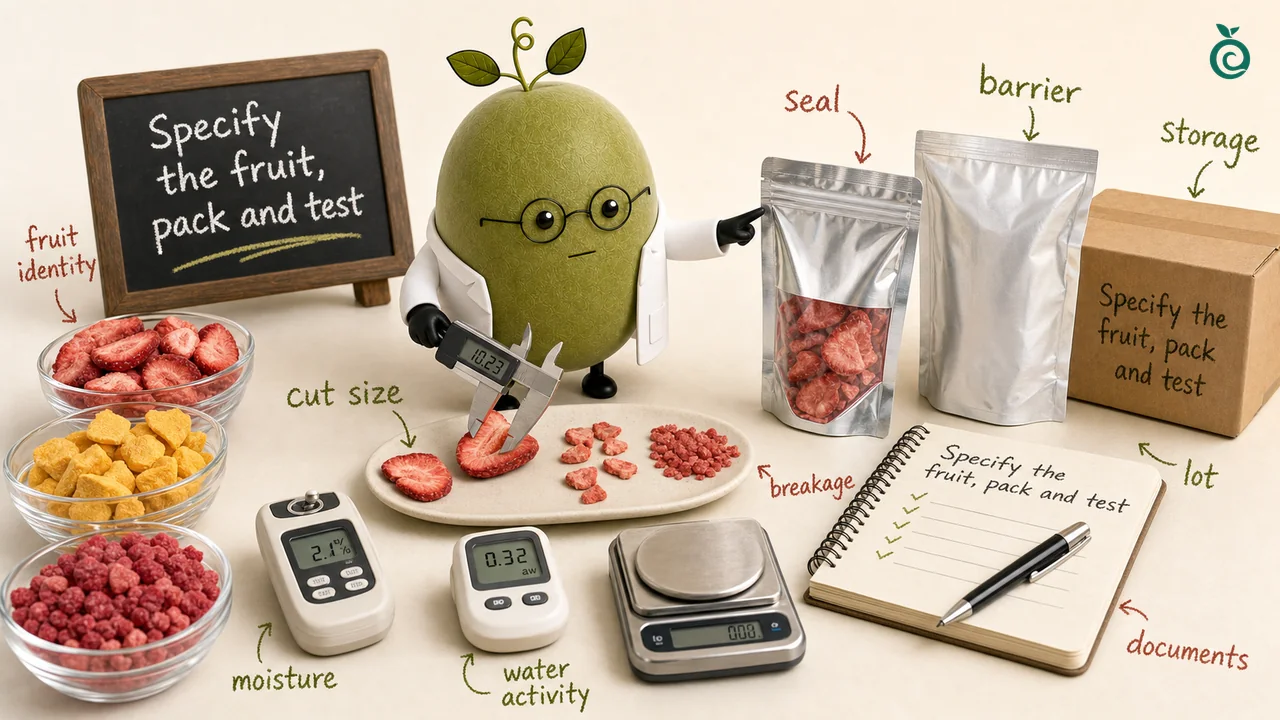
Define the fruit form before comparing suppliers
Name the fruit, variety when relevant, agricultural or origin requirement, cut or piece size, whole or broken format, powder or inclusion use, color expectation and any pretreatment. For mixed-fruit products, list each component. A whole slice, small dice, powder and granule can have different surface area, breakage risk and moisture response even when they share a fruit name.
Make the analytical and visual results comparable
Keep moisture content and water activity in separate fields. Ask for the method, reporting basis and sample identification with each result; one result does not substitute for the other. Define visual checks just as clearly so two suppliers are not measuring different things.
| Field | Record with the result | Buyer comparison check |
|---|---|---|
| Moisture content | Result, units, method, lot and test date | Compare the same reporting basis and method. |
| Water activity | Result, method and measurement temperature | Keep separate from moisture content; agree the required test conditions. |
| Piece size and fines | Size range, sampling amount and measurement method | Define what counts as a fine or broken piece before comparing percentages. |
| Color, odor and texture | Reference sample or agreed description; observation conditions | Record the sample condition and opening time, not only a pass/fail label. |
Set acceptance limits for the actual fruit, use and agreed specification. This checklist does not supply universal moisture, water-activity or breakage limits.
Ask what the sample can actually prove
A sample can help compare fruit identity, appearance, bite, piece size, moisture, water activity, breakage and pack condition. It cannot by itself prove long-term shelf life, every production lot, the final food label or performance after you add a coating, sweetener, filling or other ingredient. Ask whether the sample is from a normal lot, a pilot lot or a selected presentation lot, and request more than one lot when the decision is material.
Treat packaging as a finished-pack specification
Record the primary pack format, film or container structure, moisture and oxygen barrier information with test conditions where available, seal width or seal standard, fill weight, headspace, closure, desiccant or oxygen absorber, case packing and transit protection. Inspect the finished pouch or container, not only a film data sheet. Dust in the seal, pinholes, poor closure or rough transit can undo a good barrier material.
| Finished-pack check | What to request or record | What to inspect on the sample |
|---|---|---|
| Primary pack and fill | Structure, closure, net fill and relevant barrier data with units/test conditions | Check that the supplied pack matches the quoted format. |
| Seal and handling | Agreed seal checks and handling instructions | Look for trapped particles, damage and closure problems. |
| Case and distribution | Case packing, protection and expected transport route | Record broken pieces and pack damage after the relevant handling trial. |
| Opened or repacked product | Opening frequency, exposure conditions and repacking plan | Evaluate the intended use; an unopened-pack claim does not establish opened-pack performance. |
Match storage and handling to the buyer's route
State whether the pack will be opened repeatedly, sold as a snack, used as an ingredient, mixed into cereal, added to chocolate or included in a bakery or dairy product. Note temperature, humidity, light, distribution time and whether the product will be repacked. Freeze-dried fruit is especially sensitive to moisture uptake after opening, but the rate depends on the product, package and environment.
Make documents part of the quotation brief
Ask for the documents that match the market and finished use: product specification, COA, allergen statement, microbiological or foreign-material controls, origin information, food-safety files, organic or non-GMO support where applicable, and packaging or storage instructions. A certificate or supplier statement is evidence for review, not automatic approval of a finished food in every country.
Download the supplier comparison sheet
Use the free Excel below to put your requirements beside two suppliers or two lots. It covers fruit identity, sample traceability, analytical and visual checks, finished packaging, storage, documents and commercial terms. Yellow cells are editable; no email is required.
Leave unknown results blank and record the missing document or next action. Enter currency, price unit, quantity, freight and delivery basis before comparing quotes. The sheet contains no preset limits, automatic supplier score or invented supplier data.
Source and specification boundaries
The USDA Commercial Item Description A-A-20365, dated August 30, 2012, is an example of a purchaser defining fruit types, physical characteristics, analytical requirements and packaging. Use that structure to ask clearer questions. Its requirements belong to that procurement document; they are not universal limits for every fruit or commercial project.
Connect a sweet coating to the fruit specification
If the project includes a sugar or sweetener coating, specify it separately from the freeze-dried fruit. Record full composition, addition method, coating weight where known and the effect on particles, surface stickiness and moisture pickup. Test the coated product in its final pack and intended serving condition. A raw-fruit moisture result does not establish the coated product’s stability.
Review note
Reviewed October 16, 2026. The downloadable sheet is a blank buyer comparison aid. Product acceptance, shelf life and market requirements remain specific to the agreed material and intended use.
Common questions
What should I ask a freeze-dried fruit supplier for first?
Specify the fruit, form, intended use and packaging, then request the sample or lot ID, agreed test results with methods, and relevant documents. Use the same brief for each supplier before comparing price.
Discuss a dried-fruit sweetener sampleAre moisture content and water activity interchangeable?
No. Record them separately with their methods and reporting conditions. Do not infer a water-activity result from a moisture percentage, or treat either result alone as proof of shelf life.
Discuss a dried-fruit sweetener sampleCan one good sample approve future bulk deliveries?
One sample supports a decision about that sample under the conditions checked. Identify whether it came from normal production, a pilot lot or a selected presentation lot, and agree how future lots will be checked.
Discuss a dried-fruit sweetener sampleDoes high-barrier film guarantee a good finished pack?
No. Inspect the filled and sealed package as well as the material specification. Record seal condition, damage, closure, transit handling and the intended opening or repacking conditions.
Discuss a dried-fruit sweetener sampleDoes the Excel include acceptance limits or supplier scores?
No. It provides blank fields for your requirements and two supplier or lot responses. Add results with methods, units and document references; leave missing information blank. The download requires no email.
Discuss a dried-fruit sweetener sampleHow do I use this checklist for a sweetener coating project?
Keep the fruit specification and sweetener work separate. Send the full coating composition, addition process, intended market and test goal with the fruit details. Evaluate the coated product in its intended package; raw-fruit results do not establish the finished product’s stability.
Discuss a dried-fruit sweetener sample