
Read this guide in
Hengliyuan Applications and Selection
Whole Monk Fruit Powder for Drink Mixes: Selection Guide
Buying guide for whole monk fruit powder in drink mixes: flavor, particle size, direct-mix vs filtered use, and sample evaluation tips.
When selecting whole monk fruit powder, first clarify how the finished product will be used: will the powder be blended into the formula and consumed with the beverage, or will the residue be separated through a filter bag or another method after preparation? These two use cases have different requirements for particle size, mouthfeel, and filtration. Determine the use method first, then select the powder specification.
Hengliyuan whole monk fruit powder is made by directly grinding the whole fruit, so the fruit material included in the grinding process is retained. Its processing is different from that of juice powder and monk fruit extract. Selection should consider the fruit flavor, powder characteristics, and production process together.
First decide: does your product need a whole-fruit-ground ingredient?
If you want to use a whole-fruit-ground monk fruit ingredient in your formula, start by evaluating whole monk fruit powder and confirm whether its flavor and powder characteristics fit the product positioning. If you are more concerned about a clear appearance after preparation, fewer visible particles, or choosing a sweetening ingredient based on mogroside V content, you can compare juice powder and extract options at the same time. Different raw materials should be compared in the actual formula and must not be directly substituted at the same weight. Your raw-material form requirements should be part of the selection basis. First clarify whether you need whole-fruit powder, juice powder, or extract, then compare the corresponding specifications and prices so that the purchasing direction is clear.
Direct drinking and filtration need different checks
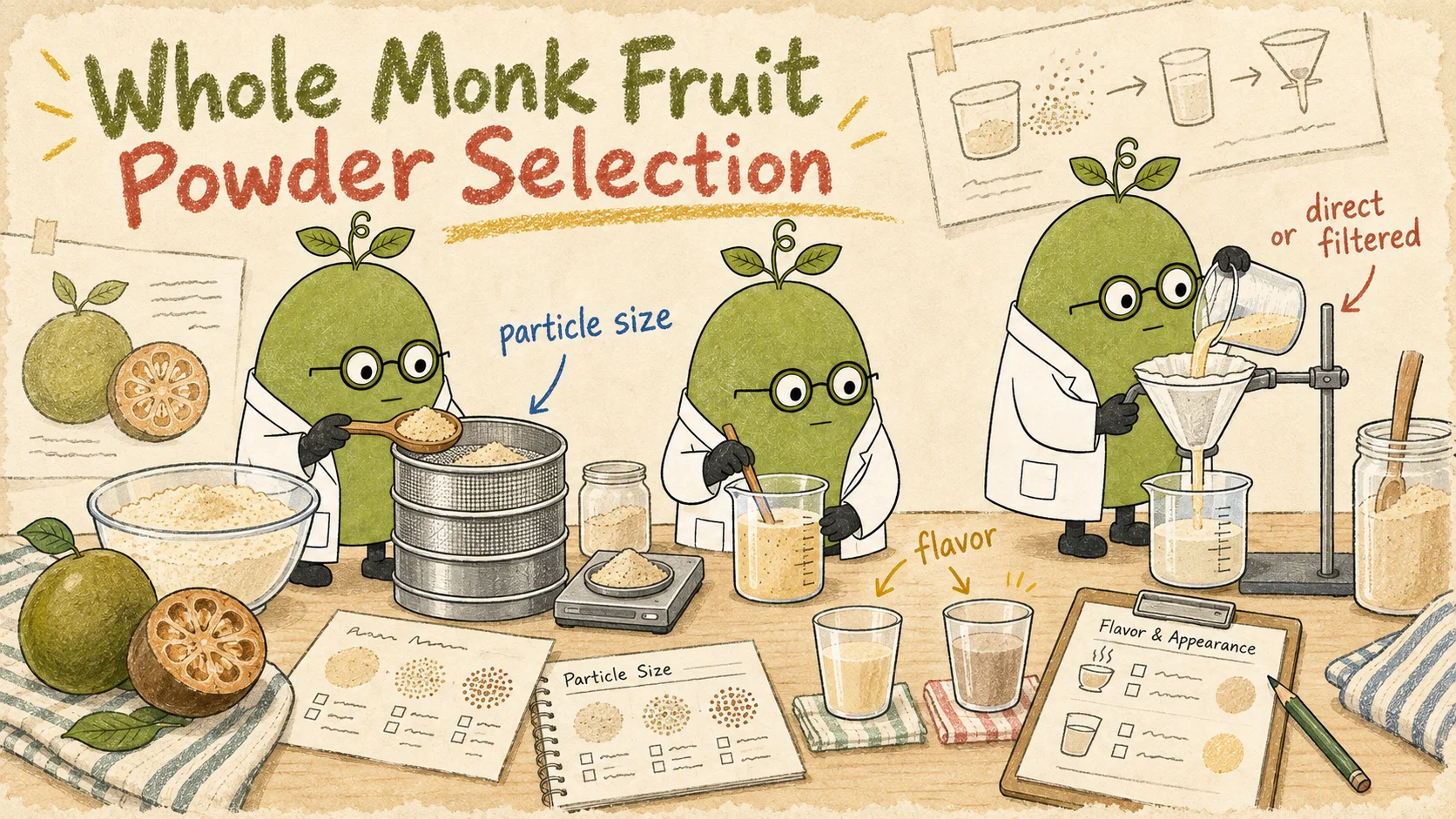
For products that are mixed and consumed directly, the material in the whole monk fruit powder will be consumed with the beverage. Sample evaluation should focus on monk fruit flavor, mouthfeel, and residue at the bottom of the cup during drinking, so you can judge whether the result is acceptable to consumers. If the product design includes filter bags, screens, or other filtration steps, select particle size together with the filter media and operating method. Check whether the powder passes through the filter media, whether filtration proceeds smoothly, and whether the filtered beverage has the required flavor.
| Planned usage | Key points in selection | How to evaluate samples |
|---|---|---|
| Blend into the formula and drink directly | Flavor, mouthfeel, sedimentation, and residue at the bottom of the cup | Use the complete formula, prepare it as intended, and evaluate it by tasting |
| Filter after preparation | The fit between particle size and filter media, filtration operation, and post-filtration flavor | Test with the planned filter bag or filtration equipment |
The distinction here is the method of use. If you plan to develop a tea-bag or pouch product, confirm it separately based on the actual product format. Do not directly apply the powder-mixing and filling requirements for powdered beverage mixes.
Choose particle size around mouthfeel and the process
When discussing specifications with Hengliyuan, explain your mouthfeel requirements, production process, and equipment conditions. For products consumed directly, focus on the mouthfeel created by the powder; for products with a filtration step, also check whether the particle size is compatible with the filter media. Factories with existing requirements for screening, mixing, or metering and filling can provide their current standards and test methods. During sample testing, confirm again that sieving, mixing, and filling proceed smoothly. Mesh size or particle size is a basis for discussing specifications, but a number cannot replace actual use results. The specific available specification should be based on the sample and supply information confirmed by Hengliyuan. Do not assume in advance that "finer is always more suitable."
Finer grinding does not mean complete water solubility
Grinding the whole fruit changes particle size, but does not completely separate mogroside V from the other fruit material. Even a fine powder cannot be treated as a fully water-soluble raw material on the basis of fineness alone. After preparing a sample, check whether the powder disperses, whether it feels grainy in the mouth, and whether sediment appears after standing. Uniform dispersion and complete dissolution are different conditions. If the finished product still cannot meet the requirements for a clear appearance or no perceptible particles after the particle size is adjusted, reassess the raw-material form. Continuing to request a finer powder may not resolve a mismatch between the formula and whole-fruit material.
Set fruit flavor and sweetness together when determining dosage
The dosage of whole monk fruit powder needs to balance sweetness and monk fruit flavor. For products intended to highlight monk fruit character, evaluate whether the flavor fits the positioning. For products based on tea, coffee, or other ingredients, judge whether the whole fruit powder changes the original flavor. When increasing the dosage, also observe mouthfeel and residue during drinking. If sweetness has not reached the target but fruit flavor or powder texture has already exceeded expectations, revisit the overall formula or raw-material plan. For products with a filtration step, taste the filtered beverage; the taste of an unfiltered sample cannot substitute for the final result. Set dosage according to the actual performance of the beverage delivered to consumers.
Keep preparation conditions with the sample result
Compare identified samples in the intended base, using the same preparation and observation conditions where practical. If you change the dose, particle specification or filtration method, record the change so the next sample round answers a specific question.
| Record | Details to keep with the comparison |
|---|---|
| Material and formula | Sample code, batch or version, stated particle specification and method, full base and measured dose with its mass basis. |
| Preparation and filtration | Water or base quantity and temperature, addition order, mixing method and duration, standing time, and actual filter medium or equipment if used. |
| What the consumer receives | Observe the direct-mix drink or the actual filtered drink as intended: flavor, sweetness, graininess, visible particles and sediment, with actual elapsed time and serving temperature. |
| Process result and next question | Record sieving, mixing or filling observations where relevant, retain labeled photos or original measurements, and identify the one change or issue to check next. |
Keep dispersion, sediment and dissolution as separate observations. A clear-looking filtered drink is a result of that sample and filtration process; it does not demonstrate that the starting whole-fruit powder dissolved completely. Set acceptance criteria for your product rather than treating the illustration or a mesh number as a universal pass mark.
Start with the use method and the sample question
Tell us whether the whole monk fruit powder will be blended directly into a beverage formula or used in a filtered product, and how much monk fruit flavor you want to retain. If you already have requirements for equipment, screens, or filter media, provide those as well. Hengliyuan will discuss available specifications and samples according to your application, so you can compare them in the actual formula and process. After sample confirmation, the composition, powder specification, packaging, and quantity for formal supply can be determined accordingly. If you have not decided between whole monk fruit powder, juice powder, and extract, begin with the finished product’s flavor, appearance, and use method. Select the raw-material form first, then determine the purchasing specification. You can start this discussion before every specification is settled. Share the final sales market and the main flavor or texture question; packaging, quantity and documents can be clarified as the sample direction becomes clear.
Common questions
Is whole monk fruit powder an instant-soluble extract?
It is directly ground whole fruit, with fruit components retained. A fine powder may disperse in a drink while leaving particles or sediment. Judge the actual sample in the intended base; fineness alone does not establish complete dissolution.
Discuss this requestShould I compare the direct-mix drink or the filtered drink?
Compare what the consumer will actually drink. Use the unfiltered preparation for a direct-mix product; for a filtered product, test the planned filter medium and operation, then assess the filtered beverage. Keep the two routes separate in your records.
Discuss this requestWhat should accompany a particle-size request?
Include the stated specification and test method when available, plus the intended mouthfeel, equipment and filter medium. Evaluate mixing, filling or filtration with the actual sample. The finest available powder is not automatically the best fit.
Discuss this requestCan I copy the dose used for monk fruit extract?
Do not transfer the dose or a sucrose-replacement ratio from a different ingredient form. Whole fruit powder contributes fruit material and flavor as well as sweetness. Select a measured dose in the complete formula and assess mouthfeel and residue alongside sweetness.
Discuss this requestWhat should we review before the next sample round?
Keep the sample code or version, actual dose and base, preparation conditions, filter details where relevant and observations at recorded times. State the result you want to change. If several conditions changed together, identify them before attributing the difference to particle size or material alone.
Discuss this requestCan I contact Hengliyuan before I know the specification?
Yes. Tell us the drink, final sales market, whether you mix directly or filter, and the flavor or texture problem. Available samples and specifications can be discussed first; packaging, quantity, documents and quotation terms are confirmed as the project develops.
Discuss this request