
Read this guide in
DRIED FRUIT FORMULATION GUIDE
Low-sugar dried fruit: why moisture migration matters
Test low-sugar dried fruit beyond sweetness: distinguish moisture from water activity, compare mixed components, and check texture in the intended sealed pack.
A low-sugar dried-fruit sample can taste sweet enough on day one and still fail after packing. The reason is simple: sweetness is one result, while water movement controls many of the texture and storage questions. A fruit piece can gain moisture from a neighboring piece, a filling, headspace or the outside environment even when the sweetness target has already been met.
Our first decision is to separate three questions: is the fruit itself ready for packing, will neighboring components exchange moisture, and will the pack limit exchange with the environment? A sweetener can address taste without solving any of those three. Keep the drying route and intended texture visible when choosing the next sample.
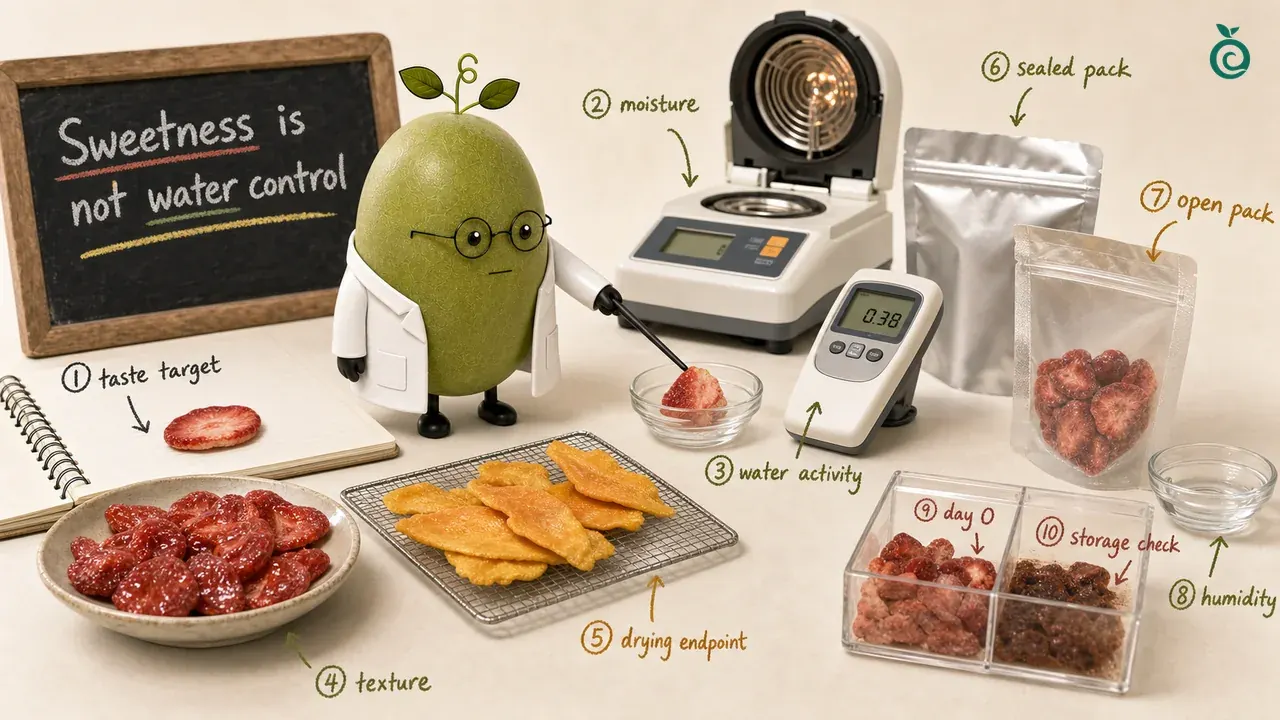
Start with the first principle: sweetness is not water control
Sweetness describes how the sample tastes. It does not tell you how much water remains, how strongly that water is held, or where it will move during storage. In a dried or candied fruit system, sugar and other solids can change tissue, viscosity and the state of water. Replacing part of the sugar can therefore change both sweetness and the physical balance of the product. Treat the sweetness target, moisture result, water activity and texture result as separate fields from the first bench sample.
Keep candied fruit and freeze-dried fruit in different test lanes
Candied or osmotically dehydrated fruit involves water loss, solids uptake and fruit tissue changes before or during drying. Freeze-dried fruit has a porous structure and a different texture and moisture-uptake problem. The 2025 candied-strawberry study compared trehalose/sucrose treatments within that specific route; it does not supply a monk fruit, stevia or allulose replacement ratio. Keep chewy dried fruit, candied fruit and crisp freeze-dried fruit in separately identified trial plans.
Use a small but complete sample record
Record the fruit lot, maturity information where available, cut or piece size, pretreatment, sweetener and bulk system, drying route and endpoint. Define when and where you sample: freshly dried, cooled, packed or stored. Use the same preparation and measurement method for the control and candidate. If coatings, fillings or mixed pieces are present, measure or assess each component separately before testing the assembled product.
| Question | Keep or record these conditions | What the result can tell you |
|---|---|---|
| Is the fruit itself consistent? | Lot, piece size, drying endpoint, cooling and sampling location. | Moisture, water activity and texture differences within the lot or between matched trials. |
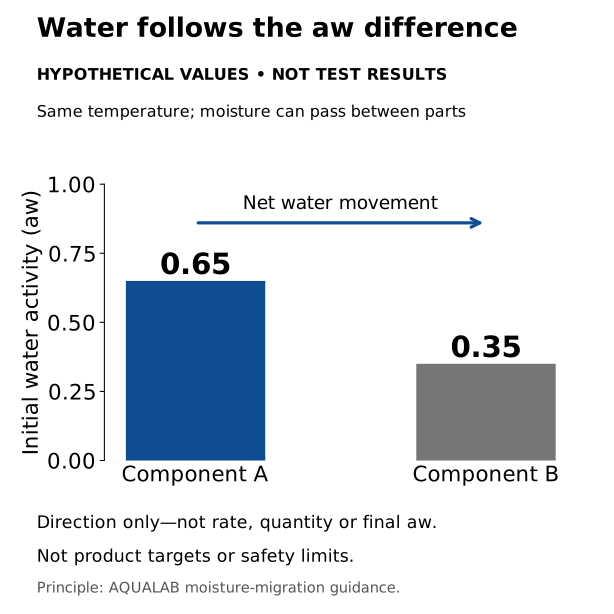
| Will components exchange moisture? | Each component’s water activity at the same temperature; contact or shared headspace. | The initial direction of the moisture-driving difference, not the amount or speed of transfer. |
| Does the package protect the product? | Finished pack, seal, barrier specification, storage temperature and humidity. | How the actual packed sample changes under the defined exposure. |
| Does the intended bite survive? | Defined texture assessment, sample age and handling; matched unopened packs. | Whether crispness, chewiness or stickiness changes at agreed checkpoints. |
Use water activity to understand the direction of movement
Moisture content measures how much water is present. Water activity is a vapor-pressure ratio measured at a defined temperature; the two are related through the particular product’s composition and sorption behavior, not a universal conversion. Where components can exchange moisture at the same temperature, the net driving direction is from higher to lower water activity. Measure mixed pieces, coatings or fillings separately: a bulk reading can hide the differences that change texture.
- AQUALAB: water activity and moisture migration
- FDA technical explanation of water activity and equilibrium humidity
Test the package as part of the sample
Test the finished pack, including seals and handling, rather than relying on a film specification alone. Record the barrier material, any stated water-vapor transmission test conditions, pack dimensions, fill and closure, plus storage temperature and humidity. An oxygen-control component is not automatically a moisture-control component. If using a desiccant, specify and validate it for the actual package. A better outside barrier does not eliminate moisture transfer between ingredients already inside the same pack.
Build a time-based decision, not a day-one tasting
Agree the intended bite and acceptable change before testing. Keep the current or sucrose control and prepare enough matched packs to use separate unopened units at each checkpoint where possible; repeatedly opening one pack changes its exposure. Record moisture, water activity, texture, color, aroma and visible condensation when relevant. Log test temperature and elapsed time. A short screen identifies the next trial; it does not establish shelf life or food safety on its own.
Turn the result into the next supplier brief
Describe the defect and the point at which it appears: sticky after drying, soft only after mixing, or changed after sealed storage. Send the fruit and cut, drying route, formula differences, component results and package conditions where available. Add target market, quantity and document needs. We can discuss a sweetener direction without treating a taste adjustment as a completed drying or packaging solution.
Sources and what they support
The FDA technical guide explains water activity and its measurement relationship to equilibrium humidity; it is used here for the physical definition, not as a product-specific safety cutoff. AQUALAB’s measurement guidance explains the direction of moisture migration. The 2025 Food Science study examines trehalose/sucrose substitution during candied-strawberry osmotic dehydration. Its formulation and processing conditions are not transferred to other fruits or sweeteners.
Common questions
Is water activity the same as moisture content?
No. Moisture content is the amount of water; water activity is a measure based on vapor pressure at a defined temperature. Do not convert between them without a validated relationship for that product.
Discuss this requestWhich way will moisture move between mixed fruit pieces?
Where exchange is possible at the same temperature, the net driving direction is from the component with higher water activity toward the one with lower water activity. That difference alone does not tell you the transfer rate or final moisture content.
Discuss this requestCan a high-barrier pouch stop migration inside a fruit mix?
It can limit exchange with the outside environment, but it does not automatically stop exchange among components already inside. Test the assembled product as well as the individual ingredients.
Discuss this requestCan one sample be reopened at every storage checkpoint?
Repeated opening changes exposure. Use matched unopened units for each checkpoint where possible, and document any different sampling approach so the results are interpreted correctly.
Discuss this requestCan a candied-fruit replacement ratio be used for freeze-dried fruit?
Do not transfer it directly. Solids uptake, tissue, drying route, porosity and intended texture differ. Start a separately identified trial for the actual product.
Discuss this requestWhat should I send for a useful sample discussion?
Start with the fruit, cut, drying route and the defect to solve. Add component water activity or moisture results with methods, packaging and storage conditions where known, then market, quantity and document requirements.
Discuss this request