
Read this guide in
MEAT SNACK SUGAR REDUCTION
Low-sugar jerky: why sweetness is not a water, color or chew test
Choose a low-sugar jerky sweetener trial: compare fixed drying schedules and matched endpoints, then measure moisture, water activity, color and chew separately.
A low-sugar jerky sample can taste sweet enough and still be too dry, too hard, too pale, too dark or unstable in its package. The reason is that sweetness is only one output of a meat-snack process. Moisture, water activity, drying, color, texture, oxidation and packaging need their own checks.
Our starting point is the finished meat snack, not the sweetness of the marinade. Decide whether the trial is asking how a new blend behaves in the existing process or how the product compares at an agreed endpoint. Those are different experiments. Keep that distinction visible before choosing the next ingredient sample.
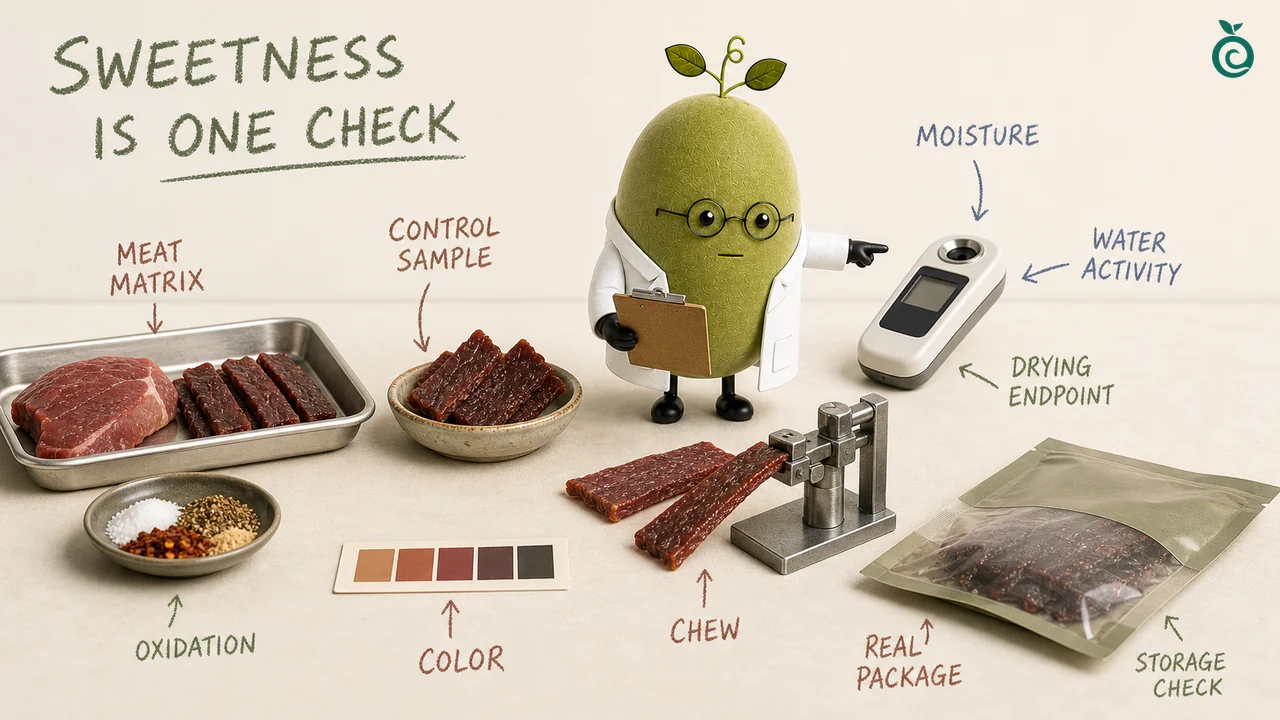
Decide which jobs the sugar replacement must do
Write down every role the current sugar, syrup or sweetener system plays: sweetness, marinade solids, surface color, flavor balance, water binding, tack, chew and the way salt or spices read after drying. Monk fruit and stevia can support sweetness, but they do not automatically replace those physical or process roles. Allulose or a polyol direction may add different functions, but the target market and finished product still decide whether the route fits.
Choose the comparison before changing the formula
Record the meat species and cut, whole-muscle or restructured format, slice thickness, starting mass, marinade uptake, salt, spice and other ingredient changes. Keep the control in every run. Do not promise that time, water activity and yield will all remain identical after a formula change; measure what actually happens.
| Trial question | Keep defined | Measure the consequence |
|---|---|---|
| Does the blend work in our current process? | Use the same documented drying schedule, load and preparation. | Measure final water activity, moisture, yield, color and chew; do not assume equal endpoints. |
| How do samples compare at our chosen endpoint? | Use a justified endpoint and the same measurement method; document any process adjustment. | Record the time and yield needed to reach it. This compares complete formula/process combinations. |
| Did the sweetener or another change cause the difference? | Separate the sweetness change from a humectant, salt or solids change where practical. | If changes are bundled, report the combined treatment rather than assigning the outcome to one ingredient. |
Separate moisture, aw and food-safety validation
Measure moisture content and water activity separately. Moisture is the quantity of water; aw is the equilibrium vapor-pressure ratio relative to pure water at the same temperature. Record the sample preparation, measurement temperature and method. In Vidal et al. (2025), beef jerky made with the tested sugar levels showed no significant aw difference within the same drying time, while drying time affected aw. That result is limited to the study conditions; it is not evidence that sugar never affects water activity.
Read moisture, color and chew as different outcomes
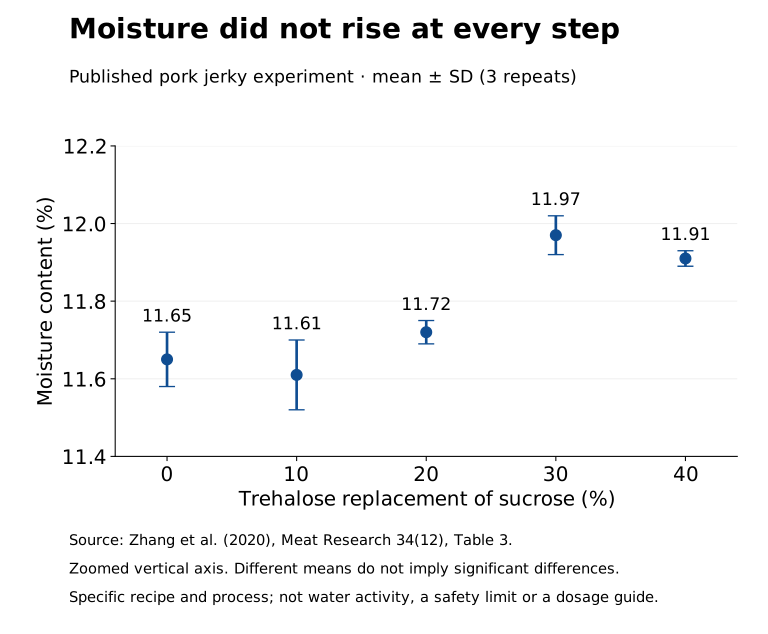
The published pork-jerky data below show mean moisture contents of 11.65%, 11.61%, 11.72%, 11.97% and 11.91% at increasing trehalose substitution levels. Moisture did not increase at every step, and the error bars show reported standard deviations rather than safety margins. These are results for one recipe and process, not predictions for monk fruit or stevia, and they do not measure water activity.
For color, compare the same surface and lighting or the same L*, a*, b* method. For chew, keep sample dimensions, fiber orientation, cooling time and test conditions consistent. A softer sample is not automatically the preferred sample; record the intended bite and any surface tack.
Taste after drying and during storage
Taste only finished samples cleared under the project's food-safety procedures. Evaluate sweetness, salt and spice balance, meat flavor, bitterness and lingering sweetness after drying and cooling; a sweet marinade does not establish the finished result. Use coded samples and vary their order. Repeat texture, sensory and relevant stability checks in the intended package at defined storage conditions and checkpoints.
Separate ingredient selection from safety and label approval
A dry appearance, acceptable chew or a single aw result cannot establish that a lethality treatment worked. The FSIS commercial jerky guidance separates pathogen reduction from drying and shelf-stability controls. Use process-specific validation, including handling and packaging, rather than borrowing a paper's drying time. Ingredient permissions and low-sugar or no-added-sugar claims also need review for the target market and finished product. Trehalose is a sugar; the cited experiment is not a sugar-free labeling argument.
Research scope and the next sample discussion
The beef study compares drying time and sugar level; the pork study examines trehalose substitution in a different formulation. Neither tests a Hengliyuan monk fruit or stevia blend. Send your meat format, current sugar system and the main defect to resolve, together with the process, packaging, target market, estimated quantity and document needs available. We can then discuss ingredient specifications and a focused sample comparison.
Common questions
Can monk fruit replace every function of sugar in jerky?
No. It can supply sweetness, but the current sugar system may also affect solids, water relations, browning and eating quality. Evaluate the finished product and any linked formulation changes.
Discuss this requestShould every sample have the same drying time?
Use the same documented schedule when testing behavior in the existing process. If comparing at a chosen endpoint, record the time and yield required to reach it; those results answer a different question.
Discuss this requestIs moisture content interchangeable with water activity?
No. Measure each with a defined method and temperature where relevant. Equal moisture contents do not establish equal water activity.
Discuss this requestDoes the trehalose chart show the best replacement percentage?
No. It shows published moisture measurements for one pork-jerky recipe. It does not identify a universal optimum, validate a safety limit or predict a monk fruit or stevia blend.
Discuss this requestDoes acceptable water activity prove the heating step was effective?
No. Pathogen reduction and control during subsequent storage are separate questions. Use validated processing and appropriate handling and packaging controls.
Discuss this requestWhat should I send for a meat-snack sweetener discussion?
Start with the meat format, current sugar system and the problem to solve. Add the process, intended package, target market, estimated quantity and required documents where available.
Discuss this request