
Read this guide in
SAVORY PUFFED RICE FORMULATION GUIDE
Low-Sugar Puffed Rice Snacks: Separate Sweetness, Oil and Oxidation
Trace ingredient oil, separate sweetness from rancid odor, and compare oil condition, seasoning, package exposure and storage in savory puffed rice snack trials.
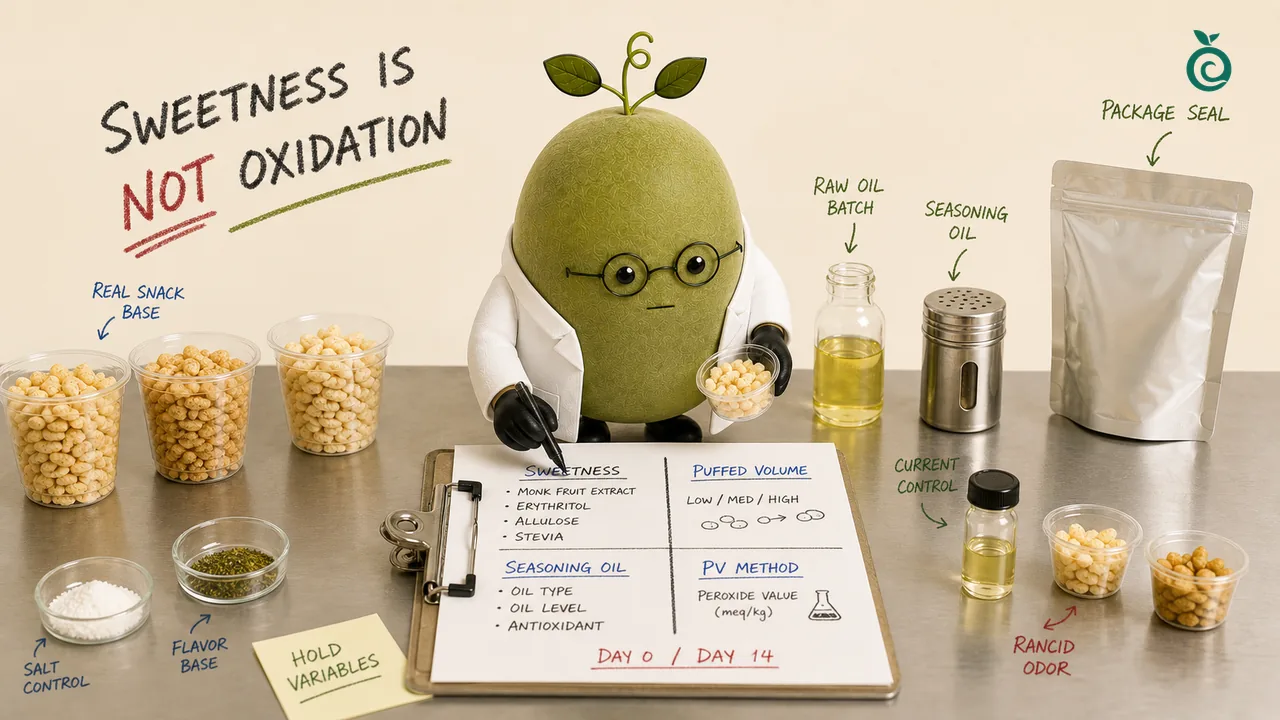
A low-sugar savory puffed rice snack can taste right and still develop a stale or rancid odor. That does not mean the sweetener caused the problem. In a real sample, keep sweetness and seasoning separate from puffed structure, oil contact, package exposure and storage.
Start with the oil history and a retained control, then change one defined part of the product at a time. A sweetness comparison needs the same oil and seasoning conditions; an oil or package comparison needs the same formula. This keeps a useful sweetener trial from becoming an unexplained comparison of several changes.
Start with the product lane
Write down whether the product is baked, fried, air-puffed, extruded, coated or seasoned after puffing. Add the rice or starch base, piece size, coating, salt and flavor direction. A thin rice cracker, a hollow puff and a dense extruded piece can expose oil and moisture differently, so they should not share one unexplained pass target.
Keep sweetness and structure separate
Monk fruit or stevia can restore sweetness at low use levels but contribute little replacement mass. Check whether sugar was part of the rice base or added with the seasoning after puffing. The 2014 fried-Yukwa study shows why sugar-alcohol changes can also affect expansion, oil uptake and texture. For the structure measurements and a separate formulation screen, use the existing rice-cracker guide rather than judging oil stability from crispness.
Treat oil and seasoning as their own variables
Track the oil from receipt to actual use. A supplier result describes a particular sample at a particular time; it does not describe every later stage after a drum or tank has been opened. Record process oil separately from surface spray and oil carried in a seasoning. Keep antioxidant identity and declared use with the oil specification when available, rather than assuming that an antioxidant compensates for the starting oil condition.
| Point in the oil history | Record with the sample code | Why it matters |
|---|---|---|
| Receipt | Oil identity, supplier lot, receipt date, specification and available test result/date | Links the ingredient to the actual supply lot. |
| After opening and storage | Opening date, container/tank, storage conditions and handling history | Distinguishes the supplier result from the condition at use. |
| During production | Oil lot used in frying/process, spray or coating; actual application amount | Separates oil sources and contact routes. |
| Finished snack | Production batch, seasoning lot, package, seal, storage and test time | Lets later odor or lab results be traced to the same product. |
Use odor and oxidation results together
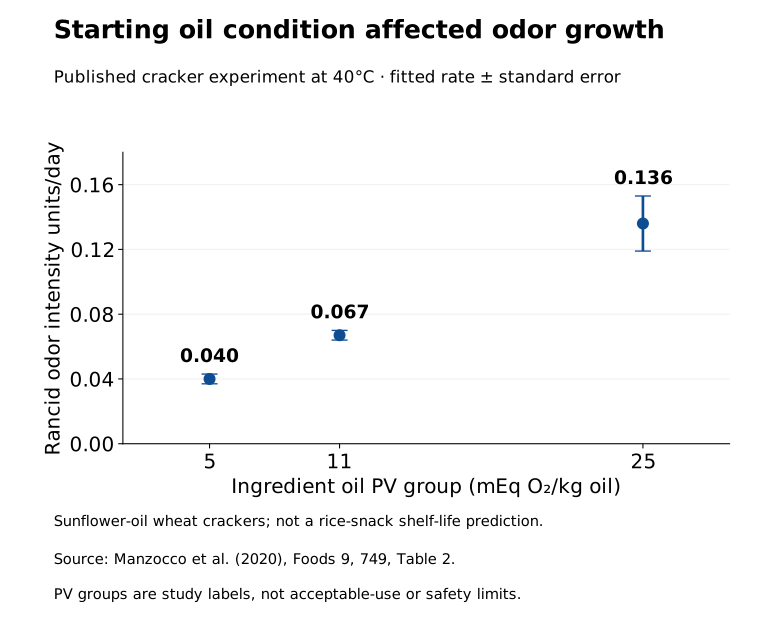
The 2020 study used sunflower oil in baked wheat crackers, not puffed rice. Freshly made samples did not clearly reveal all the starting-oil differences, while rancid odor developed differently during storage. Its peroxide-value results also illustrate why one primary oxidation indicator may not discriminate every batch. Use paired sensory and suitable laboratory observations with a retained reference; keep the test method, sample preparation, units and reporting basis on the report.
- 2020 original study: ingredient oil and cracker oxidation, Table 2
- Read the published PDF and Table 2
Keep package and storage in the same brief
Record pouch construction, seal condition, fill, headspace or oxygen-control settings, light exposure, storage temperature and opening status. Oxygen barrier and moisture barrier address different parts of the problem; a crisp product can still develop rancid odor. Ask for barrier data with its measurement conditions and verify the actual filled pack. Select the applicable product and test-method requirements for the sales market; a material data sheet does not establish the finished snack’s storage performance.
Build a small sample matrix
Run the sweetness comparison first with the same approved oil lot, application amount, seasoning and package. If odor needs investigation, keep the formula fixed and make a separate oil or package comparison. Agree the checkpoints and acceptance criteria before reviewing results; day 0, 7, 14 and 28 are possible screening points, not a universal shelf-life schedule.
| Comparison | Hold steady | Read separately |
|---|---|---|
| Sweetener direction versus current control | Oil/seasoning lots, application route, process and package | Sweetness and aftertaste; structure; odor and storage results. |
| Approved reference oil versus the oil under review | Formula, oil application amount, process, seasoning and package | Point-of-use oil condition and subsequent snack odor/lab results. |
| One package or oxygen-control change | Product batch and oil lot, fill, storage conditions and test method | Package performance, odor trend and moisture/crispness; keep unopened and opened tests distinct. |
Use research models to choose tests
Oil condition, processing, structure and packaging can interact. The linked Yukwa and cracker studies help decide which variables to record; their recipes, temperatures, sensory scales and model estimates are specific to those experiments. Define and validate the finished product’s own requirements rather than importing a paper’s shelf-life number or sensory cutoff.
Common questions
Can monk fruit or stevia replace sugar in a savory puffed rice snack?
They can help restore sweetness. Identify any removed solids, coating or binding function and test the physical replacement in the real rice base. Keep oil and seasoning unchanged during the initial sweetener comparison.
Discuss this requestDoes a crisp first bite prove that the oil is stable?
No. Crispness and rancid odor are different outputs. Keep the oil lot, application route, package and storage history with the sensory and laboratory results.
Discuss this requestCan peroxide value alone approve a puffed rice snack?
No. Interpret the selected method alongside odor, product history and other suitable laboratory observations. A single number does not explain every stage of oxidation or establish the finished snack’s shelf life.
Discuss this requestCan I compare every PV result directly?
Check the method, unit and reporting basis first. A result for ingredient oil and one expressed per amount of whole snack are not automatically comparable; an extracted-fat result also needs its sample-preparation basis. Ask the laboratory to clarify mismatched reports.
Discuss this requestCan the 40°C chart predict our rice-snack shelf life?
No. It shows fitted odor-development rates in a published wheat-cracker model with sunflower oil. Your product, oil application, seasoning, package and storage require separate validation.
Discuss this requestWhat should buyers send before requesting a sample?
Send the market, rice base, puffing process, sugar-reduction goal and main defect. Add the oil identity/lot, opening and use history, seasoning route, package and available control results. Quantities and required documents can be added when known.
Discuss this request