
Read this guide in
KOMBUCHA PROCESS VALIDATION
Low-Sugar Kombucha Sweetener Guide: Fermentation and Post-Sweetening Validation
Choose where to change kombucha sweetness: fermentation substrate or the finished drink. Separate Brix from residual sugar and check the packaged product over time.
Kombucha sugar reduction has three separate questions: what supports the fermentation stage, how the finished tea reaches its acidity endpoint, and when sweetness is adjusted for the final drink. A post-fermentation sweetener can change the taste of a finished sample, but it cannot by itself prove that the fermentation process, acidity target or label plan has been validated.
Our first question is where the change belongs. If the fermented tea base is already suitable and only the finish needs work, compare post-fermentation sweetening in that same base. If you change the fermentation substrate, treat it as a process trial. A familiar sweetener name is not enough: check the full ingredient composition, including carriers and other sugars.
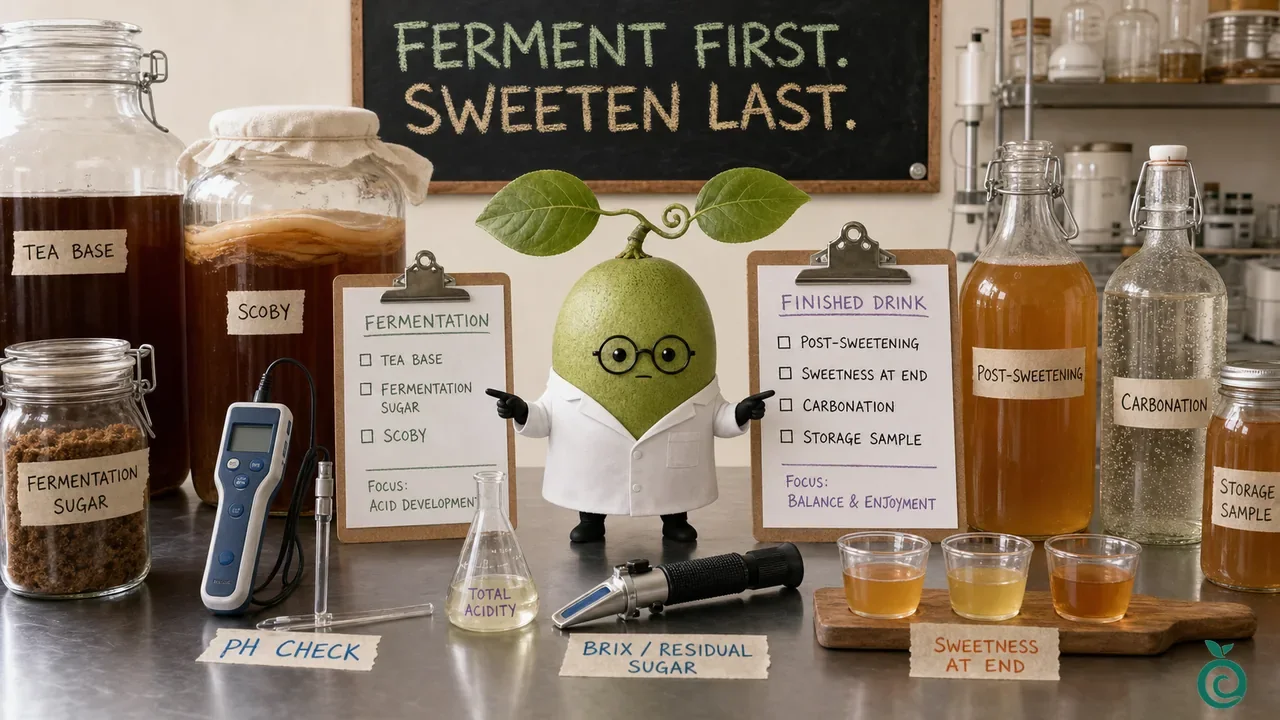
Choose the stage before choosing the ingredient
Keep the current control and identify the question each trial answers. Do not change tea, culture, substrate and sweetening timing together and then attribute the whole result to monk fruit or stevia.
| Decision | Useful comparison | Keep separate |
|---|---|---|
| Change fermentation substrate | Current process versus a defined substrate change; track actual fermentation conditions and measurements. | A sweetness-equivalent dose is not evidence of equivalent fermentation. |
| Adjust finished sweetness | Split one defined fermented base into control and candidate samples; record dilution, dose and serving conditions. | A better finish does not prove residual sugar, alcohol or process stability. |
| Approve the packaged direction | Repeat relevant tests in the intended package over justified storage conditions and checkpoints. | A day-zero tasting is not proof that the bottled product stays unchanged. |
Start with the tea and process brief
Name the tea base and strength, culture, vessel, substrate and actual time/temperature record. Identify whether the finished beverage is live, heat-treated or otherwise stabilized, and what process evidence supports that description. For each candidate ingredient, record the grade, composition, carrier and addition point. A tabletop blend and a concentrated extract may have very different compositions even when both are sold using the same sweetener name.
Compare the finished cup without changing the base
For a post-fermentation screen, split a defined base and record each addition, including carrier and dilution. Use coded samples and vary their order. Compare at the same serving temperature and carbonation condition. Record sweetness onset, sourness, tea astringency, aroma and the finish separately. Only taste samples suitable under the project's food-safety procedures; a tasting is not a process-safety check.
Measure residual sugar separately from apparent Brix
Record pH and titratable acidity as different measurements, with methods, temperature and TA units/acid equivalent. Treat a refractometer reading as apparent Brix in this mixed fermented beverage. It is not a direct residual-sugar assay or an alcohol measurement. Use appropriate analytical methods when sugar or alcohol results drive a specification or label decision. Keep the actual results beside the sensory notes instead of estimating them from how sweet the drink tastes.
Check what happens after bottling
Adding a sweetener does not establish that fermentation has stopped. Residual fermentable material, culture activity and storage conditions still matter. Review alcohol, carbonation or package-pressure behavior, acidity and sensory changes in the intended package as relevant to the process. For U.S. sales, TTB specifically notes that fermentation and alcohol increases can occur after bottling; a bottling-day result alone is not the whole compliance assessment. Review the applicable market requirements with the responsible team.
What the process study can tell us
Cohen, Sela and Nolden (2023) compared sucrose concentrations and fermentation temperatures in a black-tea model, tracking pH, Brix, titratable acidity and sensory response. Temperature affected acidity and astringency in those conditions. We use that finding to keep process history visible in sweetener comparisons, not to prescribe one fermentation temperature or dose. The study did not establish the performance of a Hengliyuan monk fruit or stevia blend.
Turn the unresolved question into the next sample
If the fermented base is too sharp, review its process and acid balance before changing several finished-drink ingredients. If the base is suitable but the finish lingers, compare the post-fermentation sweetness direction. Send the tea base, process stage, ingredient composition and main issue, with packaging, target market, estimated quantity and document needs where known. The discussion can then focus on a useful next comparison.
Common questions
Can monk fruit or stevia replace fermentation sugar gram for gram?
Do not assume that a sweetness substitution supplies the same fermentation substrate. Check the full ingredient composition and test the process change separately from finished-drink sweetening.
Discuss this requestWhen should I start with a post-fermentation comparison?
When the defined fermented base is suitable and the question is finished sweetness or aftertaste. Split the same base and keep dilution, temperature and carbonation conditions comparable.
Discuss this requestCan I calculate residual sugar from a Brix reading alone?
Not reliably for a mixed fermented beverage. Keep apparent Brix separate from sugar analysis, pH, titratable acidity and alcohol measurements.
Discuss this requestDoes adding a high-intensity sweetener stop fermentation?
No such conclusion follows from the addition. Review residual fermentable material, culture activity, stabilization and storage evidence for the complete product.
Discuss this requestWhy test the bottled product if it tasted right on filling day?
Fermentation and product changes can continue depending on the process and storage. Check the intended package over justified conditions and checkpoints, including the measurements needed for the target market.
Discuss this requestDo I need another spreadsheet for this guide?
No. The direct download reuses our existing kombucha record. Keep a separate matched record for each checkpoint and retain the methods and sample identities.
Discuss this request