
Read this guide in
COFFEE CREAMER FORMULATION GUIDE
Low-sugar coffee creamer: separate sweetness, emulsion and heat stability
Compare low-sugar coffee creamers in the actual coffee: distinguish feathering, creaming, oil and sediment, control the hot-cup test, and reuse a free trial record.
A coffee creamer can taste sweet enough and still fail when it meets hot, acidic coffee. Check the real coffee base, heat history and addition order separately from sweetness, because feathering, a floating oil layer, creaming, sediment or a changed white appearance are physical observations rather than sweetness results.
Our rule is to approve the sweetness direction and the physical behavior separately. First describe what failed and when it appeared; then change the variable most likely to answer that question. This guide explains the comparison, with the existing blank trial record linked below for use without registration.
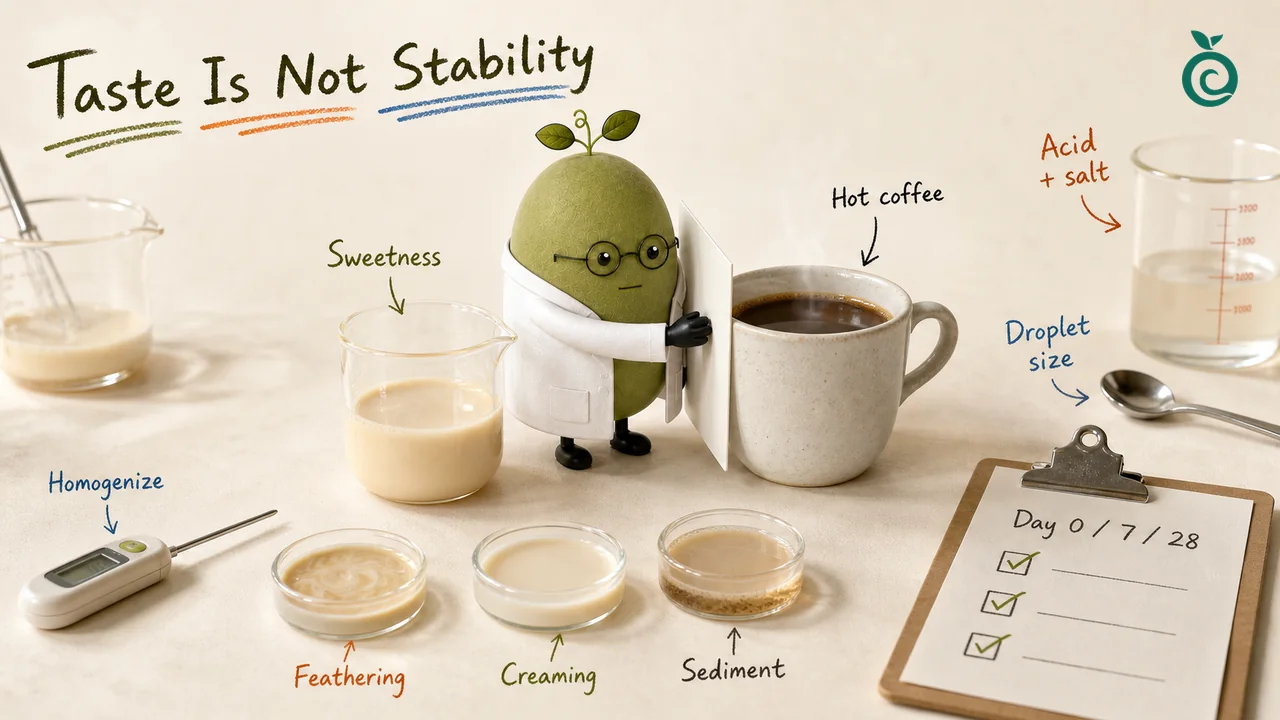
Sweetness and physical stability need separate decisions
Monk fruit or stevia can support sweetness at low use levels, but sweetness is only one part of a coffee-creamer system. The original sugar or syrup may also contribute soluble solids, body or processing behavior. The oil phase, protein or other emulsifier system, carrier, stabilizer and process determine how the creamer disperses and behaves in coffee. Keep the sweetener question separate from the physical-stability question.
Define the real base before choosing a sample
Name the liquid creamer or powder whitener, protein and fat system, carrier, stabilizer and process. For the coffee challenge, record the coffee identity, brew or preparation method, concentration, measured temperature at addition and water source. Include pH and water mineral information if available. Keep dose, addition order, stirring method, cup and observation time consistent between control and trial. Record missing measurements as unknown rather than treating different coffees as equivalent.
Use particle measurements with their method
A particle-size number without the method is not a transferable target. State the instrument or method, reported size metric, sample preparation and whether the sample was measured before or after processing or coffee addition. Record homogenization conditions as process variables. The 2020 model liquid-creamer study tested a specific fat, emulsifier and protein system under its own pH and heat conditions; it supports recording those variables, not borrowing its settings for every creamer.
Test the hot coffee event, not only the ingredient cup
Compare the control and trial in the same coffee at the measured addition temperature. Record immediate dispersion and whitening, then observations after an agreed standing or cooling interval. Take photographs in the same cup and lighting if appearance is part of the decision. Describe feathering, a cream-rich layer, free oil and sediment separately; calling all four “separation” makes the next trial less useful.
| Observation | Describe what you see | Useful next comparison |
|---|---|---|
| Feathering or visible flocs | Fine flakes, specks or curd-like material appearing after addition. | Compare the same creamer across controlled coffee temperature and base conditions; note when the particles appear. |
| Creaming | An upper cream-rich layer developing while the lower region becomes less opaque. | Record elapsed time and whether a defined gentle mixing step redistributes the layer. |
| Free oil | Visible oil droplets, a slick or an oily ring distinct from an opaque cream layer. | Compare fat/emulsion and process records with the control; photograph before disturbing the surface. |
| Sediment | Material collecting at the bottom after standing. | Record amount or an agreed visual scale, timing and re-dispersion under a defined mixing step. |
| Powder wetting or clumping | Dry islands, floating powder or lumps during preparation. | Compare preparation order and mixing conditions before concluding that the reconstituted emulsion is unstable. |
These are observation categories, not diagnoses from a photograph. A sample can show more than one defect. Re-dispersion is useful information, but it does not by itself establish storage stability or product safety.
Separate liquid and powder validation tracks
For liquid creamer, compare the packaged product before use and the result after addition to coffee. For powder whitener, first check storage-related moisture pickup, flow, wetting and clumping, then assess the reconstituted drink. State whether the powder goes directly into coffee or is reconstituted first. A powder that wets poorly and a prepared drink that develops flocs are different trial questions.
Use the existing record to choose the next trial
Keep the current control and change one main condition where practical. Record the hot-cup event separately from storage of the packaged creamer: surviving one cup of coffee does not validate a thermal manufacturing process or shelf life. Choose storage conditions and checkpoints for the actual product and package. The existing Excel has blank control and trial fields, with no automatic pass score. Download it directly; sharing it with us is optional.
Research context and limits
Brown and colleagues (2019) studied a defined unsweetened soymilk in instant coffee across composition, temperature and pH conditions. Wanthong and Klinkesorn (2020) studied a model liquid creamer made with rambutan kernel olein, sodium caseinate and an emulsifier, including heat and pH challenges. Neither study establishes a universal creamer formula, a Hengliyuan product result or a guarantee across coffee types. The useful lesson is to document the system and challenge conditions alongside the result.
Bring the failure pattern to the sample discussion
Start with the creamer form, actual coffee and the visible or taste problem. Tell us when it appears, the addition temperature, dose and process where known. Add target market, packaging, estimated quantity and document requirements. We can discuss the sweetener direction while keeping unresolved emulsion or process questions visible.
Record these fields before comparing coffee-creamer samples
- Creamer form and coffee base
- Dairy or plant protein and fat system
- pH, acidity and salt context
- Particle size or homogenization method
- Heat history and mixing order
- Feathering, creaming, oil layer or sediment
- Sweetness and aftertaste
- Cooling and storage checkpoints
Common questions
Why can a sweet creamer still fail in coffee?
Sweetness does not describe its behavior under the actual coffee temperature, acidity, composition and addition conditions. Record the taste and physical result as separate decisions.
Discuss this requestAre feathering, creaming and free oil the same defect?
No. Feathering describes visible flakes or flocs; creaming describes an upper cream-rich layer; free oil appears as droplets, a slick or an oily ring. Describe each observation and its timing before deciding what to change.
Discuss this requestCan I use a published particle-size or homogenization target directly?
Not without checking the formulation and measurement context. Record the method, metric, preparation and processing stage, and compare within your actual system. A reported value in a model creamer is not a specification for every product.
Discuss this requestShould liquid creamer and powder whitener use one test?
No. Powder needs wetting, clumping and reconstitution checks as well as evaluation of the prepared drink. Liquid needs its own packaged-emulsion and coffee-addition checks. Both need product-specific storage assessment.
Discuss this requestDoes passing hot coffee prove heat-processing or shelf-life stability?
No. The hot-cup event, manufacturing heat treatment and packaged storage are different exposures. Passing one does not approve the others.
Discuss this requestCan I download the trial record before contacting you?
Yes. The linked Excel is free to download without email or registration. Use the control and trial fields for a matched checkpoint, leave unknowns unassessed and share the completed record only if useful to the discussion.
Discuss this request