
Read this guide in
SOY BEVERAGE FORMULATION GUIDE
Soy Milk Sweetener Guide: Low-Sugar Formulation & Protein Stability
Compare soy milk sweeteners in the real base. Separate undisturbed appearance, re-mixing, taste, processing and the actual chilled or ambient storage route.
For a low-sugar soy milk formulation, compare the sweetener in the actual soy base and separate taste from physical stability. Keep the same base and process for the initial sweetener comparison, then investigate a physical or process adjustment as a separate trial.
Inspect the undisturbed sample before re-mixing it. Use consistently re-mixed samples for the taste comparison, and keep chilled, ambient-unopened and after-opening conditions in separate records. A pleasant first pour is one observation; the buyer still needs results over the intended product and storage route.
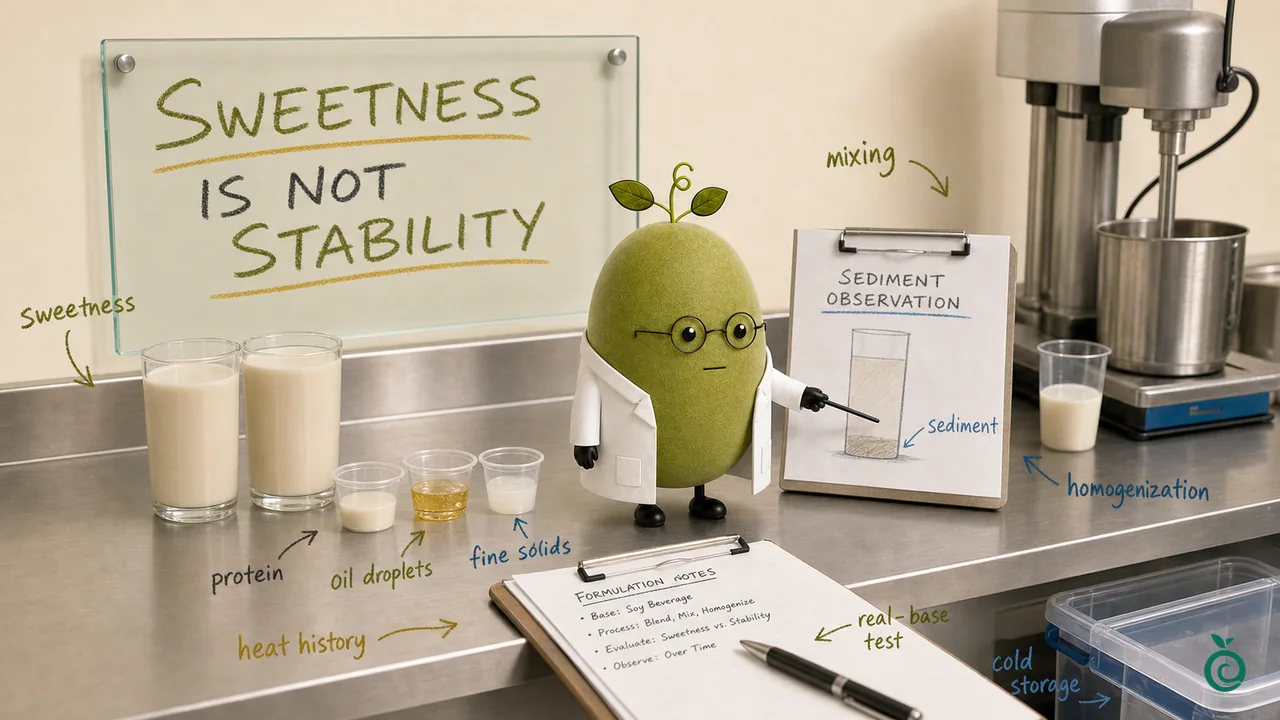
Start with the real soy beverage
Name the exact product: a chilled soy drink, an ambient-stable unopened format, a flavored milk alternative or another lane. Record the soy base/grade, protein and total solids, fat system, mineral additions, pH, stabilisers, current sugar system and sales market. Use the same base lot and water source in the first comparison; a mineral premix or dilution change should not be hidden inside the sweetener change.
Why sweetness and stability can move apart
A soy beverage contains protein, oil droplets and fine solids that respond to the formula and processing. Particle interactions, pH, salts, viscosity, homogenisation and heat history can matter alongside storage time. The 2021 physical-stability review supports selecting more than one characterisation method; a sweetener’s taste score cannot replace those measurements.
Treat sediment as an observation, not a diagnosis
Describe what you see: bottom sediment, an upper creamy layer, clear separation, visible particles or a change in flow. The 2024 commercial plant-drink study distinguished visible sediment from protein-related sediment measurements in its tested products. To identify a protein change, use an appropriate analytical method and sampling procedure; neither the glass bottom nor easy re-mixing identifies the cause or establishes food safety.
Inspect before re-mixing, then compare the same way
Use retained control and candidate samples with the same container, fill, age and storage conditions. Record the undisturbed state first so shaking does not erase the separation observation. Then apply the same defined re-mixing procedure and distinguish physical appearance from the taste result.
| Check | Keep the comparison consistent | What the result answers |
|---|---|---|
| Undisturbed appearance | Time since filling, storage temperature, container/fill and photo conditions | Where and how separation appears before handling. |
| Re-mixing | The same inversion/stirring routine and the same wait before re-inspection | Whether the observed layer disperses under that routine and reappears during the agreed rest. |
| Taste and mouthfeel | Consistent re-mixing, serving temperature, sample age and cup/fill | Sweetness timing, finish, off-notes and perceived body in the real base. |
| Physical or protein analysis | Sample location, dilution/preparation, test temperature and method | A defined pH, viscosity, particle or protein result; these are different measurements. |
| Storage route | Unopened chilled, unopened ambient or after-opening status plus actual temperature/time | Performance in the tested route, without treating these conditions as interchangeable. |
Write down the process history
Record filtration, mixing order, hydration, homogenisation, heat-treatment sequence, cooling and filling against the sample code. Compare relevant stages before and after the intended process, at matched measurement conditions. The 2020 two-step heating study found sequence-dependent protein and oil-droplet changes in its laboratory soymilk model. It supports recording the sequence, not copying a heat program into a commercial product.
Use a small, readable sample matrix
Begin with the current control and a sweetener candidate in the same soy base, protein/mineral system and process. Compare at a similar perceived sweetness for the taste assessment. If a physical issue remains, keep that formula fixed while testing one defined mixing, homogenisation or processing question. Repeat promising directions in separate batches; do not combine several process changes and assign the result to the sweetener.
Use the intended storage route and separate opened samples
Set the sampling schedule from the actual product and intended handling. An unopened ambient-stable format, a chilled drink and a product after opening need separate conditions and records. Use separate retained packs for destructive checks so a repeatedly opened bottle does not silently become the comparison for sealed storage. Physical uniformity, acceptable taste and microbiological validation remain separate decisions; none establishes the others.
Use the research to choose measurements
The physical-stability review, commercial-drink storage study and laboratory soy-heating study concern different products and methods. They support a defined sampling and comparison plan. They do not supply a universal sweetener ratio, particle-size threshold, processing schedule or shelf-life approval for a Hengliyuan customer product.
UAE projects: check total sugars and the local sales route
A UAE government news report dated October 6, 2026 describes phased limits for selected packaged foods, including sweetened milk drinks and milk alternatives. It reports total-sugar limits of 9.6 grams per 100 grams in the first phase and 8 grams per 100 grams in the final phase for that category. These are total-sugar values on a mass basis, not added-sugar values or grams per 100 millilitres. Replacing added sucrose does not by itself show that a soy beverage meets the relevant limit. The report covers products in the named categories that are manufactured locally or imported for trade in the UAE. It distinguishes products for direct export or onward export that are not traded inside the country. For a UAE soy beverage project, have the buyer confirm the actual category, local sales route, nutrition analysis and applicable phase against the current resolution. The news report is a source of market context; its publication date is not a verified legal effective date. Do not calculate a compliance deadline from that date or assume that every soy beverage belongs to the sweetened-milk-alternative category.
Record these fields before comparing soy beverage samples
- Soy beverage format, base/grade and lot
- Target market and label direction
- Current control and proposed sugar reduction
- Protein, solids, fat and mineral additions
- Mixing, homogenisation and heat history
- Undisturbed and consistently re-mixed observations
- Unopened chilled/ambient or after-opening storage route
- One defined variable changed
Common questions
Can monk fruit or stevia solve soy beverage sediment?
They can change the sweetness direction, but they do not by themselves prove protein, particle or emulsion stability. Test the sweetener and the physical system in the real soy base.
Discuss this requestDoes a sweet taste and uniform first pour prove stability?
No. Inspect before re-mixing, then repeat the defined appearance and taste checks at the agreed storage points. A uniform first pour does not establish later physical stability, microbiological safety or shelf life.
Discuss this requestIf sediment re-mixes, is the beverage stable?
That shows it disperses under the particular mixing routine. Record whether separation returns after a defined rest, and compare with the control under the same conditions. Re-mixing alone does not identify the sediment or approve shelf life.
Discuss this requestDoes visible sediment mean the soy beverage is spoiled or unsafe?
Not by itself. Sediment is an observation that needs product, process, package and storage context. Do not make a safety or spoilage decision from the glass-bottom appearance alone.
Discuss this requestCan one soy beverage sample prove all plant-based milks will behave the same way?
No. Soy, oat, pea, almond and other plant-based beverages have different bases and processing conditions. Keep sample tracks tied to the actual product.
Discuss this requestWhat should buyers send before requesting a soy beverage sample?
Send the sales market, soy base/grade, protein and mineral system, current sugar use, reduction goal, process and one main problem. Add packaging, unopened/opened storage route and available control results; quantities and documents can follow when known.
Discuss this requestCan a UAE soy beverage’s sugar limit be checked in grams per 100 millilitres?
The cited government report gives the sweetened-milk-drink and milk-alternative limits per 100 grams. Keep the mass basis and total-sugar definition attached to the values, and confirm that the category and phase apply to the actual product.
Discuss this request