
Read this guide in
PLANT PROTEIN SWEETENER TESTING
Stevia and Plant Protein Drink Sweetener Guide
Compare stevia grades in soy, pea and oat protein drinks. Separate aftertaste, sweetness and physical stability, with a real-base sample plan and sensory record.
For a plant-protein beverage, specify the protein base, exact steviol glycoside, process and sensory or stability checks together; do not choose a sample by sweetness alone.
This guide helps buyers turn that brief into a supplier discussion for stevia, monk fruit, allulose or other natural sweetener blend samples in plant-based protein drinks and ready-to-mix nutrition beverages.
Name the protein base and process first
State the protein source and level, target serving size, fat system, flavor, pH or acidity if known, heat treatment, package format and whether the product is RTD or powder. A sweetener that works in water may read differently in soy, pea or oat protein, so the sample should match the intended base and process.
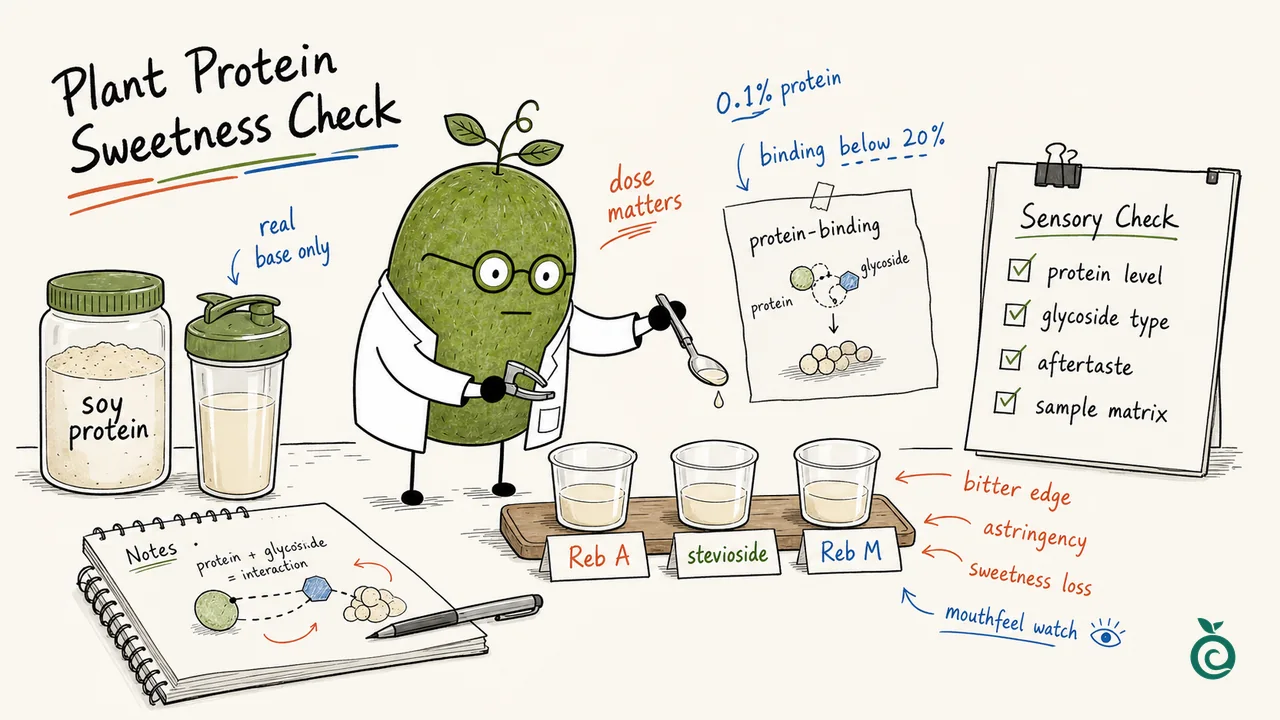
For a ready-to-drink (RTD) product, compare the processed, packaged beverage at the intended serving condition. For a ready-to-mix (RTM) powder, record the complete powder formula, powder-to-water ratio, hydration method and waiting time: that reconstituted drink is the real base, not merely a water screening of the sweetener.
Compare the exact steviol glycoside in the real matrix
Do not treat every stevia extract as the same ingredient. Reb A, stevioside, Reb M and blends can differ in sweetness timing, bitterness and aftertaste. Ask the specification and batch COA to identify the glycoside profile, then compare candidates in the same protein base, serving condition and process.
Build controls that answer the taste question
Use an unsweetened base to understand its own notes, then compare the current sweetened control with a coded candidate. Those controls help locate a problem; they do not by themselves prove a molecular cause. Keep the protein grade and lot, full recipe, process, preparation and serving condition with each code.
| Comparison | Keep or record | Decision it can support |
|---|---|---|
| Unsweetened real base | The same protein, flavor and process; record anything removed with the sweetener system | Which notes are already present before the candidate; this is a diagnostic control, not an equally sweet alternative. |
| Current sweetened control and candidate | Exact commercial grades, both actual doses and the intended sweetness target | Compare the finish at matched sweetness; record any dose, stock carrier or formula adjustment. |
| Same fixed addition, where that is the question | The same stated addition basis and actual masses; score sweetness separately | Check what happens without dose adjustment; unequal sweetness can influence the taste judgement. |
| Processed or stored comparison | Actual process, package and checkpoint; preparation, temperature and sample history | Whether the observed taste or physical difference persists after the intended treatment; a fresh cup alone does not answer it. |
Score taste and stability beyond sweetness
Record sweetness onset, peak and linger together with bitterness, astringency, chalkiness, aroma release, sediment and viscosity. Check the hydrated drink after the intended heat and storage conditions, and note changes after repeated sips. A blend can be a test direction, but it does not guarantee a smooth finish or solve every plant-protein issue.
Keep taste intensity, target fit and liking distinct. Record sediment, separation, viscosity and re-dispersion with their own method, units and acceptance criteria rather than hiding them inside a taste total. A better aftertaste score does not close a physical-stability, food-safety or label question.
A soy model shows why the protein fraction matters
Ran and colleagues (2026) compared Reb A, stevioside and Reb M with isolated glycinin (11S) and beta-conglycinin (7S) in prepared aqueous systems. For the selected Reb A comparison below, both Reb A and the protein fraction, where present, were at 0.1% by mass. The study used a trained descriptive panel of 12 people, nose clips and expectoration; three independent repetitions do not mean 36 independent consumers. These were separately prepared ingredients in a pH 7 buffer model, not a finished soy, pea or oat drink.
| Published model sample | Bitter aftertaste: mean ± SD | Original comparison letters |
|---|---|---|
| Reb A alone | 3.45 ± 0.93 | de |
| Reb A + 11S | 2.62 ± 0.77 | c |
| Reb A + 7S | 1.67 ± 0.65 | b |
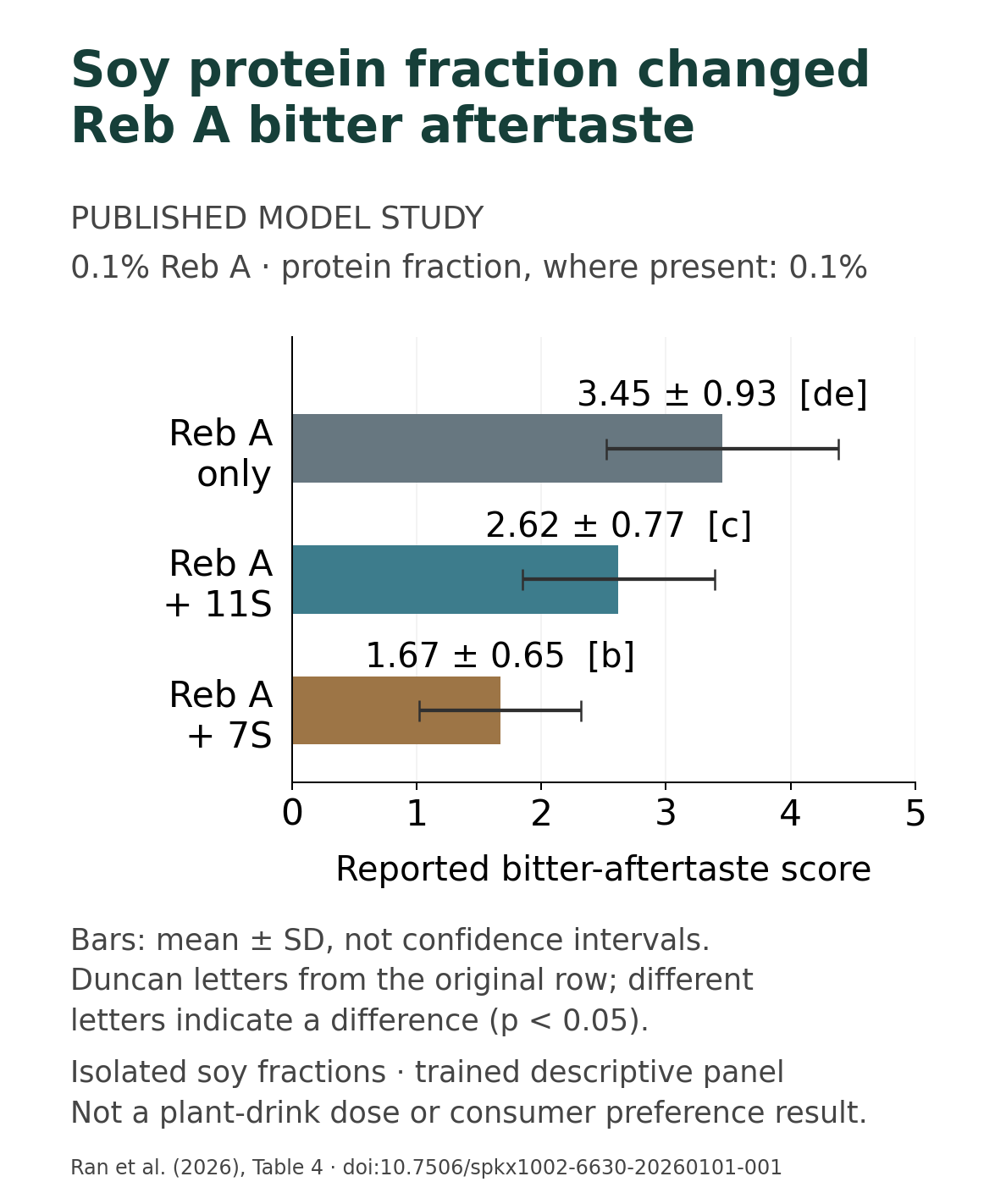
The wider study found concentration-dependent effects; a result for one glycoside and isolated protein fraction does not select a commercial grade for every plant drink. Its below-20% binding result concerns the bound share of glycosides under that model, not the share of bitterness removed. Compare the exact proposed material in the actual drink and keep the observed sensory and physical outcomes separate.
Use time-based sensory methods without borrowing a dairy result
The cited Harwood and Drake (2021) study used vanilla-flavored ready-to-mix whey-protein-isolate beverages and assessed temporal liking alongside temporal check-all-that-apply. Its useful question is whether an attribute appears when liking falls; that is different from assuming the strongest taste is the least liked. It is a dairy study, so it does not establish the same effect or dose in plant protein. A single early or late score also does not reproduce a continuous time-based test.
Separate taste work from compliance work
Review the target market and intended use alongside sample work: ingredient identity and production route, allergens, nutrition and claim treatment, and corresponding product documents each need their own review. A good sensory result does not approve an ingredient or finished label. Confirm the selected stevia, monk fruit, allulose or blend direction before treating any general document as applicable.
Keep a usable sample record
Use one coded sample, one assessor and one checkpoint per sensory record. The optional Excel records six sensory dimensions and three separate review gates; it has no automatic ranking or ratio calculation. Add the actual ingredient masses and recipe revision to the sample notes. For a physical or storage problem in a soy beverage, use the existing stability guide and its separate paired record instead of treating a sensory sheet as a stability protocol.
Start with the product and the problem you have
Tell us whether it is an RTD drink or an RTM powder, the intended market and the taste or stability issue you want the next sample to answer. Share the protein source, known level, flavor, current sweetener and process information you already have. Missing pH, volume forecasts or a completed spreadsheet need not prevent the first discussion; exact sample identity, documents, packaging, quantity and quotation scope can follow.
Common questions
Does soy protein remove stevia aftertaste?
It can change the result under a defined comparison. The cited model used isolated soy fractions and named glycosides, not a finished plant drink; its Reb A bitter-aftertaste scores were lower with the selected fractions but did not become zero. Compare the actual protein material, dose and process.
Discuss this requestIs below-20% binding a 20% reduction in bitterness?
No. Binding fraction describes the share of glycoside bound in that model. Bitterness and aftertaste are separate sensory measurements; the figure labels cannot be converted into a taste-reduction percentage or a drink recipe.
Discuss this requestCan I use the same stevia sample in soy, pea and oat drinks?
Use the same identified material if that is the comparison you want, but validate it separately in each complete base. Record the actual protein and flavor system, dose, preparation and process; a water screen or a different protein result does not establish the outcome.
Discuss this requestShould I compare fixed doses or match sweetness?
Choose the question first. Fixed addition checks the result at the same stated addition basis; matched sweetness helps compare finish at the intended sweetness. Record the actual masses and any recipe changes so the two comparisons are not confused.
Discuss this requestDoes the whey-protein study establish a plant-protein result?
No. It supports considering time, attributes and liking as separate observations. Its dairy base and specific study formulations do not establish the same outcome or dose in a plant-protein product.
Discuss this requestDoes a better taste score establish stability or shelf life?
No. Keep sediment, separation, viscosity and handling observations with their own methods, samples and checkpoints. Physical stability, food safety, shelf life and market or label review require their corresponding evidence.
Discuss this requestCan I download the sensory sheet without contacting you?
Yes. The article links directly to the Excel file without an email gate. It is an optional record, not an approved formula, automated ranking or physical-stability test; you can discuss an observation without filling it in.
Discuss this requestWhat do you need for the first sample discussion?
Start with the product format, intended market and one problem to solve. Send the protein base and process details you know; sample selection, specification, documents, pack and quantity can be clarified during the discussion.
Discuss this request