
Read this guide in
Purchasing guide
Monk Fruit Juice Powder With or Without a Carrier: What's the Difference?
Compare carrier-free and carrier-containing monk fruit juice powder: ingredient declarations, percentage basis, final-powder COA and matching samples.
Monk fruit juice powder can be made without an added carrier or with a carrier. Hengliyuan offers both options, allowing customers to choose according to ingredient requirements, production use and target specifications.
The most direct difference is composition: the carrier-free option has no added carrier; in the carrier-containing option, the carrier is part of the final powder. When comparing two juice powders, therefore, establish the carrier type, proportion and final-powder test parameters alongside the product name and price.
The illustration places juice powder, a possible carrier, prepared drinks and composition notes side by side. It shows what to compare, rather than identifying a carrier or a formula for a particular Hengliyuan product; confirm those details in the selected product’s current documents.

What is a carrier, and why use one?
A carrier is an auxiliary ingredient that may be added when making juice into powder; it is not a mogroside. Maltodextrin is one common carrier used in juice spray drying to help address wall sticking and powder recovery. Actual results depend on the raw material, carrier type, addition rate and processing conditions. These are general processing uses in juice powder production. They do not mean that all Hengliyuan products with carriers use maltodextrin. The carrier and its amount must be specified for the selected Hengliyuan product. Process reference: the linked study examines sour cherry juice spray drying with maltodextrin and gum arabic. It supports the general processing discussion; its carrier ratios, temperatures and results do not establish a formulation or performance result for Hengliyuan monk fruit juice powder.
What differs between carrier-free and carrier-containing options?
Use the same level of specification detail for both options. “Without added carrier” is a composition requirement, not a substitute for the rest of the product specification.
| Comparison | Without added carrier | With added carrier |
|---|---|---|
| Is a carrier added? | No carrier is added | The selected carrier is added as part of the final powder |
| Composition details to confirm | Juice raw material and full composition declaration | Juice raw material, carrier name, proportion and full composition declaration |
| Starting point for selection | The customer explicitly requires no added carrier | The customer permits a carrier; choose according to powder production and subsequent application requirements |
| How to assess content | Check mogroside V or total-mogrosides test results for the final powder | Also check the final powder; do not directly reuse the content value of the ingredient before carrier addition |
| How to confirm performance | Test reconstitution, taste and storage behavior using the actual product | Test reconstitution, taste and storage behavior using the actual product |
Carrier-free does not mean a high-purity mogroside V extract. It means no carrier is added, not that all other juice constituents have been removed. Likewise, the presence of a carrier alone does not determine product quality. First confirm whether the customer accepts that ingredient, then whether the selected specification fits the application.
Why must the carrier proportion be stated?
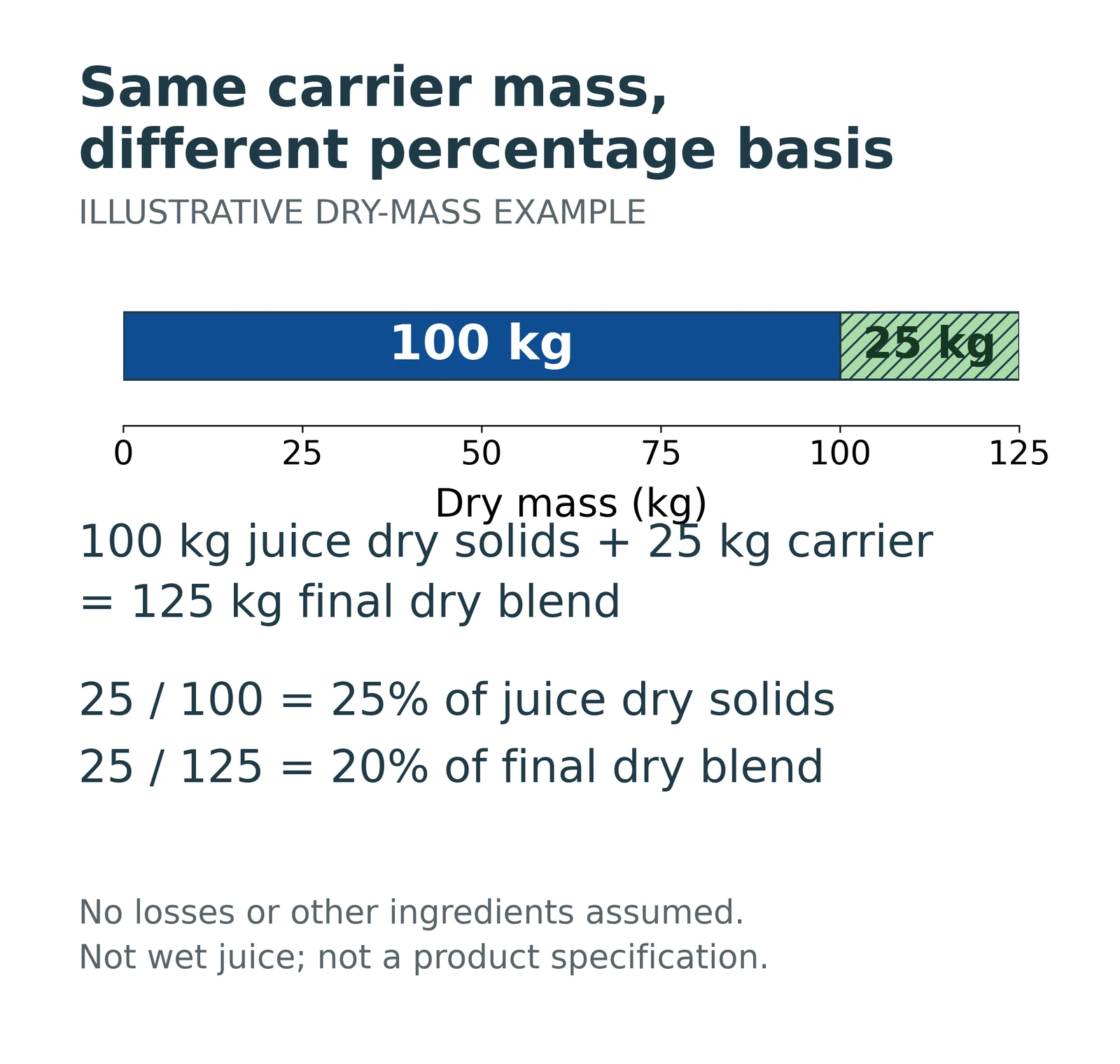
The carrier contributes to the final product’s total weight. All else being equal, adding a carrier changes the proportion of original constituents, such as mogrosides, in the final powder. Test values before carrier addition therefore cannot simply be used as the final juice powder’s test values. State the calculation basis when discussing carrier proportion. For example, “percentage of final powder weight” and “addition rate relative to the feed liquid” are different concepts. When confirming a carrier-containing option, Hengliyuan will clarify the carrier name, proportion and calculation basis with the customer, and confirm the corresponding final product specification. The figure below uses a simplified dry-mass balance to show why the denominator matters. It compares two ways of stating the carrier percentage in the same hypothetical blend, not two product grades. A percentage relative to wet feed liquid is another basis again. To relate it to a final-powder percentage, you need the feed composition and solids basis as well as the relevant process information. The dry-mass illustration is not a conversion from wet feed to supplied powder.
Match each purchasing question to the right document
An ingredient declaration tells you what the product is made of; a content test tells you how much of a particular tested constituent is present. A mogroside V result alone does not establish whether a carrier was added, its identity or its proportion. An ingredient declaration naming juice and a carrier cannot replace a content test either. Use the documents together and make sure they refer to the same selected powder.
| Purchasing question | Document or record to check | What to match |
|---|---|---|
| What is in the powder? | Complete ingredient declaration and agreed composition details. | Selected product, carrier identity and any agreed exclusions; confirm the proportion and its calculation basis. |
| What is being purchased? | Current final-powder specification. | Product/model, version, agreed indicators, units and reporting basis. A specification limit is not an actual batch result. |
| What did this batch measure? | COA for the relevant batch. | Product and lot, reported results, applicable limits and test/reporting basis. Keep mogroside V distinct from total mogrosides. |
| Does the evaluated sample match the order? | Sample reference, specification and quotation/order details. | The same composition and selected specification; reconfirm if carrier identity or proportion changes. |
When comparing reports, check whether the same constituent, method, unit and moisture/reporting basis are being used. Do not treat a value for juice before drying or carrier addition as the final powder’s batch result. Confirm unclear or missing information before using it to approve the ingredient or compare offers.
How does Hengliyuan help you choose?
If you require no carrier, state that requirement directly and Hengliyuan can offer a corresponding option. If you accept a carrier, start with the product’s intended use and ingredient requirements to discuss suitable carrier options and specifications. Once the direction is selected, evaluate taste, dissolution or dispersion, visible sediment and other practical behavior with the relevant sample. Samples, specification sheets and quotations should refer to the same composition. When switching from carrier-free to carrier-containing, or changing carrier type or proportion, reconfirm the sample and specification together. For price comparisons, start with two samples that meet the same finished-product requirements. Calculate ingredient cost from each accepted use level and a quotation on consistent units, currency and delivery terms; include any preparation or handling differences. Equal pack weight does not make two compositions equivalent.
Common questions
Does Hengliyuan offer juice powder without an added carrier?
Yes. Hengliyuan offers both carrier-free and carrier-containing options. State the ingredient requirement when selecting a sample, then confirm the selected product’s current complete ingredient declaration, specification and batch documents.
Discuss this requestDoes carrier-free mean high-purity monk fruit extract?
No. It means no carrier is added, not that the other juice constituents have been removed. It does not establish a particular mogroside V content or make juice powder equivalent to a high-purity extract.
Discuss this requestDo all carrier-containing products use maltodextrin?
No. Maltodextrin is a common processing example in juice powder production, not a declaration for every Hengliyuan product. Confirm the selected carrier, its proportion and the calculation basis in the agreed composition documents.
Discuss this requestCan 25% carrier and 20% carrier describe the same blend?
Yes, if the denominators differ. In the illustrative dry-mass example, 25 kg carrier added to 100 kg juice dry solids is 25% of those juice solids, but 20% of the resulting 125 kg dry blend. These are hypothetical calculation inputs, not product ratios; ask what each quoted percentage is relative to.
Discuss this requestCan the mogroside V result prove that no carrier was added?
No. A content result does not establish the full composition. Check the complete ingredient declaration and agreed composition details alongside the final powder specification and the relevant batch COA.
Discuss this requestWhat if the carrier or its proportion changes after sample approval?
Reconfirm the composition, specification and corresponding sample together before relying on the earlier evaluation. Check taste, mixing or dispersion, visible residue and any other requirements in the actual application.
Discuss this requestHow should I compare the purchase cost?
First compare composition, percentage basis, final-powder indicators and performance at the accepted use level. Then compare cost for the same finished-product quantity on consistent quotation terms, including preparation and handling. A lower price per kilogram alone does not establish the lower cost in use.
Discuss this request