
Read this guide in
POWDER PARTICLE SIZE
Granulated vs Powdered Sweetener Blends: Particle Size and Handling Guide
Granulated vs powdered sweetener blends: how particle size and granulation affect flow, dosing, dissolving and packaging.
Choose powder or granulated sweetener from the mixing, dosing, dissolution and packing task. Compare the supplier’s measured particle-size specification with a process trial; a mesh label alone does not choose the best material.
For stick packs, beverage powders, tabletop jars and premix projects, a sweetener blend can taste right in a lab cup but still fail during filling, transport or daily consumer use.
Particle size and granulation are practical sourcing questions because they affect flow, dusting, segregation, caking, scoop accuracy and dissolving.
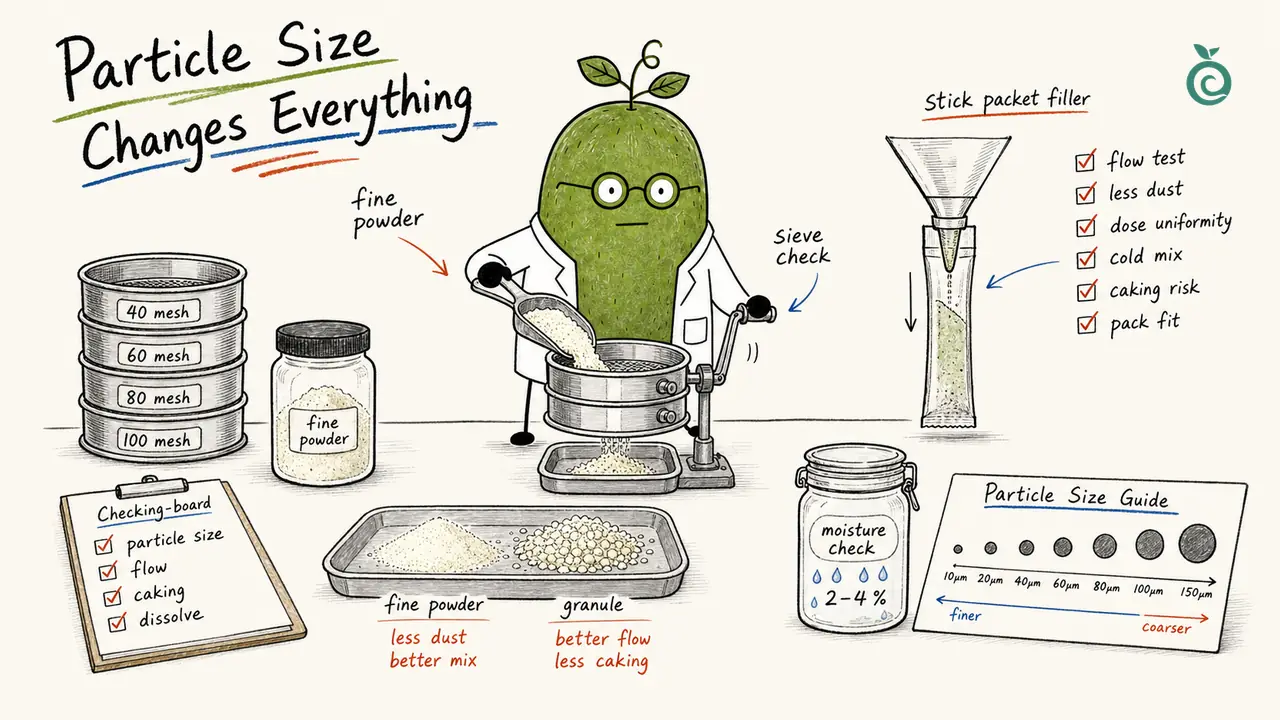
The Doctor illustration brings sieving, filling and moisture checks into the same selection discussion. Its mesh and micron labels, 2–4% moisture range and handling checkmarks are illustrative, not Hengliyuan specifications or measured results. Test the chosen material before treating a label such as less dust or better flow as a performance claim.
Hengliyuan's two blend production routes
Hengliyuan uses fluid-bed granulation for its erythritol-based sweetener blends and high-speed mixing for its allulose-based blends. In food-powder processing, fluid-bed granulation generally lifts particles in moving air and joins them into larger agglomerates; powder mixing distributes ingredients through particle movement. These are established process types, not a claim of a unique method. The selected formula, powder or granule form, particle-size specification and matching sample still determine what a buyer can evaluate in a specific application.
Fine powder is not always better
Very fine powder may disperse quickly in some systems, but it can also dust during filling, cling to packaging, compact in storage or segregate from larger ingredients. Buyers should test handling as well as taste.
Granulation can improve handling
Granulation or agglomeration may improve flow, reduce dusting and support more even dosing, depending on the blend. It should be checked against dissolving speed, mouthfeel, package format and cost.
Specify the distribution and measurement method
Request the size distribution with the sieve standard or measurement method, not a single unqualified mesh number. Powder, granulated and agglomerated describe material forms; they do not establish fixed micron ranges for every supplier. Record the actual passing or retained fractions and the nominal aperture used. If a laser-diffraction report is supplied, retain its stated distribution metrics and method rather than converting them into a sieve result without justification. Use the table to request the selected material's actual values and method. Keep the sample code, composition and specification revision with the result. Powder or granule appearance cannot supply a missing distribution, and a size result alone does not establish the material's flow or preparation performance.
| Form | Size information to request | Handling test |
|---|---|---|
| Powder | Actual sieve / micron distribution and method | Dust, mixing, dosing and wetting |
| Granulated | Actual sieve / micron distribution and fines | Flow, segregation and dissolution |
| Agglomerated | Actual distribution, structure and fines | Wetting, dispersion and pack handling |
Read the distribution, not only Dv50
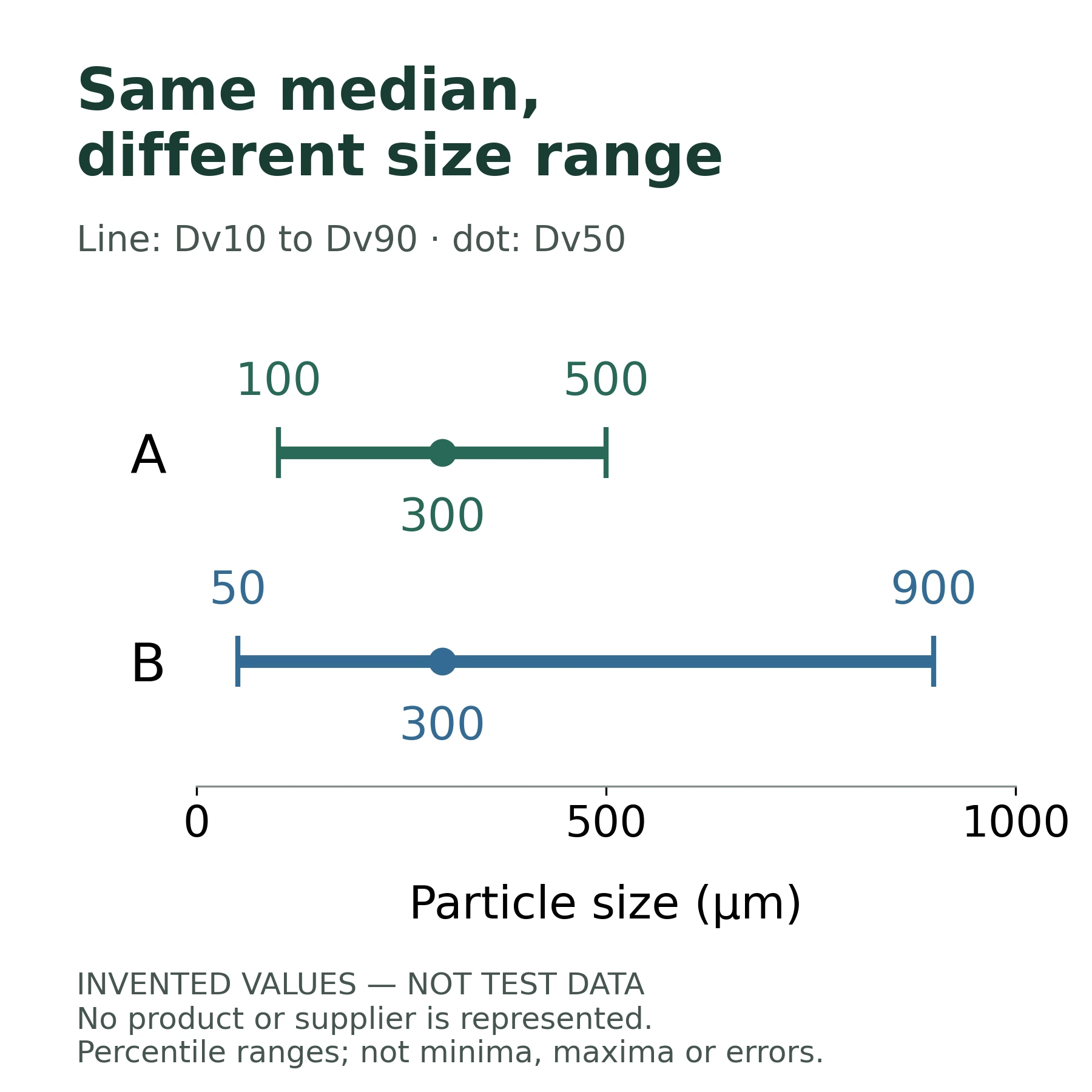
For a volume-weighted report, Dv10, Dv50 and Dv90 are sizes below which 10%, 50% and 90% of the particle volume lie. Dv50 is a volume median; Dv90 is not the maximum particle size. Retain the distribution basis and measurement conditions when comparing reports.
Keep size, fill mass and composition checks separate
Choose the question before selecting the test. A packet can have the correct total mass without proving that every ingredient is present in the intended proportion. Similar particle sizes do not, by themselves, prove blend uniformity.
| Question | What to retain | What the result does not establish |
|---|---|---|
| Particle-size distribution | Named method, preparation, distribution basis, apertures or metrics and actual fractions | Uniform ingredient concentration or performance on your line |
| Fill or scoop mass | Actual portion weights, equipment settings, container and sampling stages | The amount of each ingredient within those portions |
| Blend composition or uniformity | The relevant component, suitable agreed analytical method, sample positions and stages | A claim based only on size, colour, appearance or a single tasting |
For a uniformity question, agree the relevant compositional measurement and a sampling plan suited to the process. Keep samples from named locations or fill stages identifiable. A single cup or a single average must not conceal the comparisons you need to make.
Test handling and preparation in the actual application
For a dry premix, compare the material with the rest of the powder system. Differences in particle size and density can influence segregation during conveying or filling. Record mixing order, equipment, sample positions and fill stages. For a tabletop sachet, also observe dose consistency, dust and seal-area contamination. For a drink mix, add the actual cold-water preparation method. A material that flows better may not dissolve faster in every product, and a material that disperses well may still need moisture and storage review. Test each function separately. If the supplier changes fines content or granulation, identify which accepted result needs to be repeated. Preserve the original sample and method when comparing a revision.
Set the acceptance specification after the trial
Document the distribution and method that belong to the accepted sample. Include material identity, full composition, package, storage instructions and relevant incoming acceptance tests. Avoid copying a mesh requirement from a competitor when the equipment or application differs. When the first production batch arrives, match its documents to the order and confirm the relevant handling result. A matching ingredient name is not enough if the form or size distribution changes. Record any deviation and decide whether a repeat process trial is needed before accepting the delivery. This keeps the specification tied to a manufacturing result rather than a general preference for fine or coarse powder. Where conveying or handling may break agglomerates, compare the received material and the material after the relevant transfer stage using the agreed size method. Do not assume the original fines result still describes the powder at the filler. Record the change and repeat only the affected checks against the accepted reference.
Start with the task, even if you do not know the mesh
Tell us the product or sample, final sales market, package or filling method, and what is going wrong: dust, inconsistent portions, separation, caking or preparation. Add the existing size report, method and photos when available. You do not need to invent a mesh or finish the order quantity before starting that discussion. After a useful direction is selected, confirm the composition, particle specification and method, accepted sample reference, packing, requested documents and quantity for the corresponding offer.
Common questions
Is a mesh number enough to order a sweetener blend?
Include the sieve standard or measurement method, nominal aperture and actual passing or retained fractions. Powder, granulated and agglomerated do not define universal micron ranges. Match the agreed specification to the selected material and sample.
Discuss particle size and handlingDoes the same Dv50 mean two powders are equivalent?
No. It is the volume median on a volume-weighted report, not the complete distribution. Check the fine and coarse ends, distribution basis and method, then assess the relevant handling or preparation task.
Discuss particle size and handlingDoes a faster-flowing granule always dissolve faster?
No. Evaluate filling or pouring separately from wetting, dispersion and dissolution under the actual consumer or process method. Keep the material amount, liquid amount, temperature, mixing and observation endpoint identifiable.
Discuss particle size and handlingDoes consistent packet weight prove blend uniformity?
No. Total packet mass and ingredient concentration are different measurements. Agree a suitable component analysis and sampling plan for a uniformity question, rather than relying on particle appearance, portion weight or one tasting.
Discuss particle size and handlingWhich production routes does Hengliyuan use for these blends?
The erythritol-based blend route uses fluid-bed granulation and the allulose-based route uses high-speed powder mixing. Keep those descriptions tied to the selected formula, powder or granule specification and sample; the process name alone does not guarantee a particular distribution or handling result.
Discuss particle size and handlingWhat if the fines or granulation change after a sample is accepted?
Identify the changed material and specification, retain the accepted reference and method, and decide which size, transfer, filling or preparation checks are affected. Match the proposed supply documents to the actual revision before accepting the change.
Discuss particle size and handlingCan I ask for a sample without knowing the mesh?
Yes. Start with the application, material or sample code, final market, pack or filling method and observed problem. Send an available report or photo if useful. Particle specification, quantity, documents and sample arrangements can be clarified for the selected direction.
Discuss particle size and handling