
Read this guide in
POWDER FORMULATION
Does Monk Fruit Sweetener Dissolve in Water? Solubility and Carrier Guide for Beverage Powders
Does monk fruit sweetener dissolve in water? Solubility factors, carrier selection and cold-water checks for beverage powders.
Monk fruit sweetener can dissolve in water, but the result depends on the actual extract or blend, its carrier, water temperature and mixing method. This guide covers dissolution and carriers; the cold and acidic beverage guide covers the taste and stability of the complete drink.
Many beverage powder projects start with a simple question: how much monk fruit sweetener should be used? In commercial development, the better question is what sweetener system will dissolve, taste balanced and run through packaging equipment.
This guide helps buyers prepare a more useful sample request for hydration sticks, instant tea, coffee powders, functional drink powders, flavored water mixes and private-label sachets.
The Doctor illustration separates carrier identity, mixing, cold-water preparation and clarity checks. Its powder names, cup appearances and 2.00 g scale reading are illustrative, not a Hengliyuan formula, recommended dose or measured comparison. Judge the actual material in the complete drink under the recorded consumer preparation method.
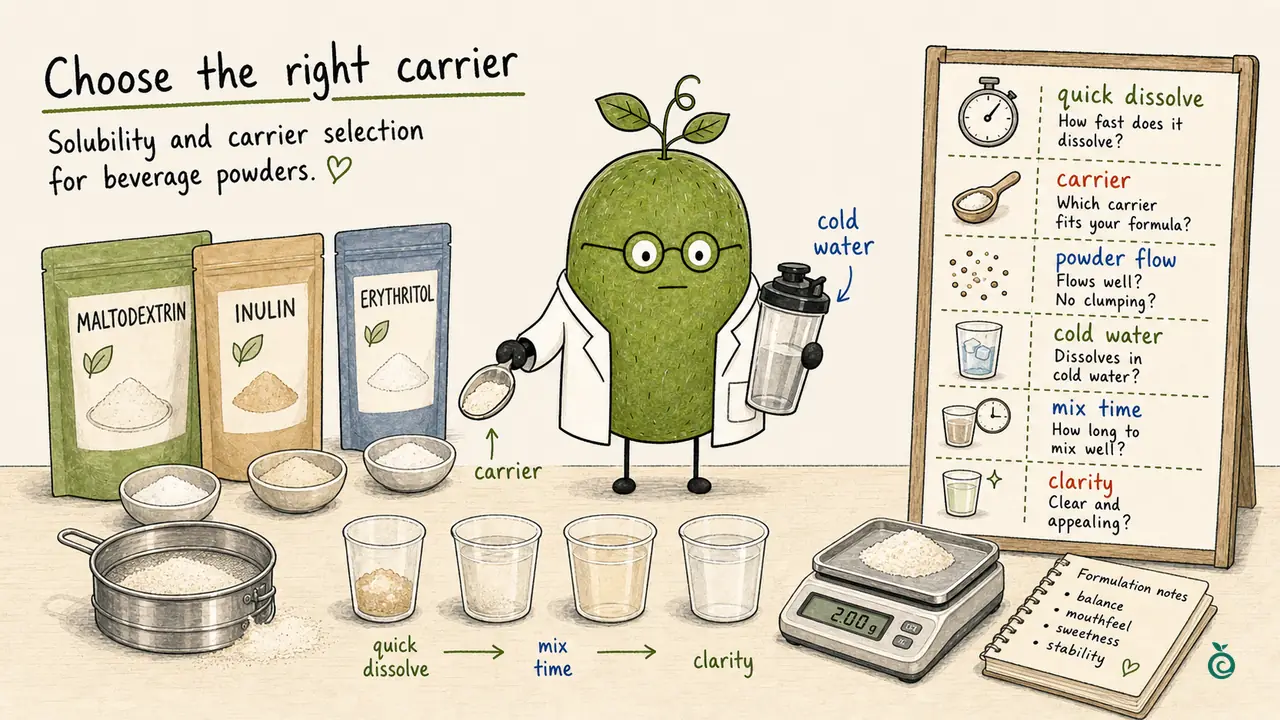
Solubility depends on the complete formula
Monk fruit sweetener performance can change when acids, minerals, tea powder, coffee, vitamins, flavors, colors, fibers or proteins are added. Test the complete drink powder in the water temperature consumers will actually use. Keep the powder portion and the sweetener addition as separate records. Grams of a complete drink powder do not identify the grams of extract or blend inside it. Record the actual material, formula revision, water amount and whether the comparison is by fixed addition or matched sweetness.
Carrier choice controls use experience
A carrier system can affect serving size, sweetness strength, mouthfeel, cost, powder flow, clumping risk and label wording. Buyers should not choose only by ingredient name; they should choose by final product behavior.
Carriers: confirm identity before comparison
Maltodextrin, inulin, fructooligosaccharides (FOS) and resistant dextrin are examples of ingredients that may appear in sweetener or beverage-powder systems. They are not interchangeable specifications, and this list does not establish that a particular Hengliyuan material contains them. Ask for the actual ingredient statement and grade. Different carriers can change solids, preparation, mouthfeel and label treatment as well as the mass needed to deliver sweetness. Read the sample label and specification together. “Monk fruit powder” may refer to a whole-fruit material, a juice powder, an extract or a formulated blend. A residue from fruit solids is not the same observation as an undissolved carrier or a precipitate after storage. Identify which material is being tested before setting the acceptance criterion. If two candidates have different carriers, record that difference rather than attributing the outcome solely to monk fruit. Where useful, compare the carrier in the same base and serving condition. Obtain the supplier’s preparation guidance and then test it against the intended consumer method, especially when the final product will be mixed in cold water without industrial equipment. If you compare a carrier-only control, identify its amount and the other recipe components held fixed. Keep a change of carrier, sweetener addition or total powder solids visible in the trial record. That comparison can help locate a question for the next test; it does not identify an unknown residue by appearance.
Separate wetting, dispersion and the later drink result
Name the endpoint before timing a sample. The time until a lump breaks, a sample looks uniform or a chosen particle criterion is met can describe different events. A stopwatch value without that definition and the preparation method cannot be compared fairly.
| Stage | What to observe | What the observation does not establish |
|---|---|---|
| Wetting | Floating powder or dry pockets when liquid first contacts the portion | The identity of the material inside a lump |
| Dispersion | Whether lumps break and the sample becomes visibly uniform under the named mixing method | A quantitative concentration of dissolved material |
| After the defined rest | Undisturbed clarity, suspended particles or settled material at the recorded interval | Which ingredient caused the appearance |
| After re-mixing | Whether particles redistribute, remain or settle again under the recorded method | Finished-product safety or a validated storage life |
Keep photographs and notes with the same sample code and observation interval. For a quantitative solubility specification, agree the material, preparation, separation or analytical method, temperature, units and endpoint; do not convert a clear-looking cup into an unsupported numerical result.
Cold-water preparation record
Use the actual powder serving and water volume. Record measured water temperature, vessel, addition order, mixing equipment and time. Define when observations will be made before the test begins: immediately after mixing, after the intended drinking interval and after any relevant chilled storage. The time points are chosen for your application, not a universal solubility specification. Observe wetting, dispersion and apparent dissolution separately. A floating lump may be an agglomeration problem; suspended base solids may be expected for the product. A clear fresh sample can still develop particles later. Photograph the undisturbed sample before remixing and record whether particles redisperse, remain suspended or settle again. If the result needs chemical identification, use an appropriate analysis rather than guessing from appearance. Compare a control, the selected powder and an alternative material under the same method. Use the intended final acidity, flavors, proteins and minerals in the application trial because water alone cannot represent their interactions. Keep dissolution results separate from the sensory decision in the cold and acidic beverage guide. For a shaken product, record the actual shaking method, container and liquid amount. For a stirred product, use the intended stirring method. Industrial mixing can answer a production question, but it does not establish that a customer can prepare the same drink with a spoon.
| Parameter | Record | Comparison rule |
|---|---|---|
| Water temperature | Measured value at addition | Same starting condition |
| Mixing | Equipment, speed where available, order and time | Same written method |
| Observation interval | Agreed rest and storage times | Same intervals |
| Clarity / particles | Photo, haze, sediment and resuspension | Describe before remixing |
| Final drink | Full base, acidity and serving dilution | Taste separately from physical result |
Cold-water and hot-water checks are different
Hydration powders and flavored water mixes often need cold-water performance, while tea, coffee and cocoa powders may be used hot. Test dissolving time, clarity, sediment, aroma release and sweetness after mixing. Separate the measured temperature at preparation from the temperature at evaluation. If you use ice or dilute after mixing, record that change with the served sample; do not compare it silently with the original concentration.
Packaging can expose powder problems
Stick packets, sachets, pouches and jars need different powder flow and moisture control. A sample that tastes good may still fail if it bridges, clumps or fills inconsistently during packaging. Keep unopened storage observations separate from handling after opening. Record the pack version, opening history and observed filling or flow behaviour before deciding what to change; good cup performance alone does not establish dosing consistency in a packing trial.
When to ask for a different material
Send the record with the selected grade and sample code. If preparation is unrealistic for the consumer, specify the actual method the revised material must support. If the powder is intended for sachets, include the fill and handling requirement as well as dissolution. A material optimized for bulk mixing may need another packing review before it is selected for a small serving. Keep the destination market and label direction in the request. A carrier change is also a composition change, so recheck the full ingredient list and any relevant finished-product claims. Ask for an updated specification and ingredient declaration with the next candidate. Approval belongs to the material, process and product that were actually tested.
Start with the preparation problem, then confirm the order
Send the drink type, actual powder or sample code, portion, water amount, temperature, mixing method and the specific observation. Include when it appeared and what happened after re-mixing. Start with the notes or photos you have; final quantity and packaging are not required to ask about a failed preparation. Once a useful material direction is selected, confirm the full composition and specification, target market, packaging, estimated quantity, requested files and sample needs for a matching quotation.
Common questions
Does a clear cup prove complete dissolution?
It is an appearance observation under the method used, not a quantitative dissolved-material result. Identify the material, preparation, temperature, observation interval and endpoint. If a numerical solubility specification is needed, agree the appropriate separation or analytical method and units.
Discuss powder preparationWhy is a floating lump different from sediment after standing?
They describe different stages. Record the initial contact and mixing separately from the undisturbed sample at a defined rest interval. Keep photographs and the re-mixing result, but do not identify an unknown particle or its cause from appearance alone.
Discuss powder preparationIs the drink powder serving size the sweetener dose?
No. Record the complete powder portion and the commercial extract or blend it contains separately. Keep the carrier, total recipe and added water identifiable, and state whether the candidates are compared at fixed addition or matched sweetness.
Discuss powder preparationCan hot-water or industrial mixing results settle a cold-water consumer claim?
Use the method the customer will actually use. Record measured temperature, liquid amount, vessel, addition order and stirring or shaking conditions. A different preparation answers a different question, so retain those results as separate named conditions.
Discuss powder preparationWhich carrier is best for every monk fruit drink powder?
There is no single choice established by an ingredient name. Check the actual grade and composition in the full drink, intended preparation, filling method and label direction. Record differences in carrier, solids and sweetener addition before comparing results.
Discuss powder preparationDoes fresh clarity establish storage stability?
No. Check the chosen rest or storage interval and package history as separate recorded conditions. Describe the undisturbed sample before re-mixing and complete any product-specific safety or shelf-life assessment separately.
Discuss powder preparationWhat should I send when a beverage powder does not mix as expected?
Send the sample and formula reference, portion, water amount and temperature, mixing method, time of observation and a photo if available. Describe floating lumps, haze or settled material separately, plus what changed after re-mixing. Quantity and final packaging can follow as the next sample direction becomes clear.
Discuss powder preparation