
Read this guide in
BEVERAGE POWDER STABILITY
Why Drink Powders Clump: Sweetener Blend Stability Guide for Beverage Powders
Find where drink-powder clumping starts: dry storage, dosing or cold-water mixing. Use controlled checks before changing the sweetener blend or packaging.
First establish when the clump appears: in the unopened pack, after opening, or only when water is added. Those observations lead to different tests. Our factory view is to identify the handling or preparation problem before replacing the sweetener.
A beverage powder can taste clean in a fresh beaker and still cake, separate or dose unevenly after storage. Use the checks below for hydration sticks, electrolyte powders, fruit drink mixes and instant tea. Test the complete blend in its intended package and preparation method.
Five reasons a drink powder may clump
Treat clumping as an observation with several possible causes. Compare the unopened product, the handling history after opening and the actual reconstitution method before changing the sweetener. The table below is a troubleshooting plan; it does not establish the cause in a specific batch.
| Possible cause | What to check | A controlled comparison |
|---|---|---|
| Moisture pickup | Package seal, humidity, water activity and exposure time | Same powder in intact versus opened pack |
| Temperature history | Storage temperature, condensation and cooling before opening | Same lot with documented handling |
| Particle-size mismatch | Sieve method, size distribution and segregation | Compare agreed material forms with same dose |
| Poor mixing or local overdosing | Premix order, weighing accuracy and mixing record | Sample several positions in the blend |
| Preparation differences | Water temperature, mixing order and resting time | Repeat under one written preparation method |
Separate dry-powder stability from dissolution
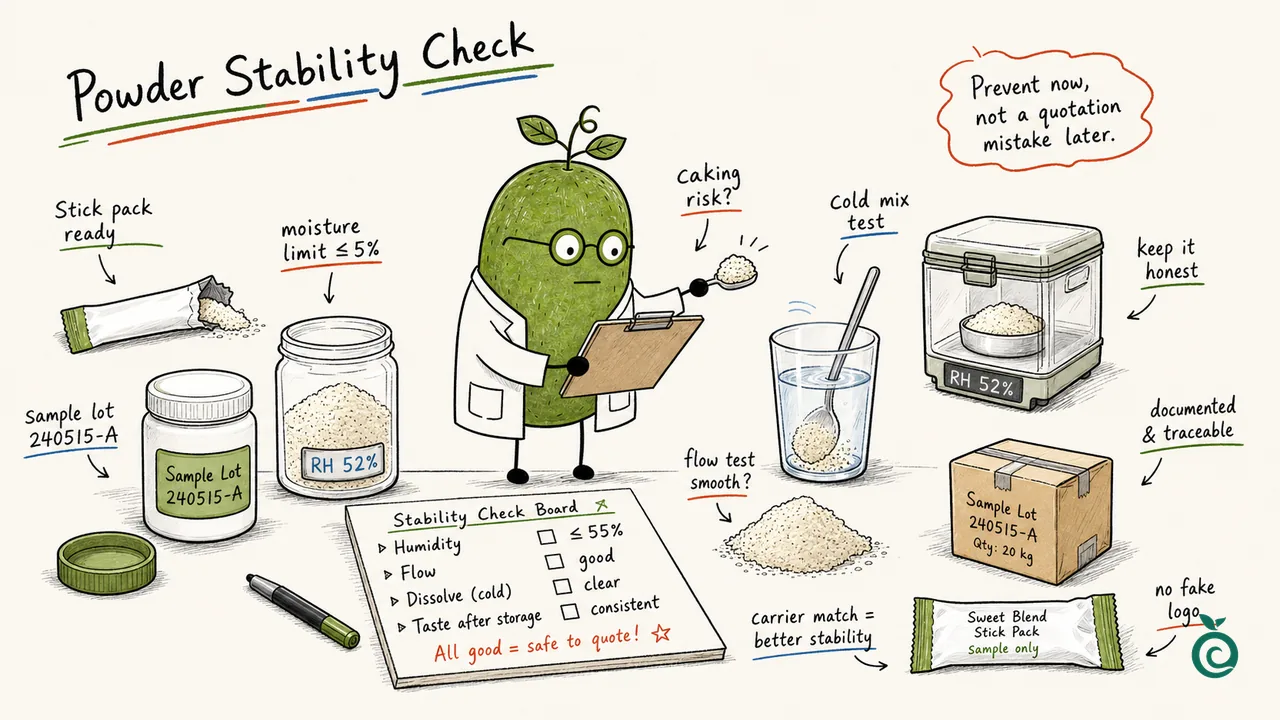
Dry flow and drink preparation are different tests. A free-flowing powder may disperse poorly in cold water, while a powder that dissolves when stirred can still cake during storage. Record the initial material form, the carrier and any hygroscopic ingredients in the complete blend. Ask the supplier for the particle-size method, moisture or water-activity specification where available, and storage instructions for the quoted packaging. For the dry trial, weigh a coded sample into the actual package and define how it will be opened, stored and dispensed. Record lumps, pour behavior and dosing repeatability at the agreed checkpoints. Do not compare a freshly opened sample with an older opened control without recording that difference. If the powder is used in sachets, compare fill consistency and seal contamination as well as the appearance of the bulk material. For the drink trial, use the actual serving mass and water volume, not an arbitrary spoonful. Keep temperature, mixing equipment, mixing time and addition order the same. Observe wetting first, then dispersion, apparent dissolution and sediment after a defined rest. Photograph undisturbed samples before shaking them again. Differentiate a floating agglomerate, an insoluble base ingredient and visible crystals; each calls for a different follow-up. Send the supplier the record and a concise defect description: when the lump appears, how large it is, whether it disperses, and whether it returns after storage. Ask for a revised material or process direction only after the comparison establishes which variable is useful to change. That keeps the next sample focused on the actual handling or preparation problem rather than replacing several ingredients at once.
Stability is part of the formula
For beverage powders, sweetness is only one part of performance. Buyers should also check powder flow, caking, moisture pickup, clumping after opening, carrier compatibility and whether the blend still doses evenly after shipping or storage.
Test cold-water reconstitution
Use the consumer’s actual preparation method, whether that is cold water, ice or a shaker bottle. Record water temperature and volume, serving mass, mixing equipment, addition order and mixing duration. Observe wetting, floating particles, sediment, foam, clarity and sweetness immediately after mixing and at a defined resting point. Choose that point for the product; five or fifteen minutes is not a universal pass criterion.
Watch segregation and dosing accuracy
High-intensity sweeteners such as monk fruit extract and stevia are used at small levels. If particle size, carrier choice or density are not controlled, the blend can separate and one serving may taste stronger than another.
Build a simple storage screen
Compare coded samples in the intended packaging under documented storage conditions. Include unopened packs and a separate opened-pack trial if the product will be used repeatedly. Record temperature, humidity where measured, opening frequency, storage duration and changes in flow, lumps, smell, colour and taste. A warmer or more humid condition can be useful as a stress screen if the comparison is controlled. It does not, by itself, establish the shelf life of the finished product. Keep the reference on the same schedule and record any packaging or handling differences.
What to send before supplier samples
Start with your target market, drink type and the problem you want the next sample to solve. Add the serving mass, water volume, flavour, acid system, minerals and permitted carriers where known. Tell us whether the product is a single-use stick or a multi-use tub, and whether clumping starts before opening, after opening or during mixing. For an existing defect, send the sample or lot code, storage history and a photo with the preparation method. Packaging specification, estimated quantity and required documents help us check the supply options; you can contact us before every detail is settled.
Published powder-caking references
The two reviews below describe moisture-mediated phase changes and humidity-related caking mechanisms. They support choosing a measurement and a controlled comparison; they do not diagnose a specific drink-mix batch or establish a Hengliyuan shelf-life result.
Review note
Reviewed October 16, 2026. The troubleshooting table and trial sequence are practical screening recommendations. Confirm the selected material documents, target-market requirements and finished-product acceptance criteria before purchase.
Common questions
Why do beverage powder sweetener blends cake?
Moisture, temperature history, ingredient properties and packaging can contribute. First check when the lump forms and compare the same lot under documented conditions. Clumping alone does not identify the sweetener as the cause.
Discuss a beverage powder sampleDoes a free-flowing powder always dissolve well?
No. Dry flow and preparation in water are separate checks. A powder may pour freely but wet or disperse poorly; test both with the actual serving mass and preparation method.
Discuss a beverage powder sampleShould sweetener blends be tested in cold water?
Use the intended consumer preparation conditions. If the drink is served cold, test at that temperature with the specified water volume and mixing method, then check again after the planned resting time.
Discuss a beverage powder sampleCan monk fruit and stevia work in beverage powders?
They can be evaluated alone or together. Check sweetness at the intended dose, even distribution in the blend and the result in the complete acid, mineral and flavour system. A clean taste in water is only an early screen.
Discuss a beverage powder sampleWhat details help Hengliyuan prepare a beverage powder sample?
Tell us the market, drink type, serving size and what needs improving. Share the package format, storage or mixing conditions and any ingredient restrictions you know. We can clarify the remaining sample and supply details together.
Discuss a beverage powder sample