
Read this guide in
PROTEIN BEVERAGE STABILITY
Protein Shake Sedimentation: Sweetener & Stability Testing Guide
Separate protein shake sedimentation from sweetness: a stability testing guide for monk fruit and stevia beverage samples.
When a protein drink settles, it is tempting to add more sweetness or change the sweetener first. That shortcut can miss the real cause. Protein type, pH, salts, gums, oil, heat history and storage can change the drink's particles and mouthfeel before sweetness is judged.
This guide helps beverage buyers build a stability-aware sweetener test for dairy, whey, soy, pea and other plant protein drinks. It keeps the commercial question simple: which variables should be compared in the real bottle, and which should not be confused with sweetness?
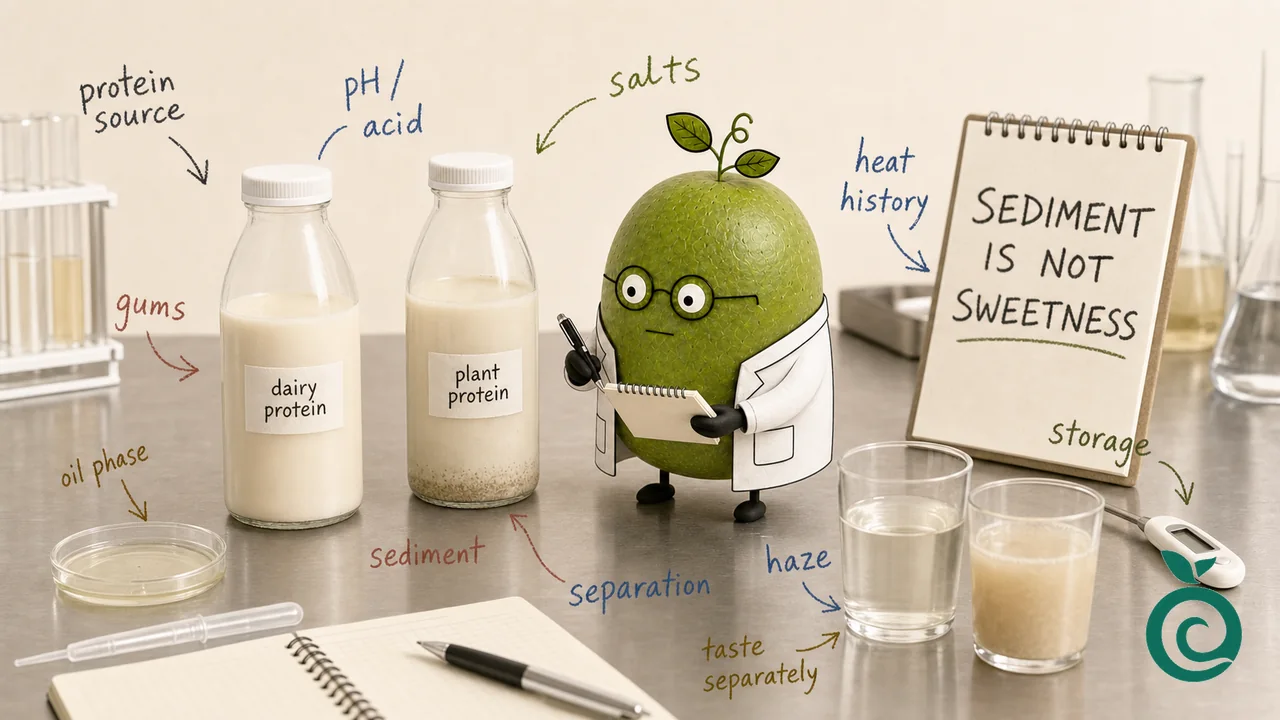
Read the bottle appearance and taste separately
The illustration connects protein source, pH, salts, gums, oil, heat history and storage to the physical checks that belong beside a sweetness comparison. Its dairy and plant bottles do not establish that one protein source settles more than another. The sediment, haze and laboratory scene are illustrative, not measured results or a record of a Hengliyuan trial.
Sediment is not a sweetness score
A drink can be correctly sweetened and still show haze, settling, a ring, flakes or a layered appearance. Start the investigation with the visible and physical defect, then check whether the same sample also has a taste problem. Do not describe a sediment issue as a sweetener aftertaste without evidence. Our factory approach is to define what changed in the bottle before choosing the next sweetener comparison. A visible deposit identifies an observation, not its composition or cause.
Describe the defect before shaking the bottle
Inspect matched bottles at the same age and temperature before disturbing them. Keep the sample upright and record the container, fill level, lighting and time since the last mixing step; photographs are more useful when those conditions are comparable. Then apply the same agreed remixing procedure and describe what remains.
| Observation | Record in the actual sample | What this does not establish |
|---|---|---|
| Material at the bottom | Location, appearance, sample age and whether it redistributes after the defined remix | Whether the material is protein, minerals, cocoa or another ingredient |
| A layer or ring | Position, visible extent and whether it changes after remixing | A diagnosis of the underlying separation mechanism |
| Haze or visible particles | Appearance before and after the same process and storage checkpoint | Particle size or turbidity as measured instrument values |
| Thickness or flow changes | Serving temperature and the same handling procedure; instrument and method if measured | A numerical viscosity from a visual description alone |
| Bitterness, dryness or a long finish | The tasting procedure and separate descriptors in coded samples | A physical-stability result or the chemical cause of a deposit |
If a project needs a numerical limit, define the method, units and acceptance criterion before using it. For example, a photographed settled layer, centrifuged sediment mass and instrument turbidity are different measurements. Do not combine them into one stability percentage or borrow a pass threshold from an unrelated beverage.
Record the variables that move stability
For each sample, record protein source and level, pH or acid system, mineral salts, oil or fat, gums, fibers, flavor, mixing or homogenization, heat process, package and storage. These details matter because a pea drink, a neutral dairy shake and an acidic whey drink are different formulation problems. Record the material grade and batch as well as the ingredient name. For a ready-to-drink product, keep the actual process and unopened storage history. For a powder mixed just before drinking, retain the complete powder mass, liquid identity and amount, temperature, mixing and standing time instead; these preparation conditions are not a bottled-RTD shelf-life test.
Use a control and one-change comparisons
Keep the current formula or sucrose control. Then compare a single sweetener direction and a blend only when the project question calls for it. If a stabilizer, carrier, fiber or allulose-supported body route changes at the same time, record it as a new formula rather than attributing the result to monk fruit or stevia alone. Identify the exact sweetener grade, carrier, addition amount and mass basis. Match the intended sweetness in the real drink for a sensory comparison; equal powder weight does not establish equal sweetness. Keep sweetness matching and physical observations as separate records.
Check the bottle after processing
Compare the current formula and candidate through the intended process, in the intended pack, at the agreed storage checkpoints. Record actual time and temperature, homogenization where applicable, and when the sample was opened. Inspect before remixing and compare taste at the intended serving temperature after the agreed preparation. Use pre-process and post-process samples to locate when a change becomes visible, while retaining the storage history of both. An unheated bench sample cannot establish the behavior of the finished heated drink. A short accelerated screen also needs its own interpretation; it is not automatically equivalent to a number of months in distribution.
Read the physical and sensory results together
A clean sweetness timeline does not prove visual stability, and a stable appearance does not prove a clean finish. Put sweetness onset, peak and finish, bitterness, metallic note and astringency beside the physical record. Keep descriptive taste notes separate from instrumental pH, viscosity, turbidity or particle-size readings. The 30/90-second observations in our application checklist are proposed tasting checkpoints, not universal persistence times or the protocol established by the two studies below. If you use timed observations, agree the starting event, serving amount, temperature and scale first. Keep the same procedure across samples and storage ages.
What the cited research actually tested
Both papers help explain why the base and test conditions matter. Neither identifies the cause of a deposit in your bottle, and neither establishes a monk-fruit or stevia treatment that fixes sediment.
- Vogel et al.: original RTD study abstract and process conditions
- Original soy-protein and steviol-glycoside binding study abstract
| Source and model | Verified test scope | Use in this project |
|---|---|---|
| Vogel et al., 2021: vanilla milk-protein RTD beverages | Five milk-protein blends; 6.3% or 10.5% protein; sucralose-containing formulations; ultra-pasteurization at 141°C for 3 s and 4°C storage through 8 weeks | Protein blend, concentration, process and storage belong with flavor observations. This is not a monk-fruit/stevia comparison or proof of ambient shelf life. |
| 2026 soy-protein/steviol-glycoside binding study | Reb A, stevioside and Reb M with soy 11S/7S fractions in aqueous solutions; concentration-dependent sensory effects | The model supports checking the actual protein and glycoside together. It is not a finished-drink heat, sedimentation or shelf-life trial. |
The milk study reported higher astringency and sensory viscosity at the higher protein level in its model. The soy study reported limited masking of bitterness and astringency at its highest glycoside concentration. These findings do not supply a universal stabilizer level, commercial sweetener dose or blend ratio.
Start the sample discussion with the bottle problem
Tell us whether the product is ready to drink or mixed from powder, the target market and what you see or taste. Add the protein base, process, storage age and a photo or existing record if available. We can discuss the sweetener specification and a comparison aimed at the actual question; a completed stability study is not required to contact us. Monk fruit extract, stevia and custom sweetener blends are possible sweetness routes to compare in the real base. If an allulose-supported body direction, carrier change or erythritol-free requirement matters, identify it separately. Share known packaging, estimated quantity, document needs and whether samples are wanted as the supplied product and quotation scope become clear.
Common questions
Does adding more sweetener fix protein-shake sediment?
It does not establish a fix. First identify the physical observation and compare the formula, process, pack and storage conditions. A change in sweetness can alter the taste without resolving the deposit.
Should I shake the bottle before assessing sediment?
Record the undisturbed appearance first at the agreed age and temperature. Then use the same defined remixing procedure for each sample and describe whether the deposit redistributes. Remixing behavior alone does not identify its composition or prove shelf life.
Can a photo tell us which ingredient caused the deposit?
No. A photo can document location, layers and visible change when the conditions are comparable. Identifying the material or mechanism may need appropriate analytical work and a controlled formula/process comparison.
Did the cited milk study compare monk fruit and stevia?
No. It used sucralose-containing vanilla milk-protein formulations and evaluated protein blend, concentration, flavor and refrigerated storage. Its 4°C study is not approval of an ambient-stable drink or a monk-fruit/stevia formulation.
Can I transfer a powder-shake result to a bottled RTD drink?
Keep those results separate. Powder preparation depends on the complete powder portion, liquid, temperature, mixing and standing time. A bottled drink also needs its actual manufacturing process, package and storage history assessed.
Are the 30/90-second taste observations a standard stability test?
No. They are proposed sensory checkpoints in our application checklist. Define the start event and tasting procedure if you use them; neither a timed taste note nor a stable appearance proves the other result.
Do I need a finished formula or full dataset before contacting you?
No. Begin with the drink format, market and visible or sensory problem. Share the protein base, process and any observations you already have. Sample goals, available specifications, packaging, quantities and documents can be clarified together.
