
Read this guide in
PROTEIN BEVERAGE VALIDATION
Protein Shake Sweetener Stability Checklist: Sweetness Timeline & Heat Testing
A checklist for protein shake sweetener stability: sweetness timeline, heat-process and sediment checks for buyers.
A low-sugar protein beverage can be sweet enough in the first sip and still fail later. Bitterness, metallic notes or astringency may appear after the drink leaves the tongue, while protein aggregation, haze, sediment or separation can show up after processing or storage.
The practical answer is to score taste over time and physical stability as two connected but separate workstreams. This checklist is for buyers preparing monk fruit, stevia, Reb-type or natural sweetener blend samples in dairy, whey or plant protein beverages.
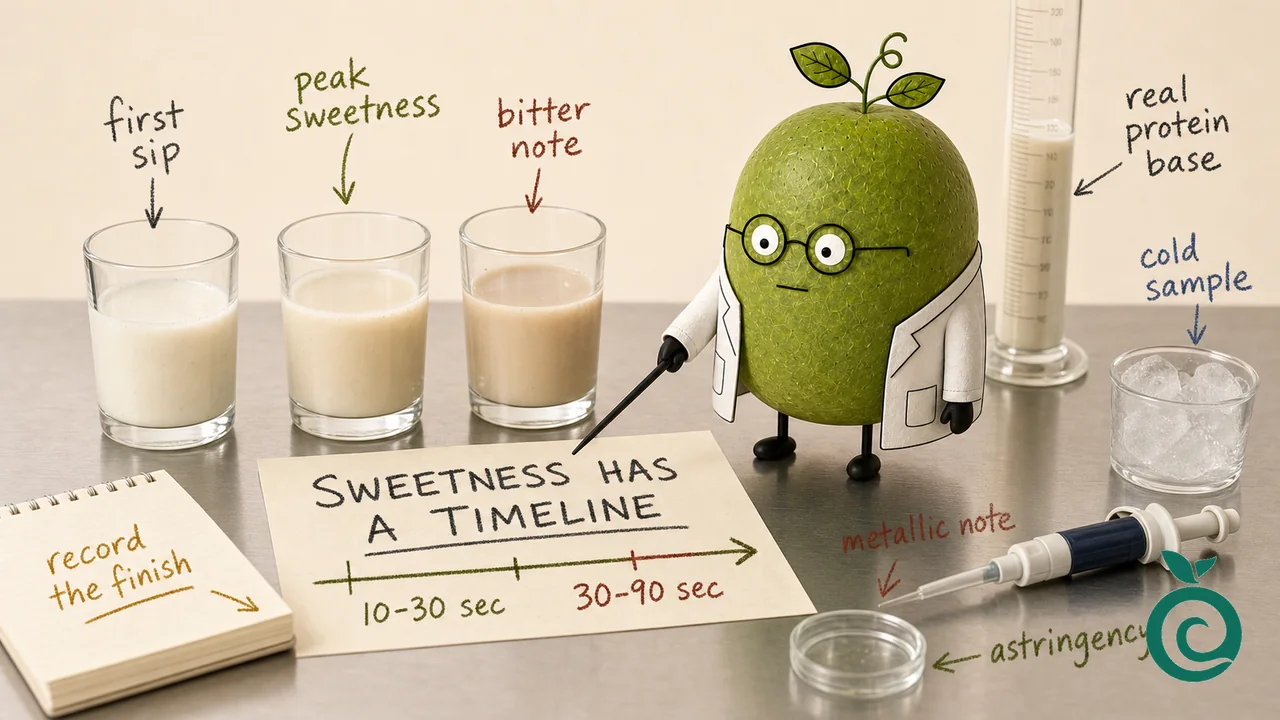
Use the illustration to plan observations
The first sip, peak and finish need separate notes because an equally sweet opening can lead to a different later experience. The pictured 10–30 and 30–90 second windows are proposed screening intervals, not measured persistence times or a universal tasting standard. The glasses, colors and laboratory props illustrate the discussion, not three measured stages of one drink or a Hengliyuan trial.
Start with the real beverage base
Name the base before choosing a sweetener: milk protein, whey, casein, pea, soy or another plant protein. Add protein level, flavor, pH or acid system, minerals, oil or fat, gums, fibers and the intended serving temperature. A water screen can find obvious off-notes, but it cannot stand in for the finished drink. Keep the material grade, carrier, batch, actual addition amount and its mass basis with each sample code. For a powder drink, also retain the complete powder portion and liquid preparation; a teaspoon of an ingredient is not the same measurement as grams of complete beverage powder.
Score the sweetness timeline
Record the first sweetness, peak, fade and what remains after the sip. Add bitterness, metallic note, astringency, protein aroma and mouthfeel as separate descriptors. Our factory approach is to retain both the time sequence and the physical result, so one favorable first sip cannot settle the whole sample decision. Choose the clock before comparing samples: state whether timing begins at intake or after swallowing, record the serving amount and temperature, and keep the procedure fixed. The suggested first-sip, 10–30-second and 30–90-second observations are screening choices. Do not copy them into a result as if the finish had been measured continuously or had disappeared at 90 seconds.
Keep three tasting records distinct
A practical comparison needs a defined observation task. Use coded samples, agree the descriptor meanings, and keep individual notes before summarizing.
| Observation task | What to keep fixed or record | Interpretation |
|---|---|---|
| First sip and later finish | Portion, temperature, starting event, observation times and descriptor definitions | Intensity at a chosen time answers a different question from overall liking or fit to a target |
| A sequence of dominant sensations | The defined dominance task and every change selected by the assessor | Dominant means the sensation drawing most attention; it is not automatically the highest measured intensity |
| Changes while finishing a serving | Cumulative amount already consumed, intake order, pace and the later observation task | Repeated-intake results may differ from an isolated sip; keep this separate from between-product palate cleansing |
Agree sample order, rinsing and intervals between different products. If the question concerns build-up during one serving, do not erase that sequence by treating each intake as a freshly rinsed first sip. This is a project procedure to define, not a prescribed universal panel size, washout or serving volume.
A study example: the first and later intakes used different times
The 2020 pea-beverage paper used trained assessors and separate static, single-intake and repeated-intake methods. Its repeated-intake experiment evaluated two selected beverages with spoonfuls at the start and after consuming 60 and 120 mL. The plotted values are timings reported in Section 3.4, not sweetness-intensity scores.
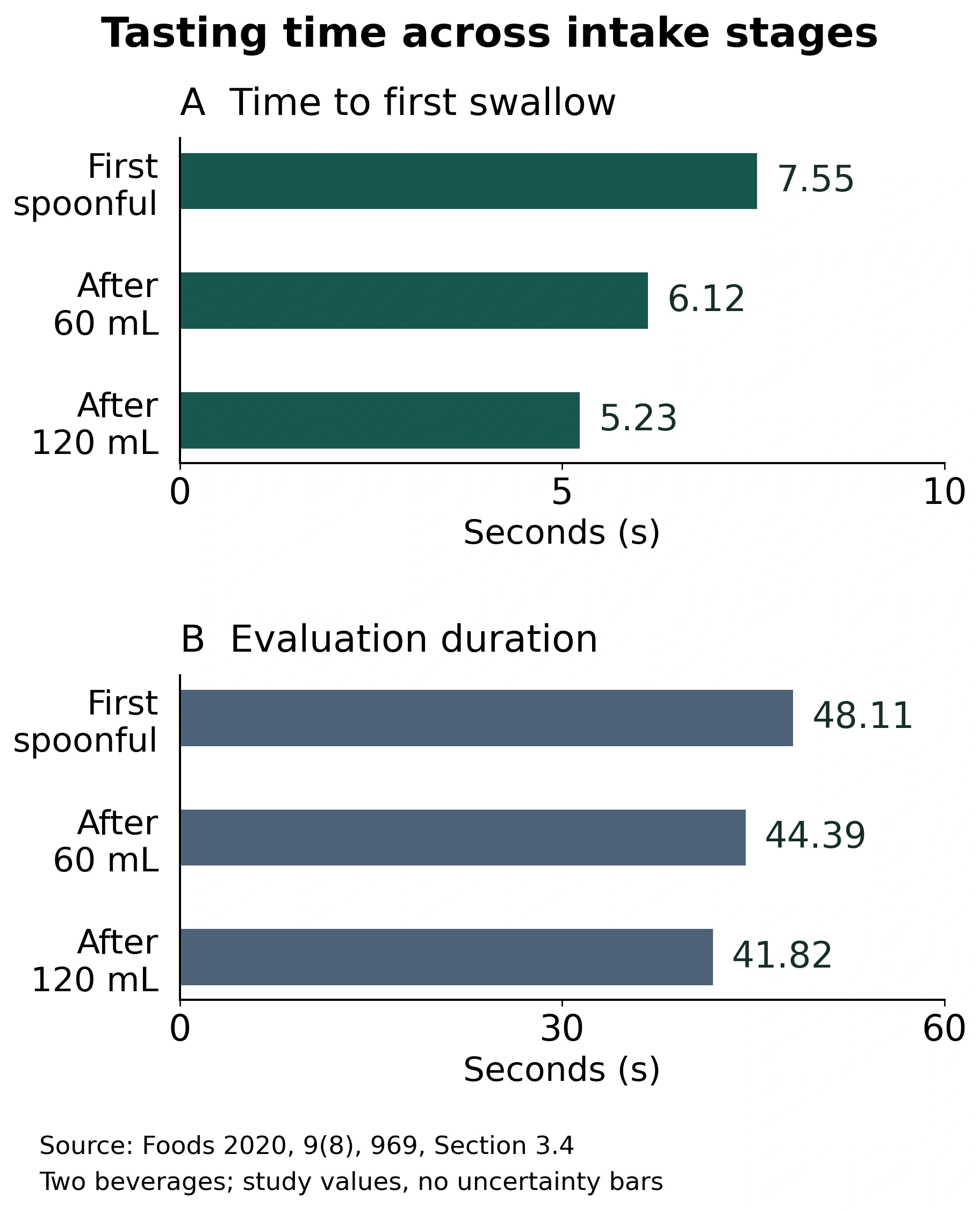
Check stability on its own line
Record perceived thickness separately from measured viscosity, and visible haze separately from instrument turbidity or particle size. Inspect sediment, layers and foam before remixing, then record the same defined remixing procedure. A clean-tasting sample that settles can pass a particular taste criterion while failing a physical requirement; a stable bottle with a harsh finish can fail a taste requirement. Keep those decisions separate and make the overall next step depend on all relevant agreed requirements. A sweetness score cannot compensate for an unresolved process, physical, market or document requirement.
| Checkpoint | Keep with the observation | Decision it supports |
|---|---|---|
| Before the intended process | Formula/sample version, serving preparation and the initial taste/physical record | A baseline for comparison, not approval of the finished heated drink |
| After the intended process | Actual process time/temperature, homogenization where relevant, pack and assessment temperature | Whether the compared material remains suitable for the next sample step in that process |
| At each storage checkpoint | Actual age, storage conditions, pack/opening history and the same measurement/tasting procedures | How that sample changes with age; a short screen does not establish commercial shelf life |
For a visible bottle problem, use the linked sedimentation guide to describe the undisturbed appearance, remixing behavior and measurement method. Keep the actual samples and raw readings tied to their codes; a photo or descriptive note does not identify the deposit chemistry.
Compare controls before blends
Keep the current or sucrose control beside a monk fruit direction, a stevia or Reb-type direction and a blend direction when appropriate. If the product needs body support, treat allulose, fiber, gum or another carrier as a separate formulation decision. Do not use a blend to hide which variable changed. State whether the comparison holds ingredient addition fixed or matches intended sweetness in the real base. If doses are adjusted to match sweetness, keep the actual doses; a fixed-dose screen and a matched-sweetness comparison answer different questions.
Keep market and taste decisions separate
A natural-sweetener label can be attractive to a buyer, but it does not establish taste, process performance or permission for a particular use. Identify the ingredient, grade, intended food category and final market separately. For a U.S. project, the FDA entry below distinguishes food-additive approval from GRAS under intended conditions; neither route is a blanket approval of every supplier grade, formula or finished label. Other destination markets need their own applicable review.
Technical references
The 2020 pea-beverage study supports keeping static descriptions, dominant-sensation sequences and repeated-intake observations distinct. The 2021 milk-protein RTD study examined blend/concentration, flavor and refrigerated storage in sucralose-containing beverages. Neither establishes a universal monk-fruit/stevia dose, a sediment fix or the shelf life of your drink.
Prepare a sample-ready brief
Begin with the drink format, final market and the issue you want the next sample to answer. Share the protein base, flavor, process and any existing taste or bottle observations. A finished formula, full study or completed scorecard is not required to contact us. We can clarify the sweetener specification, comparison purpose and sample version together. Add known packaging, estimated quantity, required documents and sample needs as the supplied product and quotation scope become clear.
Common questions
Why can an equally sweet first sip lead to a different result?
Bitterness, metallic notes, astringency, protein aroma and the finish can differ after the opening sweetness. Record those descriptors over the defined observation sequence, then check whether the experience changes while a serving is consumed.
Are the 10–30 and 30–90-second windows a standard test?
No. They are proposed screening windows. Define the starting event, portion, temperature and task before using them. A checkpoint note is not a continuous time-intensity curve or proof that every aftertaste ends at 90 seconds.
Does a dominant-sensation percentage measure intensity?
No. A dominance task records which sensation draws the most attention under that method. Keep it distinct from an intensity scale, liking score or overall target-fit score; do not interchange their numerical results.
Can I rinse between every sip when studying build-up?
That changes the question. Define a between-product palate-cleansing procedure, and keep it separate from the within-serving sequence used to examine adaptation or build-up. Record the amount already consumed and the intake order.
Does a clean-tasting sample pass if it settles?
It may meet a particular taste criterion while failing the physical requirement. Keep taste, process/physical behavior and market/document requirements separate; an average score must not hide an unresolved requirement.
Do the plotted study times tell us how to serve or sweeten our drink?
No. They describe the published two-beverage spoon-based experiment. They are not a recommended commercial serving volume, sweetener dose, universal finish time or a Hengliyuan test result.
What information helps start the sample discussion?
Start with the drink format, market and the taste or physical problem. Share any known protein base, flavor, process and observations. Sample goals, specifications, packaging, quantities and documents can be clarified together.
