
Read this guide in
SAUCE VALIDATION SCORECARD
Tomato Sauce Sample Scorecard: Brix, Flow and Separation
Low-sugar tomato ketchup sample scorecard: compare Brix, viscosity, acidity, serum separation and heat history before approving samples.
A sauce sample is easier to compare when the team decides what will be recorded before tasting. This scorecard keeps sweetness, acidity, solids, flow, serum separation, heat history and package behavior visible instead of letting one good first spoonful hide a later problem.
Use it for tomato ketchup, tomato cooking sauce, fruit-based sauce, topping, dip and condiment projects. Reuse the field structure, but set the actual targets for the product, process, package, storage plan and launch market.
Define the product lane and control
Record the final food category, tomato or fruit base, pulp or concentrate, salt and acid sources, current sugar or syrup, sweetener direction, target use and the current or sucrose control. Do not compare a spoonable ketchup with a pourable fruit topping as if they shared one viscosity release target.
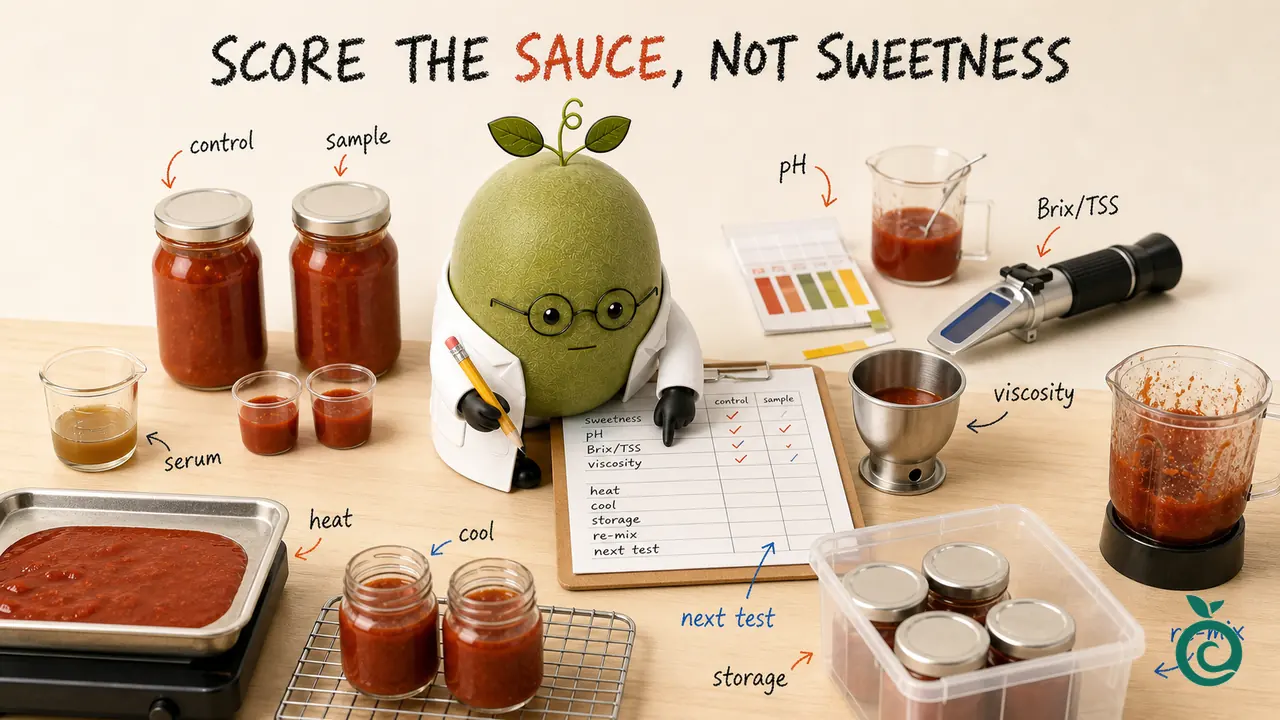
Record sweetness, acidity and solids in separate rows
Use a matched tasting order for first sweetness, acidity, sweet-acid balance, tomato or fruit flavor, bitterness, licorice-like notes and lingering finish. Then record pH, titratable acidity if used, Brix or total soluble solids and the test temperature. A sweetness score should never stand in for an acidity or solids result. In a mixed sauce, a refractometer reading is not a direct measurement of total sugar. Keep pH, titratable acidity and perceived sourness separate, and retain the reporting basis with each value.
| Check | Record for both control and candidate |
|---|---|
| Sweetness and sweet-acid balance | Actual tasting method, serving conditions and descriptive result; identify the sample and reference. |
| Refractometer reading | Measured degrees Brix, instrument, preparation, temperature and correction; do not relabel it as grams of sugar. |
| pH | Actual result, measurement method, preparation and sample temperature. |
| Titratable acidity | Value, units, acid-equivalent basis, titration endpoint and method. |
| Bostwick flow | Distance and mm or cm, elapsed test time, loading and sample temperature. |
| Apparent viscosity | Value and unit, instrument/geometry or spindle, speed or shear rate, temperature and sample history. |
| Serum separation | Named method, sample size and denominator, units, container, temperature, elapsed time and observation before mixing. |
| Heat, storage and package | Actual process and cooling history, mass or yield where measured, pack/fill/seal, opening history and checkpoint. |
Record flow with the method attached
Write down whether the result comes from a Bostwick consistometer, apparent viscosity, a rheometer, spoon flow or another method. Add temperature, shear rate or conditioning time when relevant. The same word, such as thick, can describe different physical results unless the method is kept with the observation. Bostwick distance and apparent viscosity are different outputs. Keep the distance unit and elapsed test time for Bostwick; keep the viscosity unit and instrument conditions for an apparent-viscosity result. Do not turn a spindle speed into an assumed universal shear rate.
Record serum separation and re-mixing
Note visible serum, ring formation, layering, drip, re-mixing time and any change after standing. Record the container, fill condition, temperature and observation time. Serum separation is an appearance and physical-stability observation; it is not by itself a food-safety, freshness or shelf-life conclusion. Define the separation calculation before reporting a percentage. A serum-layer height divided by total sample height is different from drained serum mass divided by initial sample mass. Keep the chosen method throughout the comparison, and observe retained jars before re-mixing.
Compare the actual heat history
Run the control and sample through the same mixing, concentration, hot-fill, pasteurization, retort or other process. Record viscosity, color, flavor, acidity, separation and package condition before heating, after heating and after cooling. If the buyer needs an ambient product, add the agreed storage checkpoints rather than using a same-day result as a commercial pass. Compare physical measurements at the same agreed sample temperature and log batch mass or yield so evaporation is not mistaken for a sweetener effect. Keep an appropriate analytical baseline separate from a safely prepared tasting reference; an unprocessed analytical sample must not be tasted when it has not undergone the required food-safety process. Keep opened and unopened storage records separate.
Turn a failed row into the next sample
If sweetness or finish fails, adjust the sweetener direction while holding the physical system steady. If Brix or body fails, review solids and carrier roles. If serum appears, review water movement, acid, salt, starch or hydrocolloid, homogenization and temperature separately. If the heat step changes the result, make process history part of the next sample question.
Use a separate record at each actual checkpoint
Agree the comparison criteria and checkpoint before judging a result. Where a test consumes or disturbs the sample, use an appropriate independent retained sample rather than treating a previously mixed or drained jar as an untouched storage sample.
| Checkpoint | Keep with the observation |
|---|---|
| Baseline | Actual formula and material identity, preparation and analytical methods; use only a safely prepared reference for tasting. |
| After processing and cooling | Actual heat and cooling history, agreed measurement temperature, batch mass or yield, fill and package. |
| Storage or opened-pack use | Actual elapsed time, storage and opening conditions, defined test method and retained-sample identity. |
Download the paired tomato-sauce record
Download the free Excel sheet without leaving an email address. It provides 32 paired fields for control and candidate, with 64 yellow blank input cells covering sample identity, formulation and process differences, measurement methods, acidity, Brix, flow, separation, taste, packaging and the next question. Use one file for one pair and actual checkpoint, keeping the record reference with original instrument reports or photos. Save a separate record for the next checkpoint. The sheet has no preset measurements, scoring formula, ranking, acceptance limit or automatic approval. Completing it is optional before contacting Hengliyuan.
References and method scope
The linked 2025 model-ketchup paper used separate methods for Bostwick flow, rheology and screen-drained serum. These are method-specific observations, not interchangeable measures or universal formulation and release targets. The companion formulation guide explains Brix, acidity, flow and separation and already includes a clearly labeled hypothetical shear-thinning figure; use that explanation without treating its curve as measured ketchup data.
Start with the sauce, market and one issue
Tell Hengliyuan the sauce you are developing, the final sales market and the difference you want the next sample to resolve. Share any available control result, sample identity, measurement method or process observation. A complete formula, finished scorecard or full document pack is not needed for the first conversation. Add known packaging, quantity, document and sample needs as the discussion develops. Keep the selected material and formula version with any later sample comparison and quotation.
Record these fields before comparing sauce samples
- Final food category and base
- Current or sucrose control
- Sweetness and aftertaste
- pH and titratable acidity
- Brix or total soluble solids
- Viscosity or flow method
- Serum separation and re-mixing
- Heat and storage checkpoints
Common questions
What should a tomato-sauce scorecard measure?
Keep sweetness and finish, acidity, refractometer readings, flow or viscosity, serum separation, process, package and storage observations separate. Record the method, units, conditions and sample identity with each result.
Discuss a sauce sampleCan Brix be used as the total sugar result?
Not directly in a mixed sauce. Report the refractometer reading as measured and use an appropriate composition or laboratory method when a total-sugar result is needed.
Discuss a sauce sampleCan Bostwick distance replace apparent viscosity?
No direct substitution is established here. Bostwick reports distance under stated time and temperature conditions. Apparent viscosity also needs its instrument and shear or spindle conditions, units and sample history.
Discuss a sauce sampleCan I compare every serum-separation percentage?
Only when the method and reporting basis match. Layer height, drained mass and a centrifuge result are different measurements; keep the denominator, time, temperature and sample preparation with the value.
Discuss a sauce sampleIs a day-zero taste test enough to approve a sauce?
No. Assess the defined formula after its actual process and at agreed storage checkpoints, keeping physical, sensory and package observations separate. This record does not validate a safe process or establish shelf life.
Discuss a sauce sampleCan the same field structure be used for ketchup and fruit sauce?
Yes, as a recording structure. Set the base, product category, acid system, process, package, storage conditions and comparison criteria for the actual sauce rather than sharing one target for all foods.
Discuss a sauce sampleMust I fill in the Excel sheet before requesting a sample?
No. Start with the sauce, final market and the issue you want to resolve. Send any observations already available; packaging, quantity, documents and sample details can be clarified as known.
Discuss a sauce sample