
Read this guide in
Formulas and Buying Guide
What Is Monk Fruit Sweetener? Extracts and Blends
Compare five monk fruit ingredient forms, Mogroside V, Brix and blends. Understand why juice concentrate can contain sugar and how to choose samples.
Monk fruit sweetener is a broad name for ingredients or products that use monk fruit to provide sweetness. It can mean whole fruit powder, juice concentrate, juice powder, a standardized extract or a blend with erythritol, allulose, steviol glycosides or other ingredients. The product form determines what you are buying, how much to use and how it fits the finished food.
When comparing monk fruit specifications, keep Mogroside V, total mogrosides, Brix, the batch COA and the sample application as separate checks. Mogroside V is one assay indicator; total mogrosides is a broader reporting scope; Brix describes soluble solids in a liquid material and is not a substitute for either assay. Match those fields to the actual extract or concentrate before comparing suppliers.
Where does the sweetness of monk fruit come from?
Monk fruit contains several mogrosides responsible for its characteristic sweetness. FDA reports monk fruit extracts as approximately 100–250 times as sweet as sucrose, depending on mogroside content. That range describes extract preparations; it is not a universal conversion for every powder, concentrate or retail blend. Check the assay basis, Mogroside V, other mogrosides, carrier and full ingredient statement before choosing a sample.
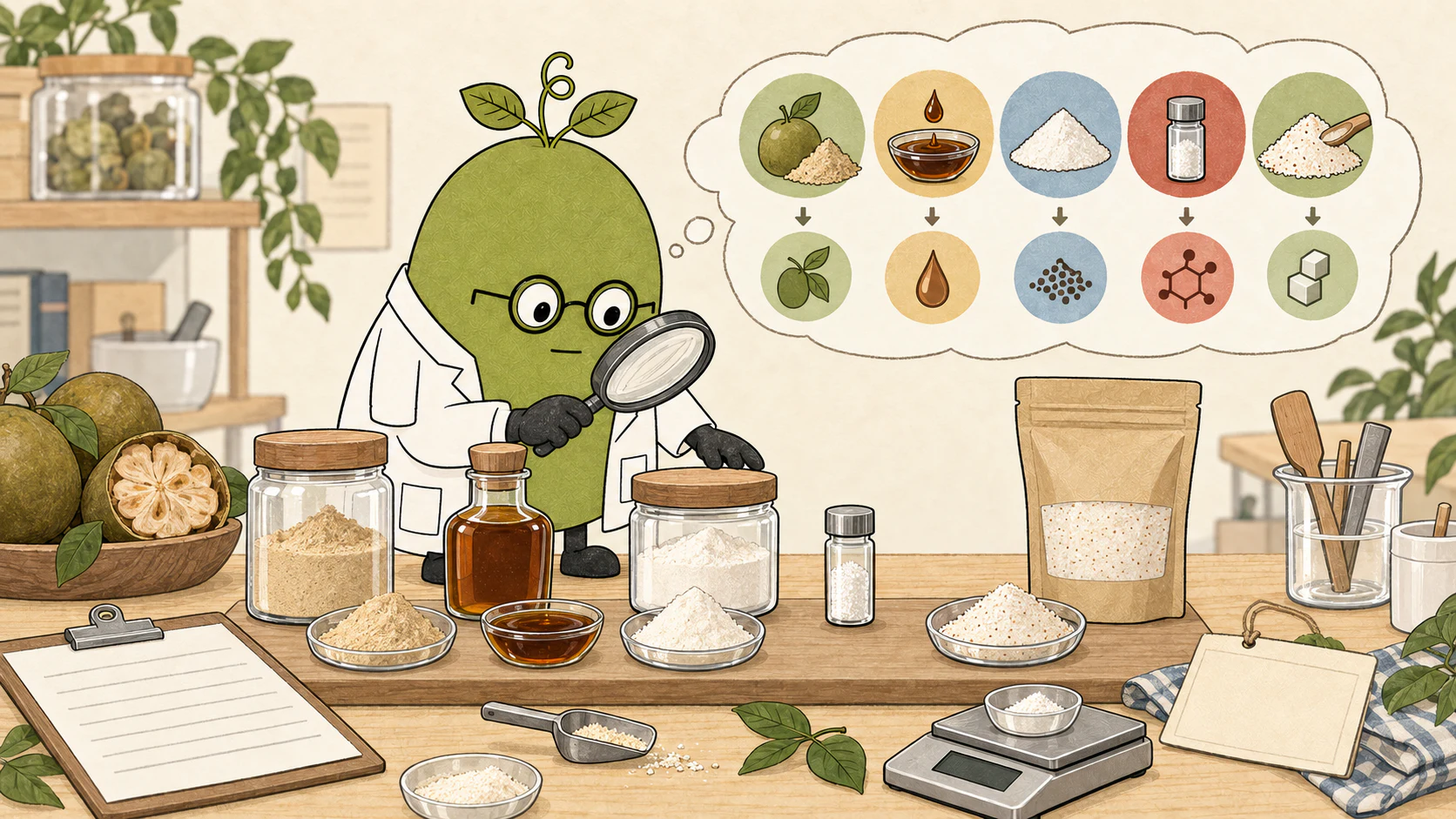
Five common product forms of monk fruit sweetener
A broad marketing name is not enough to compare samples or quotations. Identify which of these five product forms is actually supplied.
| Product form | What's inside the bag or container | Key points to confirm when purchasing | Common usage directions |
|---|---|---|---|
| Whole fruit powder | Ground whole monk fruit, retaining more fruit components | Fruit parts, processing, particle size, color, fruit flavor and dispersion | Powdered beverages and foods intended to retain whole-fruit character |
| Juice concentrate | Clarified, concentrated monk fruit juice | Sugars, soluble solids, mogroside assay, full composition and storage conditions | Beverages, syrups and other liquid foods |
| Juice powder | Dried monk fruit juice, with any declared carrier | Juice source, carrier, full ingredients, reconstitution and moisture sensitivity | Powdered drinks, premixes and other powdered foods |
| Standardized extract | An ingredient prepared by extracting and concentrating mogrosides | Mogroside V, total-mogrosides method and basis, other ingredients, sample identity and batch COA | High-intensity sweetness in the intended food or beverage |
| Sweetener blend | Monk fruit ingredients combined with bulking ingredients or other sweeteners | Full ingredients, tested sweetness, serving size, carrier, pack and intended use | Tabletop packs, baking products or manufacturing formulations |
These products cannot be compared on price per kilogram alone. Extract mainly supplies high-intensity sweetness; a blend may also provide bulk, a practical weighing quantity or taste adjustment. First decide the role in the food, then compare tested cost in use for the same finished-product quantity.
What published composition data actually show
| Source and material | Reported figures | What the figures establish |
|---|---|---|
| FDA sweetener overview: extract preparations | Approximately 100–250 times as sweet as sucrose, depending on mogrosides | A general extract range, not a fixed dose for a concentrate or blend. |
| FDA GRN 627 response: one notified juice concentrate | Approximately 65 °Brix; 3.5% Mogroside V, 1.5% other mogrosides, 56% sugars and 35% water | Mogrosides and sugars can coexist. Brix, Mogroside V and sugar are different fields; this is not Hengliyuan batch data. |
| EFSA 2019 assessment: fruit and proposed extracts | Mogrosides approximately 0.55–0.65% in fresh fruit and 2.5% in dried fruit; Mogroside V approximately 250 times as sweet as sucrose | Fruit composition differs from standardized extract. The assessment could not establish safety for the proposed additive uses from the submitted information. |
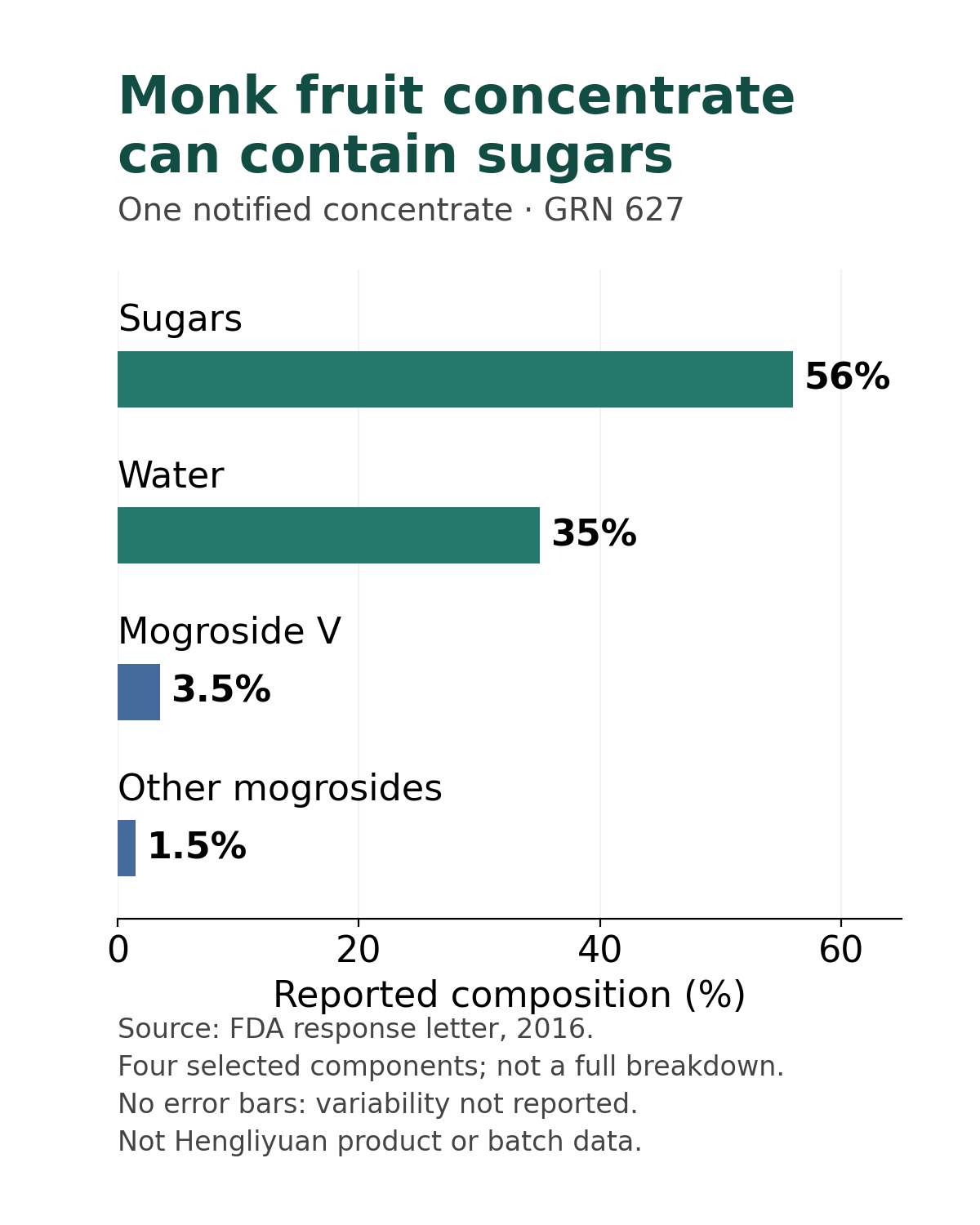
A GRAS response concerns the notified material and intended uses. It is not blanket FDA approval of all monk fruit products, applications or ingredient names. The historical composition example is useful for understanding identity, not for selecting a current supplied grade.
Does a higher Mogroside V content always mean a better fit?
Mogroside V is an important extract specification, but it cannot determine application fit on its own. Consider the total-mogrosides method and reporting basis, other sweetening ingredients, carrier, color, dissolution and aftertaste. The same specification can perform differently in different bases. Acidity, flavor, minerals, protein and processing affect sweetness perception and aftertaste. Water screening can help compare ingredients; confirm the selected sample in the actual food or beverage.
How to choose product form according to application
| Project needs | Directions that can be prioritized for discussion | Questions that need to be answered by the sample |
|---|---|---|
| Add extra sweetness to existing food or beverages | Monk fruit extract or mogroside raw material | Which specification can achieve the target sweetness, aftertaste and dissolution performance? |
| Retain juice or monk fruit flavor | Juice concentrate or juice powder | Do sugars, solids, color and fruit notes fit the complete formula? |
| Use a scoop, packet or fixed-gram serving | A prepared sweetener blend | Does the tested sweetness match the intended serving, weighing method and instructions? |
| Replace sugar in bakery products | A blend with suitable bulking ingredients | What changes in batter or dough structure, browning, moisture retention and texture? |
| Make a drink powder or powdered food | Extract, juice powder or a custom blend | How do dispersion, dissolution, moisture sensitivity, aftertaste and mixing compare? |
Baking, stick packs and beverage powders need different ingredient roles. High-intensity extract supplies sweetness but does not replace the mass, solids and structure of sucrose gram for gram. A blend can make direct weighing or a fixed serving more practical; confirm its complete ingredients and performance in the intended application.
Compare Mogroside V, total mogrosides and Brix separately
Start by confirming the material identity: extract, juice concentrate, juice powder or a blend. Then ask which test method and reporting basis are used for Mogroside V and total mogrosides, whether Brix applies to the liquid material, and whether the figures belong to the same batch and product version. A public specification can explain the terms, but it cannot establish Hengliyuan's current grade or batch result. For a sample, compare the requested document fields with the actual beverage, bakery or other application rather than selecting on one percentage alone.
Choose the ingredient before making nutrition claims
Where the target market permits it, a high-intensity extract can be a useful starting point for reducing the sweetening system's sugar or energy contribution because its use level can be low. Compare actual residual sugars, carriers and tested dose rather than treating all blends as higher in energy or assuming that every extract is sugar-free. Check Mogroside V, total mogrosides, residual sugars, carriers and the intended inclusion rate against the complete formulation. Finished-product nutrition and the applicable claim conditions determine the label; the ingredient name or a sweetness multiple does not.
Check ingredient permission and label claims separately
First check the identity and intended use of the ingredient in the final sales market. Then review the finished formula, nutrition, serving or per-100-g/mL basis and the exact claim wording. The following is a comparison of review paths, not a global approval list.
| Market | Ingredient-use review | Sugar claim review | Energy claim review |
|---|---|---|---|
| China | GB 2760-2024 lists monk fruit mogrosides, CNS 19.015. Check the listed identity, food category, Table A.2 exceptions and applicable conditions. | Under GB 28050-2011, no-sugar condition: sugars ≤0.5 g/100 g for solids or /100 mL for liquids. | No-energy condition: ≤17 kJ/100 g for solids or /100 mL for liquids. |
| United States | Match the material and intended use to the relevant GRAS basis and any applicable food standard. A response letter is not blanket approval. | Generally <0.5 g sugars per RACC and labeled serving; meal/main-dish rules differ. Ingredient and calorie-label conditions also apply under 21 CFR 101.60(c). | Calorie-free: <5 kcal per RACC and labeled serving, subject to the applicable general and labeling conditions. |
| Canada | Permitted sweeteners list M.4: monk fruit extract in table-top sweeteners, maximum 8,000 ppm calculated as Mogroside V. | <0.5 g sugars per reference amount and stated serving; except chewing gum, the food must also meet the low-energy conditions. | Free of energy: <5 Calories or 21 kJ per reference amount and stated serving. |
| Australia and New Zealand | Monk fruit extract was permitted through A1129; check the current Code conditions for the exact ingredient and food. | Schedule 4 lists “% Free” and “Low” separately from other claim wording. Low sugar: ≤2.5 g/100 mL for liquids or ≤5 g/100 g for solids; do not present these as a universal sugar-free threshold. | Schedule 4 low energy: ≤80 kJ/100 mL for liquids or ≤170 kJ/100 g for solids. Do not rename this zero-calorie. |
For US sugar-free wording, the numeric threshold alone is incomplete: check sugar-containing ingredients and any required ingredient-list explanation, plus the low/reduced-calorie claim or accompanying calorie statement under 21 CFR 101.60(c). New US projects containing allulose need separate state and wording review; this table does not clear zero-sugar, sugar-free or no-added-sugar artwork for those products. China's GB 28050-2025 takes effect on March 16, 2027. The official Q&A applies the new labeling requirements to foods produced after that date and allows earlier-produced foods to sell through their shelf life. Review the production date and transition route rather than only the launch date. The EU's 2024 non-novel conclusion concerns non-selective monk fruit water decoctions, not selective extraction of the sweetening components. It does not establish that a high-intensity extract is authorized as a sweetener. Confirm the current route for the particular material and use; the 2019 EFSA assessment is historical safety evidence, not a current authorization list. Juice concentrate can contribute natural sugars. Erythritol, allulose, maltodextrin and other blend ingredients can change nutrition calculations and claim review. Use the full formula and relevant product documents.
Start with the application, even if the form is undecided
Tell us the final sales market, what you plan to make and the sweetness or taste problem you want to solve. If you are unsure which form you need, say so; a complete formula, final packaging and finished test record are not required for the first conversation. As the discussion develops, add the product form, existing sugar or control, serving and preparation method, process, target sweetness, pack, estimated quantity and required documents when known. Agree the sample identity and test question before comparing results, and confirm the quotation scope separately.
Official sources and specification reading
Sources checked for the specific figures and review paths above. Historical notifications and assessments describe their named materials; use current rules and matching documents for a new project.
- US FDA instructions on monk fruit extract and other sweeteners
- US FDA GRAS Notice No. 627 Reply
- US calorie and sugar claim conditions: 21 CFR 101.60
- List of Approved Sweeteners in Canada
- Canadian Nutrition Facts Content Claim Conditions Table
- Food Standards Australia and New Zealand Monk Fruit Extract Application and Approval Information
- Australia/New Zealand Schedule 4: current nutrition claim conditions
- Announcement of the National Health Commission of China on the release of GB 2760-2024
- China GB 28050-2011 General principles for nutrition labeling of prepackaged foods
- Note from the National Health Commission of China on the implementation date of GB 28050-2025
- Conclusions of EU Member States on the new food status of monk fruit decoction
- EFSA evaluation of monk fruit extract
- FSANZ sugar labeling: exact claim wording
Common questions
Is monk fruit sweetener the same as monk fruit sugar?
“Monk fruit sugar” is a broad marketing term. It does not tell you whether the material is whole fruit powder, juice concentrate, juice powder, extract or a prepared blend. Check the actual product name and full ingredients; the term does not establish sugar content.
Discuss this requestCan I replace sugar one for one with monk fruit extract?
A high-intensity extract is not a gram-for-gram substitute for sucrose. A prepared blend may be designed for a particular replacement or serving, but confirm whether that comparison is by weight or volume, its tested sweetness and its role in the recipe.
Discuss this requestDoes a higher Mogroside V percentage give a fixed lower dose?
No fixed dose follows from the percentage alone. Assay basis, total mogrosides, other ingredients, target sweetness and the food base matter. Compare identified samples at measured doses in the same application.
Discuss this requestWhy might a juice concentrate contain sugar?
Juice and standardized high-intensity extract retain different components. The GRN 627 composition example above includes both sugars and mogrosides. Use the composition of the actual supplied material for nutrition calculations.
Discuss this requestDoes Brix tell me the Mogroside V content?
No. Brix is a soluble-solids reading for a liquid material; Mogroside V and total mogrosides are assay fields. Check their methods, reporting basis, sample identity and batch documents separately.
Discuss this requestCan I ask for help before choosing a specification?
Yes. Start with the product, final sales market and problem you want the sample to answer. Product form, packaging, quantity and documents can be clarified as the discussion develops.
Discuss this requestDoes a monk fruit ingredient make the finished food sugar-free?
The ingredient name does not establish a finished-food claim. Check all ingredients and their use levels, finished-product nutrition, the market, the exact wording and applicable conditions. Ingredient permission and nutrition claims are separate reviews.
Discuss this request