
Read this guide in
CHINA SUPPLIER GUIDE
How to compare a monk fruit extract supplier in China
How to compare monk fruit extract suppliers in China by product identity, assay basis and a sample matched to its specification.
Our advice is to compare the material, the sample and the supplier’s responsibility together. Confirm the product form and assay basis, identify who manufactures the quoted grade, and connect the specification and batch COA to the sample. Then compare application performance and cost at the dose your product actually needs. A higher percentage or lower price per kilogram does not settle the purchase.
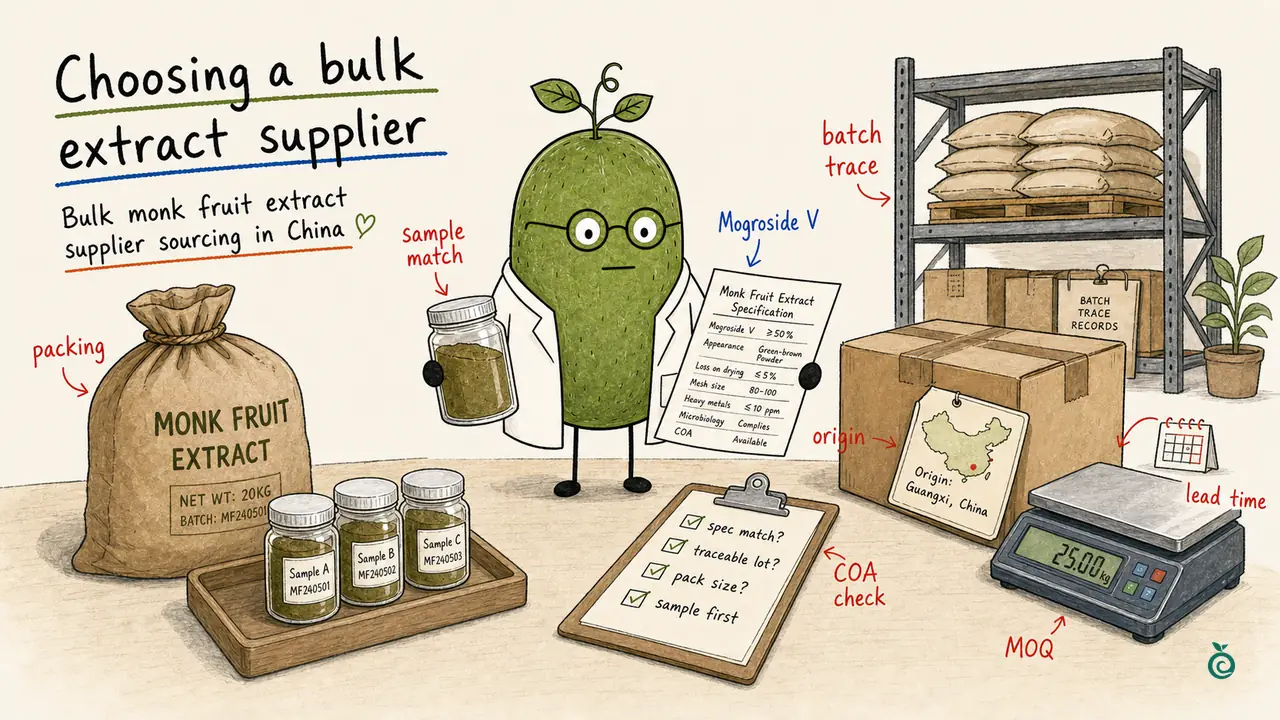
First confirm that you are buying monk fruit extract
'Monk fruit,' 'Luo Han Guo' and Siraitia grosvenorii identify the fruit, but they do not identify one fixed commercial ingredient. Suppliers may be quoting an extract, juice concentrate, juice powder, fruit powder or a finished sweetener blend. If your project needs a finished blend or private-label pack, use a blending or OEM brief instead of asking suppliers to quote it as pure extract.
| Product form | What it is | What the buyer should confirm |
|---|---|---|
| Monk fruit extract | A concentrated ingredient described by one or more mogroside measures | Analyte, assay method and basis, acceptance range, product form, carrier and batch COA |
| Monk fruit juice concentrate | A liquid juice-derived ingredient | Brix or solids basis, sugar profile, storage, packaging and intended application |
| Monk fruit juice powder | A dried juice ingredient that may include a carrier | Full composition, carrier, solubility, hygroscopicity and handling |
| Whole monk fruit powder | Dried or milled fruit material | Fruit part, processing route, particle size, flavor, color and dispersibility |
| Finished sweetener blend | Extract combined with bulking ingredients or other sweeteners | Full ingredient list, relative sweetness, serving or dosage, application and label route |
Do not compare percentages until the assay terms match
Mogroside V is one constituent within the broader group of mogrosides. “50% total mogrosides” and “50% Mogroside V” are different measurements. Before comparing offers, confirm the analyte, test method, reporting basis, acceptance range and any carrier. Ask which sample and batch COA correspond to those terms. EFSA’s 2019 review describes multiple mogrosides in monk fruit extracts. The FDA letter for GRN 629 also names several proposed Mogroside V levels, but records that the notifier withdrew that notice and FDA ceased its evaluation. Neither document verifies a Hengliyuan batch or establishes approval for a buyer’s finished product. Use the actual specification and relevant market documents for the material being offered.
Confirm who makes the quoted grade and who handles the documents
A supplier may manufacture the selected extract, source it from another factory, or handle blending and packing. Ask about the specific material being quoted. A factory address or a company certificate does not establish the source of every grade in a supplier’s range. For a Hengliyuan inquiry, confirm the manufacturing source and matching documents for the selected specification. If an alternative source is proposed, review its specification and sample before accepting the substitution. Keep the agreed source, product version and sample reference in the purchasing record.
| Checkpoint | What should match | What to resolve before ordering |
|---|---|---|
| Manufacturer and supply role | The manufacturing entity/site for the quoted grade, and the seller responsible for delivery. | Which party supplies batch documents and handles quality questions? |
| Specification and sample | Product code, grade, composition, specification version and sample reference. | Is the quotation for the material you evaluated? |
| Batch COA | Batch identity, reported results, methods or references and applicable limits. | An earlier sample COA does not report results for a future shipment. |
| Certificates and changes | Entity/site, scope, validity and the source/product version agreed for the order. | Confirm how a source or specification change will be communicated and reviewed. |
A certificate or audit report supports its stated scope. Check the connection to the selected material rather than treating a document folder as proof that every grade, site, blend or destination is covered.
Use each sample round to answer a clear question
Start with the application and the issue the sample should resolve: a lingering finish, color, clarity, dissolution or a target dose. A buyer does not need to order unrelated grades and build every comparison alone. We can discuss the useful sample directions first. Then test the selected candidates in the real product under the intended process and serving conditions. Match the target sweetness before deciding which taste profile you prefer. Record the actual dose, sweetness timing, lingering notes, aroma interaction and mouthfeel; add clarity, sediment or dispersion where relevant. Retain the sample code and test conditions so the accepted direction can be connected to the specification and quotation. That comparison selects an application direction. Finished-product stability, shelf life, nutrition and market requirements still need their own checks.
Compare application fit, not only laboratory content
A higher assay is not automatically the better purchase. The appropriate direction depends on target dosage, taste profile, process, cost in use and the finished product. For beverages, compare sweetness timing, aftertaste, solubility, clarity, aroma interaction and sediment in the real base. For bakery products, sugar also affects bulk, moisture, browning and structure, so concentrated sweetness alone does not complete the replacement. For dry mixes, check dispersion, blend uniformity, flow, moisture pickup and serving accuracy. Keep a current formula or sugar-containing control where practical, change one main variable at a time and record results under the same preparation and serving conditions.
Put all suppliers into the same quotation table
Before deciding that one supplier is cheaper, normalize the offer. MOQ, available pack formats, stock, lead time and document availability must be confirmed for the selected specification and order; they should not be inferred from a generic supplier page.
| Quotation field | What to compare |
|---|---|
| Product identity | Extract rather than a juice ingredient or finished blend |
| Analytical specification | The same analyte, method, basis and acceptance range |
| Composition | Carrier and all other declared ingredients |
| Sample link | Accepted sample code and corresponding product version |
| Packaging and quantity | Inner material, net weight, outer pack, trial quantity, MOQ and planned order quantity |
| Documents | Specification, batch COA and project-relevant quality or export files |
| Commercial basis | Currency, Incoterms, named place, freight inclusion, validity and timing assumptions |
Compare cost at the tested dose, not just price per kilogram
For each candidate, calculate sweetener ingredient cost per 1,000 servings = price per kg × dose in grams per serving. This works because 1,000 servings at d grams each use d kilograms. Use the same currency, delivery basis and accepted sweetness target. The example below uses indices, not supplier prices. Suppose Candidate B costs 30% more per kilogram but meets the same application target at 30% less dose. Its ingredient cost per serving is 1.30 × 0.70 = 0.91 of Candidate A’s, or 9% lower. The lower dose is an assumption for this calculation, not a result inferred from Mogroside V percentage.
| Illustrative comparison | Candidate A | Candidate B |
|---|---|---|
| Price per kg index | 100 | 130 |
| Dose index at the same accepted target | 100 | 70 |
| Ingredient cost per serving index | 100 | 91 |
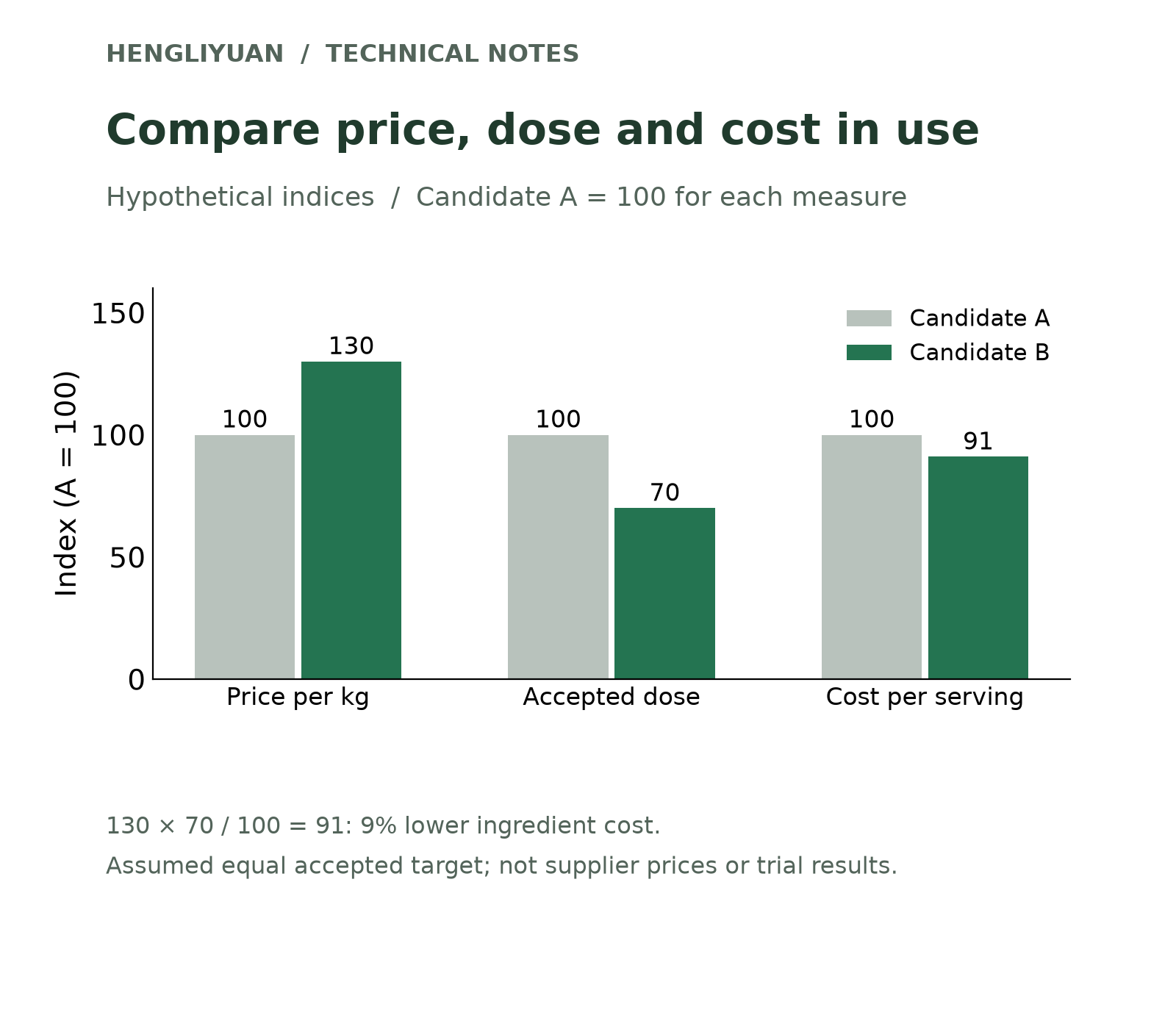
Use doses established by your own sample comparison. If B needs the same dose as A, its ingredient cost would be 30% higher instead. Include freight, duties where applicable, handling and any formula changes separately when comparing total delivered or finished-product cost. An assay percentage alone cannot provide the dose or the cost saving.
What Hengliyuan needs for a useful first reply
Send the product you are making, the destination market and the decision you need help with. If you have a target grade, current sample, dosage or trial quantity, include it. Those details let us discuss a relevant sample or quotation without requiring a finished technical brief first. Before an order is confirmed, use the quotation table above to close the remaining specification, source, packaging and delivery details. Record the accepted sample and any unresolved conditions; do not assume that an initial indicative offer fixes stock, lead time or the manufacturing source.
Review note
Reviewed October 16, 2026. The cost comparison is a calculated example, not a Hengliyuan quotation or a reported customer result.
Common questions
How do I compare two monk fruit extract suppliers?
Confirm the same product form and assay basis, identify the manufacturing source for the quoted grade, and connect each sample to its specification and COA. Compare candidates at the required sweetness in your real product, then calculate cost using the tested dose and comparable delivery terms.
Discuss this requestIs Mogroside V the same as total mogrosides?
No. Mogroside V is one constituent within the mogroside group. A percentage must name the analyte and its test and reporting basis before it can be compared with another offer.
Discuss this requestShould I request a sample before asking for a quotation?
You can discuss both together. Keep the quotation tied to the same product version as the sample, and test application-sensitive projects before locking the specification. An initial quote can help screen options; it does not replace confirming the accepted material and order terms.
Discuss this requestIs a higher Mogroside V percentage always more economical?
No. Compare actual ingredient cost at the dose needed to meet your taste and application target. A higher assay does not by itself establish a proportionally lower dose, a better finish or lower total formulation cost.
Discuss this requestDoes a batch COA prove that the extract will work in my product?
No. It reports defined results for the identified batch. Application fit needs testing in your product. A COA from a sampled batch also does not report results for a different future shipment; confirm the batch documents for the order.
Discuss this requestShould I ask whether the supplier manufactures every grade?
Ask who manufactures the specific grade being quoted and which party is responsible for documents, delivery and quality questions. When the source or specification changes, review the new material against the agreed requirements rather than assuming the earlier sample still represents it.
Discuss this requestWhat should be included in the first inquiry?
Start with your product, destination market and main question. Share a target grade, reference sample, dose or trial quantity if available. A complete specification is not required to begin the discussion; the remaining details can be confirmed before ordering.
Discuss this request