
Read this guide in
Hengliyuan applications and selection
How to Choose an Allulose–Monk Fruit Blend: Ingredients, Ratio, and Sweetness
How to choose an allulose-monk fruit blend: confirm ingredient names, blend ratio and sweetness target before buying, then trial in your product.
Before buying an allulose–monk fruit blend, confirm four things: the full ingredients, their proportions, the target sweetness and the specification for the selected sample. Our advice is to choose the sample and its documented formula together. The name “allulose–monk fruit” alone tells you neither the dose nor how it will taste in your product.
Hengliyuan provides buyers of finished sweetener blends with full ingredient names, the exact proportion of each ingredient, target sweetness and finished-product specifications. Customers can supply an existing formula or describe the application, and Hengliyuan can help select ingredients and make adjustments.
Define the application before the formula
Before development, customers can state three requirements: the intended food, the desired sweetness and any unacceptable ingredients. For baking, for example, sweetness, browning and finished texture all matter; for tabletop sweeteners, clarify how consumers will dispense each serving. If equal-weight replacement of sugar is desired, specify this as a development target rather than assuming every blend replaces sugar one for one. In an allulose–monk fruit combination, allulose provides the base and monk fruit extract supplements and adjusts sweetness. If a customer excludes stevia, Hengliyuan can develop a stevia-free option; if stevia is acceptable, stevia-containing options can also be compared. Final ingredient selection depends on customer requirements and sample performance.
What information does Hengliyuan provide?
Buyers of finished blends can receive the following information:
| Information | What the customer can confirm |
|---|---|
| Full ingredient names | Exactly what the product contains and whether it meets ingredient requirements |
| Exact ingredient proportions | How much of each ingredient is present in the blend |
| Target sweetness | The sweetness target used in development and how to determine dosage during trials |
| Finished-product specifications | The specific product ordered and its quality requirements |
This information must correspond to the selected sample. After formula changes, confirm the final version to avoid using outdated information for production or packaging design.
Once proportions are clear, evaluate the actual taste
Knowing the composition helps determine whether ingredient requirements are met; suitability for your food still requires trials. In Hengliyuan’s ingredient-selection experience, changing the grade of monk fruit extract affects both sweetness and taste. Even two products using allulose and monk fruit, with the same stated target sweetness, therefore require separate comparisons of initial sweetness and lingering sweetness. Add candidate blends to the same target food and adjust them to similar sweetness before tasting. Give specific feedback, such as weak initial sweetness, sweetness that lingers too long, or poor balance with the tea or coffee flavor. This makes the next adjustment easier to discuss. Distinguish monk fruit extract specifications from finished-blend specifications. For example, “made with an extract containing 50% mogroside V” describes the extract grade; it does not mean the finished blend contains 50% mogroside V.
Extract grade, blend ratio and finished content are different numbers
An extract grade describes the ingredient before blending. The blend ratio describes how much of that ingredient goes into the mix. Finished-blend content combines the two. Keeping them separate prevents a high extract assay from being mistaken for the composition of the entire product.
| Quantity in this hypothetical example | Calculation or meaning |
|---|---|
| Finished blend: 1,000 g | Total mass of the example mix. |
| Monk fruit extract inclusion: 0.10% by weight | 1,000 g × 0.001 = 1.0 g of extract. |
| Extract assay: 50% mogroside V by weight | 1.0 g × 0.50 = 0.50 g of mogroside V. |
| Calculated mogroside V in the finished blend | 0.50 g ÷ 1,000 g × 100 = 0.05% by weight. |
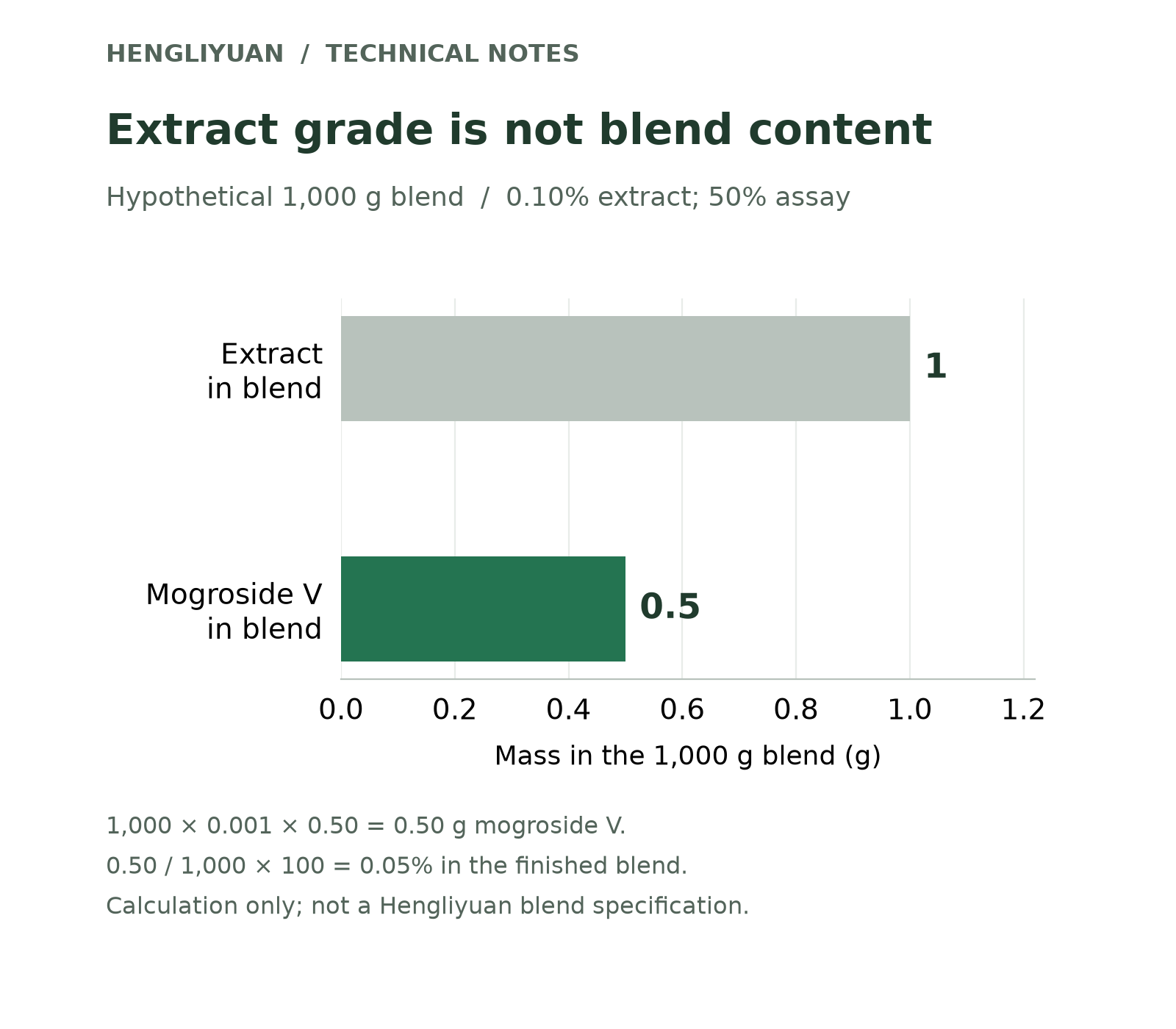
This is a hypothetical mass-balance example, not a Hengliyuan formula, recommended dose or batch test result. It assumes the assay and inclusion rate use the same as-is mass basis, the extract is the only source of mogroside V, and no material is lost. A dry-basis assay needs the appropriate moisture correction before use. For the selected product, read the agreed specification and lot documents. This calculation cannot establish blend uniformity, sensory performance or an actual laboratory assay. It also cannot convert mogroside V content directly into a reliable sugar-replacement ratio.
Confirm ordering and packaging after selecting the sample
Once the sample’s taste is agreed, confirm its ingredient names, proportions, target sweetness and finished-product specifications together before ordering. Recheck this information whenever the formula changes. When customers use the blend in their own finished products, ingredient names and proportions supplied by Hengliyuan can support ingredient-list preparation and label checks. Final packaging must still reflect the complete finished-product formula and the requirements of the country of sale. In particular, check allulose use conditions separately from requirements for claims such as “sugar-free” and “no added sugar.” When requesting samples, provide the target food, country of sale, desired sweetness and excluded ingredients. Discussions can start from an existing formula or, if none is available, from the application and taste requirements to determine a suitable blend together. Keep the approved sample code and formula revision with the purchase specification. If an ingredient grade or proportion changes, compare the revised sample before treating it as the same product. For an initial enquiry, the application and main requirement are enough to start; the remaining details can be confirmed during sample selection.
How Hengliyuan makes the corresponding blend
Hengliyuan makes its allulose-based sweetener blends by high-speed powder mixing, which distributes the powdered ingredients in the selected formula. This is a common powder-mixing method. Confirm blend uniformity, particle size and application performance against the selected specification and sample.
Review note
Reviewed October 16, 2026. The numerical example explains concentration arithmetic; actual orders follow the selected sample, agreed specification and current market requirements.
Common questions
What should I check before buying an allulose-monk fruit blend?
Confirm the full ingredient names, the proportion of each ingredient, target sweetness and finished-product specification. Then compare the sample in the food or beverage you intend to make.
Discuss this requestDo all allulose-monk fruit blends have the same sweetness?
No. Ingredient grades and proportions can differ. Ask for the intended sweetness of the selected blend rather than inferring it from the product name.
Discuss this requestDoes “50% mogroside V extract” mean the blend contains 50% mogroside V?
No. That number describes the extract grade. The finished-blend concentration also depends on the amount of extract added and the assay basis. For example, 0.10% extract inclusion multiplied by a 50% as-is assay gives a calculated 0.05% mogroside V in the blend, assuming no other source or loss. This is an arithmetic illustration, not a product specification.
Discuss this requestCan every blend replace sugar at the same weight?
No. Treat equal-weight sugar replacement as a development target. Confirm sweetness and the required bulk, browning and texture functions in your own product trials.
Discuss this requestHow should I compare the taste of candidate blends?
Use the same product base and a similar sweetness target. Record each sample identity and dosage, then compare sweetness, aftertaste and the original food or drink flavor.
Discuss this requestWhen should I confirm ordering and packaging details?
After selecting the sample and specification, confirm the required quantity, packing format and applicable documents in the project quotation. The article does not set a universal MOQ, price or lead time.
Discuss this request