
Read this guide in
FORMULATION COMPARISON
Allulose–Monk Fruit Sweetener Blend: Low-Calorie Project Buyer Brief
Prepare an allulose–monk fruit blend brief: define sugar replacement, application conditions, market, packaging and the question your sample should answer.
Start an allulose–monk fruit blend project by stating what sugar currently does in your product and what the sample must improve. Monk fruit provides high-intensity sweetness; allulose contributes material bulk and can affect mouthfeel and processing. The blend name alone does not specify the ratio, dose or sugar replacement.
Our view is that a useful sample brief starts with the real food or drink, its sugar reference and one clear comparison. A lower-calorie direction still needs the complete formula, serving basis and target-market review; it is not a finished-product claim.
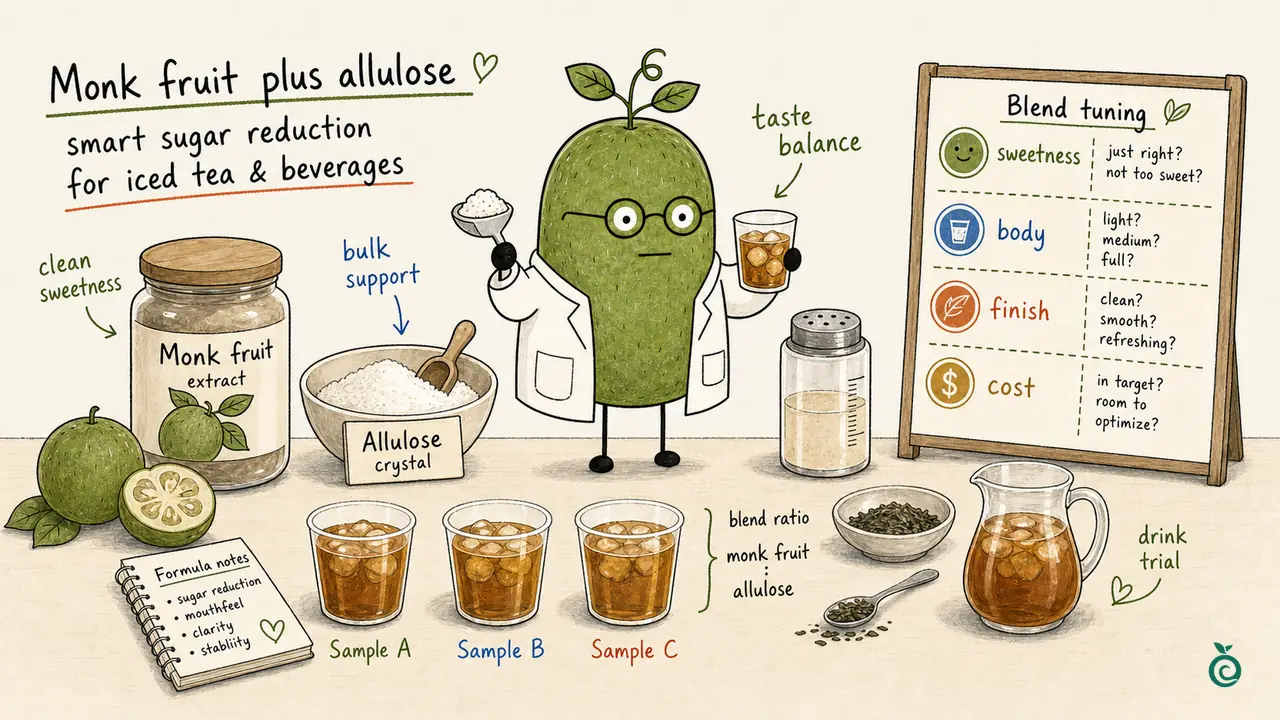
The illustrated iced-tea comparison separates sweetness, body, finish and cost. Judge those outcomes separately in the real drink; the drawing supplies no blend ratio, measured scores or validated formulation.
Why brands discuss monk fruit with allulose
Monk fruit can provide high-intensity sweetness at low dosage, while allulose can help with bulk, mouthfeel and sugar-like behavior in some applications. The blend goal is usually balance rather than using either ingredient alone.
Application matters more than the ingredient name
A drink powder, RTD beverage, bakery product, chocolate-style product, syrup and tabletop sweetener may need different sweetener systems. The same monk fruit and allulose idea may work in one format and fail in another. Record the state in which the customer consumes it: a powder after the intended dilution, a beverage at its serving temperature or a baked product after its actual process. A result in plain water cannot answer every finished-product question.
Check taste and dosage carefully
Keep the exact sample code or formula version with its specification and use level. State whether replacement is by mass, volume or a stated sweetness target; record ingredient grams and the final food or drink mass. For a powder drink, include the preparation ratio. Compare against the current sugar control in the same base, process and serving conditions. Record sweetness onset, lingering sweetness or bitterness, body and flavor separately. If sweetness matches but body does not, record that difference rather than calling the whole replacement equivalent. Compare cost at the use level that answers the application question, not just by price per kilogram.
Define the low-calorie project before choosing a blend
Low-calorie can refer to a sweetener product, a serving or a finished food. Record which one, the serving basis, the current sugar source, the target market and whether allulose is handled under local nutrition rules. U.S. FDA allulose guidance is a U.S.-specific reference; it does not set treatment in other markets. Ingredient names alone cannot establish a finished-product claim. Keep the intended packaging wording separate from the nutrition calculation. For a U.S. project, include the main sales state as well as the product category and channel. New packaging claims need the buyer’s qualified U.S. review; do not treat a supplier specification or COA as claim approval.
Confirm market and label rules
Allulose rules are not identical in every country. Before finalizing a blend, buyers should confirm whether allulose is allowed in the target market and how the ingredient must be declared on the label.
Specify format, carrier and pack
Separate the ingredient format from the sales pack: a bulk powder for a factory and a filled retail stick are different requests. Confirm the complete ingredient list, any carrier and the intended sweetness basis for the actual blend. Then describe the net weight per pack, number of units or bulk quantity, and whether the buyer needs ingredient supply or filling and packing. For several sizes or flavors, list each SKU separately. Mark undecided items as open questions. A picture of a retail blend does not establish its formula, and a powder-mixing route does not establish that a particular retail pack is available.
Turn the phrase into a sample brief
You do not need a complete commercial formula to start. Send the product type, target market and the main problem first. The table shows which additional details make a sample comparison useful; share what you already know and leave the rest open for discussion.
| Brief item | What to send or confirm | What it helps decide |
|---|---|---|
| Sugar reference | Current sugar ingredient and grams, final batch or serving mass; explain any volume-based replacement. | Whether both sides mean the same replacement target. |
| Real application | Product/base, preparation or dilution, addition stage, actual process and serving conditions. | Which sample and comparison conditions address the finished product. |
| One sample question | For example, match sweetness while checking lingering taste, or recover body at the chosen use level. | What the trial should measure and report back. |
| Material identity | Blend/sample code, full ingredient list and restrictions, sweetness basis and available specification. | Which formulation and document set the result refers to. |
| Market and label task | Destination market, serving basis and intended claim; main sales state for a U.S. project. | Which ingredient, nutrition and packaging questions need local review. |
| Supply and pack task | Bulk ingredient or retail pack, net weight and units per SKU, quantity, required documents and sample need. | What must be confirmed before sample dispatch or a comparable quotation. |
After the trial, return the sample code, actual dose, sugar control, preparation/process conditions and the result of the chosen comparison. Keep a successful taste result separate from batch specification approval, packing confirmation and the commercial quotation.
Compare with other blend directions
Depending on the product, buyers may also compare erythritol-free carriers, fibers, stevia combinations, pure monk fruit extract or other sweetener systems. The best option should be selected by testing, not by trend alone.
How Hengliyuan can discuss blend options
Hengliyuan can review monk fruit extract and sweetener blend directions based on the buyer's product type, target market, packaging plan, sample testing goal and document needs. We can begin with an incomplete brief and clarify the application before confirming a sample or offer. Availability, selected specification, packaging, quantity and delivery terms belong to that confirmation.
Technical references and boundary
FDA’s allulose nutrition-label guidance concerns U.S. nutrition declarations, while its high-intensity sweetener information explains the smaller amounts used for sweetness. Neither supplies a blend formula or establishes permission for another market. Use the market notes linked above for the relevant review; the sample comparison and the finished-product label decision remain separate.
How Hengliyuan makes the corresponding blend
Hengliyuan makes its allulose-based sweetener blends by high-speed powder mixing, which distributes the powdered ingredients in the selected formula. This is a common powder-mixing method. Confirm blend uniformity, particle size and application performance against the selected specification and sample.
Common questions
Why is my allulose and monk fruit blend not as sweet as expected?
Check the exact blend, sample code and dose first. A mass-based replacement, a volume-based replacement and a sweetness target are different instructions. Compare the actual grams in the same final food or drink, using the same sugar control and preparation conditions.
Discuss this requestWhy combine monk fruit and allulose?
They do different jobs. Monk fruit supplies high-intensity sweetness, while allulose contributes bulk and can affect body and processing. The useful combination depends on what sugar did in the original product and how the finished formula performs.
Discuss this requestDoes the blend automatically make a finished product low calorie?
No. Assess the complete formula and serving basis under the target-market rules. Keep the intended packaging claim separate from the nutrition calculation and supplier documents; those documents do not approve the finished-product claim.
Discuss this requestIs allulose allowed in every market?
No. Confirm the intended ingredient use and local labeling treatment before choosing the formula. U.S. FDA guidance does not establish another country’s rules. Include the main sales state for a U.S. packaging review.
Discuss this requestDo I need a full formula before asking for a sample?
No. Start with the product type, market and problem to solve. Add the current sugar reference, serving or batch basis, restrictions and sample question when available. We can clarify missing details before confirming the sample and quotation.
Discuss this requestCan this blend replace sugar 1:1?
Only the selected product’s declared basis and application test can answer that. State whether 1:1 means equal mass, equal volume or a sweetness comparison. Matching sweetness does not automatically match bulk, moisture behavior, texture or browning.
Discuss this requestWhat should I send after the sample test?
Return the sample code or formula version, actual use level, sugar control, final product mass or dilution, process and serving conditions, and the result of the agreed comparison. Report sweetness, aftertaste and body separately so the next sample addresses the remaining issue.
Discuss this request