
Read this guide in
SNACK BAR SUGAR REDUCTION
Protein Bar Sweetener Guide: Binders, Texture & Moisture Testing for Low-Sugar Snack Bars
Compare protein and snack bar sweeteners by binder solids, water contribution, forming, cutting and wrapped storage. Plan controlled trials before choosing a syrup swap.
Choose a protein-bar sweetener together with the binder system. Match the sweetness target, account for the solids and water entering the bar, then compare forming, cutting, bite and wrapped-storage performance against the current formula.
When a reduced-sugar snack bar becomes hard or sticky, first separate forming and cutting behavior from moisture movement during wrapped storage. Sugar syrup may sweeten the bar, but it can also bind dry ingredients, hold moisture, influence water activity, soften bite and carry flavor.
Our first question is which job the removed sugar or syrup was doing. A whey-protein bar, a granola bar and a nut cluster need different binding and texture decisions. The same sweetness does not make their ingredient systems interchangeable.
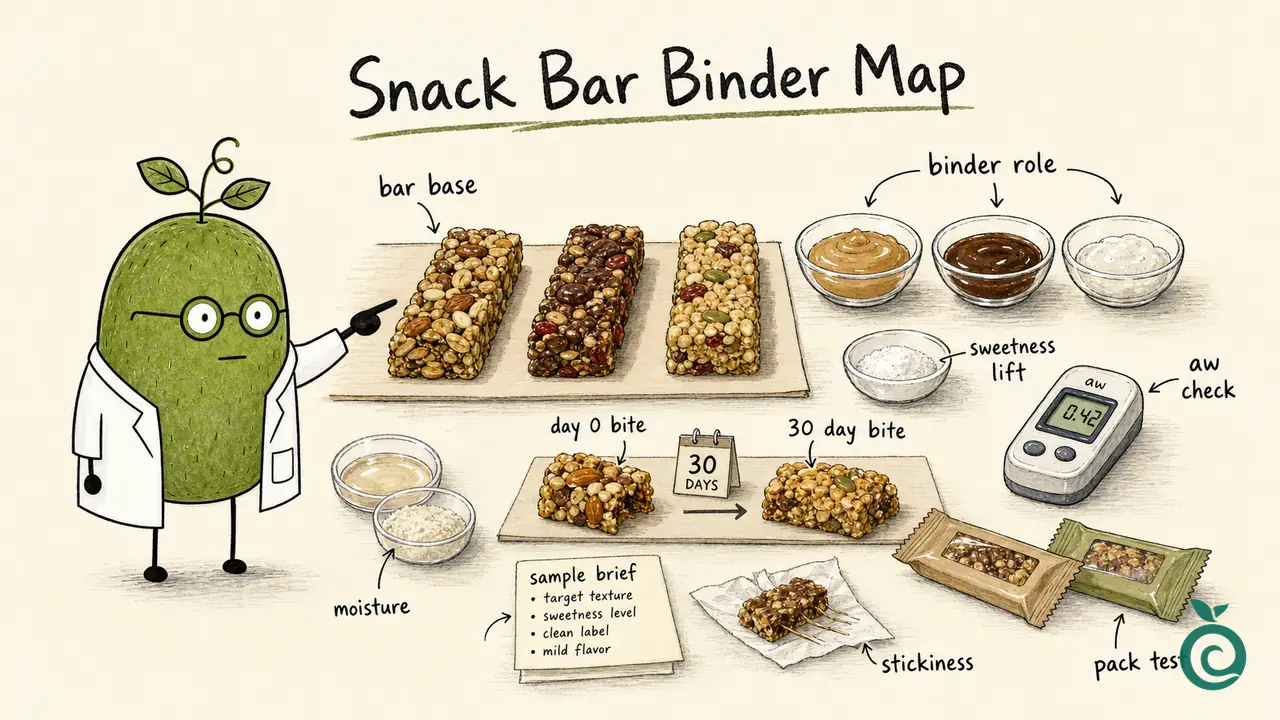
Treat the bar as a complete forming and storage system
Both drinks and bars need more than a sweetness check. A bar also has to mix, form, cool, cut and release from its wrapper while keeping the required bite during storage. Monk fruit and stevia can supply sweetness at low use levels, but their small addition does not replace the removed syrup mass or binding function.
Start with the bar matrix
Record the exact protein source and grade, cereal/nut inclusions, fat system, current syrup or binder, fiber and polyol ingredients, process temperature, bar dimensions and packaging. Identify the main defect before selecting the first trial: crumbling at forming, blade sticking, wrapper transfer, a firm center or an unwanted taste. A product called a natural syrup or a fiber blend still needs an ingredient identity and specification.
Separate sweetness from binding
Select each component for a defined job: sweetness, bulk, binding, moisture handling or process behaviour. Allulose, fiber ingredients, polyols, syrups and hydrocolloids are different materials, and each needs the appropriate market-use review. Ask for the exact form and composition; a powder and a syrup with the same ingredient name bring different amounts of water into the bar.
Compare binder solids and water before a weight-for-weight swap
Use supplier composition data and a suitable solids or moisture method. As a hypothetical mass example, 100 g of binder at 70% dry solids brings 70 g solids and 30 g water; 100 g at 50% brings 50 g of each. Neither concentration is a Hengliyuan specification or a recommended formula. Matching dry solids is only a starting mass balance: it does not prove equal binding, sweetness, viscosity or water activity.
| Check on each candidate | Record on the same basis | Why it affects the comparison |
|---|---|---|
| Identity and form | Full composition, powder/syrup form, carrier, supplier grade and lot | Similar ingredient names can describe different supplied materials. |
| Solids and water | As-supplied mass, dry-solids fraction, moisture method and added process water | A 1:1 mass swap may change both water and solids. |
| Handling | Viscosity or flow at the stated temperature; mixing order and hydration/rest conditions | A room-temperature sample may behave differently at forming. |
| Nutrition and market use | Ingredient-specific sugar/fiber/polyol data and intended sales category | Dry solids are not automatically all sugar, all fiber or claim-ready. |
If a report gives refractometer °Brix, ask whether that method is suitable for this material; do not silently equate every Brix reading with the dry-solids fraction of a mixed fiber or polyol binder.
Track hardening over storage
Keep a current-formula control and a clearly identified candidate. Fix the protein lot, inclusions, bar dimensions, process and package where possible, and record every intentional change. Measure texture at a defined time after production and at matched storage checkpoints. Use the same test temperature, geometry and instrument settings; compare the bar’s sensory bite separately from instrumental hardness.
| When the defect appears | Record first | Next comparison |
|---|---|---|
| During mixing or forming | Actual ingredient/water masses, mix temperature, hydration time, visible crumbling or slumping | Separate a binder composition change from a process-temperature or mixing change. |
| At cutting or wrapping | Rest/cooling time, bar temperature, dimensions, blade sticking and wrapper transfer | Check the same product after the same rest before changing the formula. |
| After wrapped storage | Surface versus center, moisture/aw method and location, hardness, chew and package seal | Compare retained control and candidate under the same storage conditions. |
| At tasting | Matched bar age and serving temperature, sweetness timing, bitterness, cooling and protein note | Do not use sweetness in water as approval of finished-bar taste. |
Check the package and storage path
Record the package, seal, temperature, humidity and opening status at each checkpoint. Surface tack, wrapper transfer and a firm center are separate observations. A hardness result alone cannot prove moisture migration: if that is the question, use a defined sampling method for the relevant parts of the bar. A short screen selects the next trial; the finished product still needs its own shelf-life validation.
Taste in the finished bar
Compare samples at a similar perceived sweetness after the same defined rest, then record onset, peak, lingering sweetness, bitterness, cooling and interaction with protein, cocoa, cereal, nuts or fruit. Keep this taste comparison distinct from a physical binder trial. The 2020 protein-bar study evaluated sweetener and protein source together, supporting finished-matrix comparison rather than one universal sweetness ratio.
Prepare a supplier brief
Send the sales market, bar type, protein/cereal base, exact current binder and supplied form, current use level, reduction goal and main defect. Add the forming/cooling/cutting process, package, storage conditions and available control results. Quantities and required documents help the supply discussion; start with the details already known.
What the studies support
The 2026 hydrocolloid/polyol protein-bar trial tracked moisture, water activity, hardness and sensory results at production and after storage. The date-derived cereal-bar and FOS-granola studies also evaluated their own ingredient systems. These are reasons to measure several outcomes together, not evidence that one reported ratio will work in your bar. Confirm the supplied material and water balance before adapting a published formulation.
Common questions
Can monk fruit or stevia sweeten protein bars?
Yes. They can supply sweetness, while the complete formula still needs appropriate bulk, binding, water management and storage testing. Check the selected ingredient and intended use for the sales market.
Discuss this requestCan I replace one syrup with the same weight of another?
Do not assume equivalence. Compare identity, composition, dry solids, water and handling at the process temperature. Matching either total mass or dry solids does not establish equal binding or finished-bar performance.
Discuss this requestHow can buyers separate forming problems from storage changes?
Record mixing, forming, cooling and cutting first, then compare retained bars after wrapping at matched checkpoints. Note surface tack, wrapper transfer, center texture, moisture/aw and hardness separately. A defect’s location is a clue, not proof of its cause.
Discuss this requestCan allulose or FOS replace syrup in snack bars?
They can be evaluated as specific materials where the intended market use allows them. Confirm whether the candidate is a powder or syrup and account for its composition and water contribution. Do not copy a substitution percentage across different materials and bar bases.
Discuss this requestDoes low water activity or a soft first bite prove shelf life?
No. Water activity, initial bite, stored texture, packaging and the product’s other validation requirements answer different questions. A short texture screen does not approve a shelf-life date.
Discuss this requestWhat should buyers send before snack bar samples?
Send the market, bar base, protein grade, current binder identity/form and use level, reduction goal, process and main defect. Add packaging, storage and control results; quantities and required documents can follow when known.
Discuss this request