
Read this guide in
YOGURT SAMPLE RELEASE
Low-sugar yogurt: Separate sweetness, gel and syneresis
Compare low-sugar yogurt samples with separate sweetness, gel, viscosity and whey-separation checks. Keep solids, handling and cold-storage methods documented.
A low-sugar yogurt can taste sweet enough and still miss the texture brief. Our view is to evaluate sweetness, acid gel, whey separation and cold-storage changes separately before choosing the next blend.
Start with the real yogurt base and a retained control. Set yogurt, stirred yogurt and drinkable fermented products need different handling and physical checks; a spoonful from a stirred cup cannot describe the original undisturbed gel.
Here, sample approval means accepting a defined formulation result or moving to the next test. It does not replace production release, process safety, shelf-life validation or a finished-pack sugar claim.
Start with the job the sweetener must do
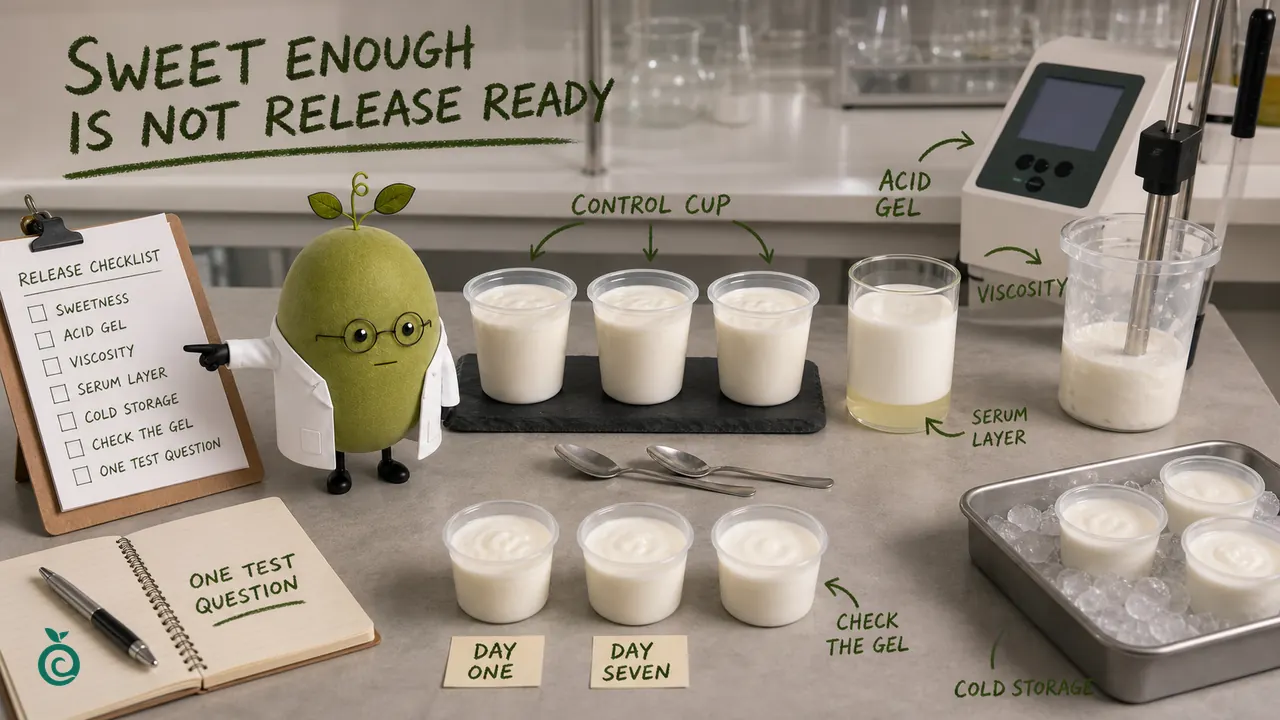
State whether you need a sweetness lift, partial sucrose reduction, a different sweetness curve or an erythritol-free direction. Monk fruit and stevia contribute sweetness at low use levels and little replacement mass. Record what replaces the removed sugar solids and how much water that replacement introduces. Allulose-supported directions require suitability and target-market review; sweetness potency alone does not decide a yogurt formula.
Treat the acid gel as its own release gate
Keep protein and total solids, milk treatment, culture, fermentation endpoint and cooling history with the sample code. Separate set, stirred and drinkable products before comparing results. For a stirred product, record when and how the gel was broken, any fruit addition and the filling history. Plant-based systems need their own base-specific comparison; do not transfer a dairy-gel result directly to soy, oat or coconut products.
Measure syneresis instead of guessing from one spoon
Observe the retained cup before shaking, spooning or mixing it. Record the visible serum and surface condition, then use a separate sample for the agreed stirring, texture or laboratory test. A drained-mass test, centrifuge test and visible layer-height measurement are different methods. Keep sample mass, time, temperature and the calculation with every percentage; for centrifuge methods also record relative centrifugal force and the rotor details when needed, because rpm alone does not specify the force.
| Sample / check | Record consistently | Keep the conclusion separate |
|---|---|---|
| Undisturbed retained cup | Cup/fill, storage time and temperature, opening status, surface photo and visible serum before handling | Describes appearance; stirring first can hide the original separation. |
| Defined stirred or spooned sample | Mixing or spooning procedure, serving temperature and time after handling | Describes texture and taste after that handling, not the original set gel. |
| Syneresis / water-holding method | Method, sample size, separation conditions and numerator/denominator | Use the same definition throughout; water-holding capacity is not automatically 100 minus any syneresis result. |
| Rheology or texture test | Geometry/probe, shear or oscillation settings, temperature and loading history | Apparent viscosity, gel moduli and instrumental hardness are different outputs. |
| pH / titratable acidity | Method, sample temperature, titration endpoint, unit and reporting basis if applicable | Read alongside taste; one pH result does not define every aspect of sourness or stability. |
Use a three-lane sample matrix
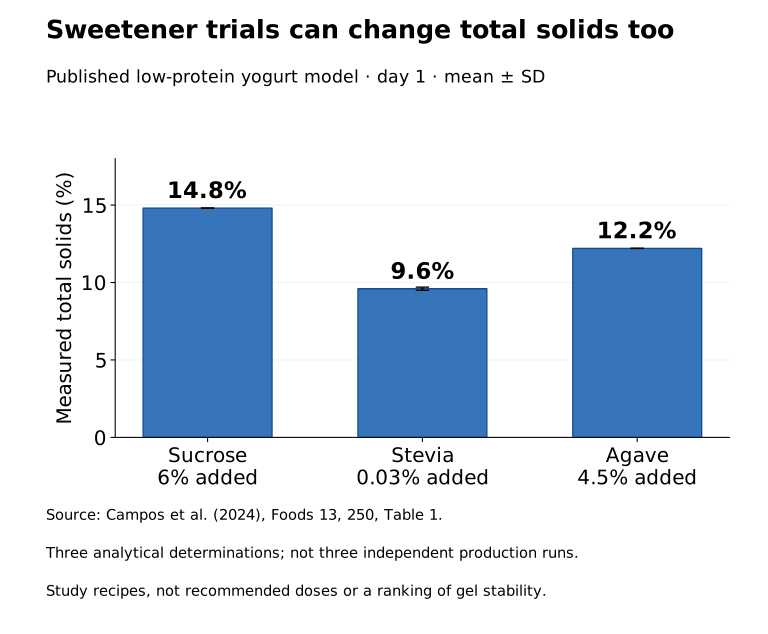
Keep the current or sucrose control, a sweetness-focused candidate and a defined solids or structure-support candidate where needed. Document the full formula differences. Holding the base, culture and process steady helps interpretation, but a sugar-to-stevia comparison is not automatically matched for total solids. Treat a later protein, stabilizer or fruit change as its own trial direction.
Record the fields buyers can act on
Use the same cold-storage conditions and record the actual temperature history. Agree checkpoints for each output instead of assuming every test uses the same days. Keep unopened retained cups apart from opened-use trials, and allocate separate cups for destructive measurements. With each taste note, record initial sweetness, peak and finish alongside sourness, bitterness, body and watery mouthfeel. Use the existing sensory scorecard for that part of the record.
Release the sample only against the stated question
Write the question, observed result, remaining gap and next action together. Agree acceptance criteria against the product brief before reviewing the sample. A candidate can pass its sweetness screen while its physical behavior remains under review; another can meet the texture target and still need a different finish. Avoid a single “approved” mark that hides which checks were actually completed.
| Question under review | Evidence to keep | Useful decision wording |
|---|---|---|
| Is the sweetness direction suitable? | Control, coded taste notes, serving conditions and actual recipe differences | Sweetness accepted for this base; physical/storage checks remain open. |
| Does the physical system meet the brief? | Defined gel/flow/texture and separation methods, handling and results | Texture accepted under the stated method; taste finish needs another screen. |
| What does the cold-storage screen show? | Independent retained samples, package, temperature history and agreed checkpoints | Meets the agreed screening criteria at the tested times; shelf-life validation is separate. |
Research helps define the checks
The 2024 low-fat yogurt study measured composition, sensory and physical properties using different schedules; it did not establish one universal yogurt test calendar. The gel-stability review describes protein, polysaccharide and complex interactions. Use these sources to choose measurements, then validate the actual base, process and package.
Common questions
If the yogurt is sweet enough, is the sample ready?
It may pass the sweetness screen. Check the defined gel, flow or texture target, separation and agreed cold-storage observations separately. A formulation screen is not production or shelf-life approval.
Discuss this requestDoes surface whey prove that the sweetener caused the problem?
No. Base composition, protein, solids, fermentation, handling, package and storage can all be relevant. Keep the original observation before mixing and compare controlled samples before assigning a cause.
Discuss this requestShould I stir every cup before assessing it?
Not for the first appearance check. Inspect undisturbed retained cups first, then use separate samples for a documented stirring, taste or instrumental procedure. Match the treatment to set, stirred or drinkable yogurt.
Discuss this requestCan I compare syneresis percentages from different laboratories?
Only after checking the method and calculation. Centrifuge force/time/temperature, drainage conditions and the reporting denominator can change what the percentage means. Do not substitute a visible whey-layer percentage for a mass-based laboratory result.
Discuss this requestDoes replacing sucrose with stevia keep the physical system unchanged?
No. Low-use sweetness does not replace the same mass of sugar solids. Document protein, total solids, added water and the complete replacement system before interpreting a texture difference as a sweetener effect.
Discuss this requestWhat should buyers send before requesting a yogurt sample?
Send the market, product type, dairy or plant base, reduction goal and main issue. Add protein/solids, current sugar system, culture/process, package, storage conditions and control results when available. Quantity, required documents and sample needs can follow when known.
Discuss this request