
Read this guide in
YOGURT SENSORY SCORECARD
Low-Sugar Yogurt Sweetener Testing: Sensory Scorecard Method
Download a free yogurt sensory Excel record without email signup. Keep sample identity, repeated-intake intensity, liking and physical observations separate.
Download the blank Excel scorecard below without leaving an email address. It gives the control and candidate a shared trial record, with separate observations for sweetness, aftertaste, liking and physical changes.
Our preference is to keep each assessor’s original record and carry one clear question into the next sample. A higher sweetness score does not mean greater liking, and a good taste score does not resolve an unexplained whey-off result.
The bench illustration separates taste, pH, viscosity and whey-off checks. Its displayed pH and cold-storage numbers are illustrative and do not set product specifications.
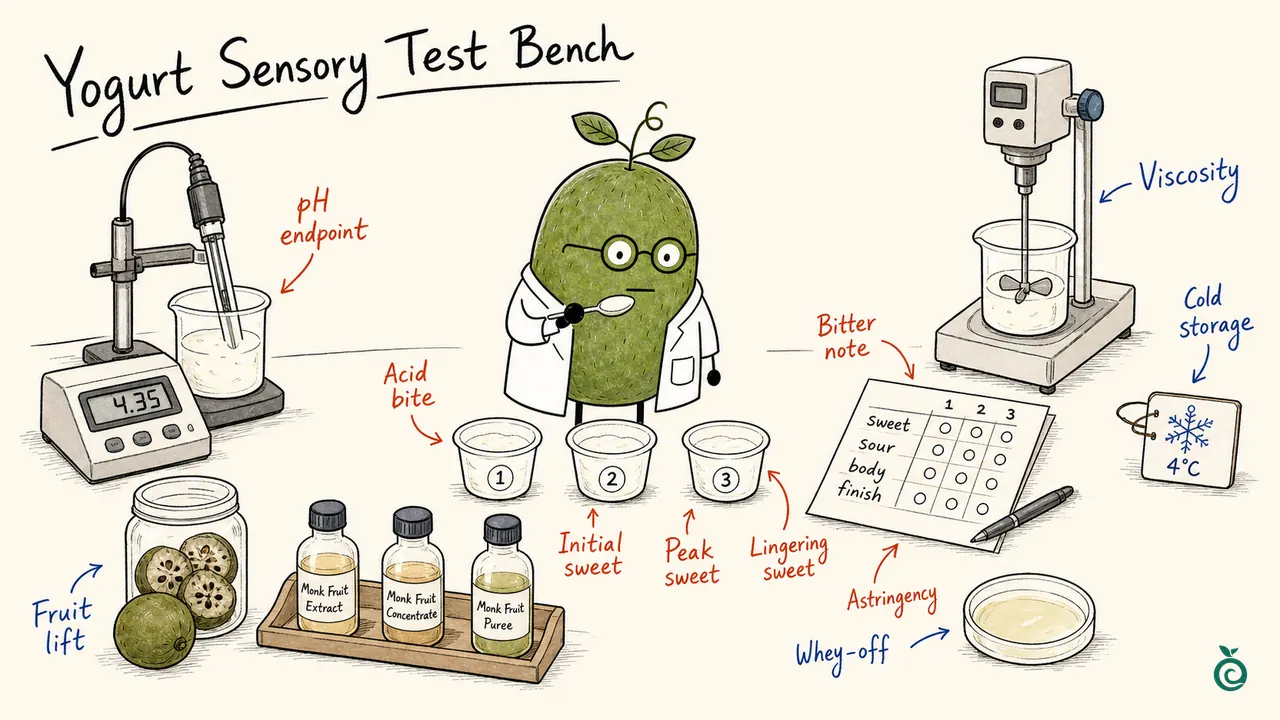
Download the yogurt sensory workbook
The Excel file has two sheets: Trial setup has 18 context fields with control and candidate columns; Sensory log has 30 prepared attribute rows for three intakes. Adjust the intake plan to your question, and copy rows for other samples, assessors or storage checkpoints. No test scores are prefilled.
Yellow cells are editable. Keep the trial ID, assessor code, sample code, storage day and intake number with each observation. Blank means not recorded; do not enter zero for a missing result. The file supplies no total score or automatic approval.
Fix the sample identity and conditions first
Record set, stirred or drinkable yogurt, dairy or plant base, protein, fat, solids, fruit preparation and stabilizer. Keep the actual sweetener grade, carrier, dose basis, remaining sugar and formula differences with the sample code. Record process and addition stage, packaging, storage history and available acidity results. Use the current product or an agreed benchmark as the control.
Use intensity and liking as different measurements
The workbook uses whole-number intensity ratings from 0, absent, to 10, strongest agreed intensity. Overall liking uses a separate 1–9 scale, from dislike extremely to like extremely. These are the template’s bench-recording conventions, not validated acceptance limits or the published TDS protocol. Agree the anchors, tasting instructions and project criteria before comparing the scores.
| Record | Keep with the observation | How to interpret it |
|---|---|---|
| Identity and session | Trial, assessor, blind sample code, storage day and intake | Keeps the result linked to the sample and conditions. |
| Attribute intensity (0–10) | Defined onset/peak/finish timing and the same anchors for both samples | More intense does not automatically mean better. |
| Overall liking (1–9) | A separate rating after the agreed intake | Preference is different from sweetness or bitterness intensity. |
| Physical observations | Undisturbed cup, method, units and separate test record | A taste score cannot substitute for pH, viscosity or separation measurements. |
| Next sample question | Unresolved attribute, proposed change and owner | Keeps the next adjustment specific instead of changing the whole system. |
Make repeated intakes comparable
Use blind sample codes, consistent portions and serving temperature, a planned tasting order and agreed palate-cleansing breaks. Define when to judge initial sweetness, peak and finish. If lingering or cumulative mouthfeel is the question, retain separate records for repeated spoonfuls rather than replacing them with a single overall impression. The template provides three intakes for convenience; the number and timing should follow your protocol.
The 2022 study used multiple-intake temporal dominance of sensations, recording which sensation was dominant over time. Dominance is different from an intensity score. This workbook is a simpler bench record; it does not reproduce the study’s software, training, statistics or dose recommendations.
Observe retained cups before mixing
Keep separate retained samples for appearance and physical measurements. Record visible serum and surface condition before disturbing a set cup, then use the defined handling for the product type. Keep laboratory separation, viscosity and acidity methods with their results; do not merge those measurements into the sensory score. At each storage checkpoint, record the actual conditions and opening history.
Send the result that the next sample should answer
Keep individual assessor and intake records available when discussing averages or preferences. If sweetness is acceptable but bitterness lingers, ask for a finish adjustment; if taste is acceptable but the gel releases serum, retain that as a separate physical question. Send the sample codes, tested material and dose basis, formula/process changes you can share and the specific unresolved result. Add market, package, quantity, document and sample needs when known.
Technical basis and use of the record
The 2022 yogurt study supports retaining repeated-intake information, while the 2025 yogurt study used equivalent sweetness, time-intensity, sensory description and acceptance methods. Their results are specific to their samples and protocols. This blank workbook helps record a controlled comparison; it supplies no formula, market clearance, shelf-life result or universal sensory ranking.
Common questions
Can I download the Excel file without providing an email address?
Yes. The link opens the blank .xlsx file directly, with no signup or email gate.
Discuss this requestDoes the workbook automatically choose or approve the best sweetener?
No. It records context and individual observations. Intensity and liking use different scales, and there is no total score or automatic pass threshold.
Discuss this requestIs an intensity score of zero the same as an empty cell?
No. Zero means the attribute was assessed as absent on the stated intensity scale. An empty score means it has not been recorded. Keep any missing or not-applicable result explained in the comment.
Discuss this requestDo I have to use three spoonfuls or follow the published TDS method?
No. Three intakes are prepared for convenience and can be adjusted to the agreed question. The workbook is a bench record, not a reproduction of the published TDS procedure.
Discuss this requestCan the same sheet compare set, stirred and plant-based yogurt directly?
Use the field structure for each product, but record its actual base and handling. Compare matched samples within the intended product; do not attribute every difference across product types to the sweetener.
Discuss this requestWhat should I send with a completed record?
Send the sample identities, grade/carrier and dose basis, conditions and main unresolved result. Add the target market, package, quantity, required documents and sample needs for the next ingredient discussion.
Discuss this request