
Read this guide in
YOGURT SWEETENER TESTING
Low-Sugar Yogurt Sweetener Blends: Stevia, Monk Fruit & Allulose Guide for Fermented Dairy
Choose a low-sugar yogurt sweetener direction by grade, carrier, added solids and real-base taste. Build a focused sample brief for stevia, monk fruit or allulose blends.
Choose the sweetener direction in your actual yogurt, not from a water tasting or the ingredient name alone. Our starting point is to match the desired sweetness and finish, then account for the removed sugar solids and the way the ingredient enters the process.
A stevia grade, monk fruit extract and finished sweetener blend are different purchasing items. Ask what is in the sample, how its dose is expressed and which yogurt conditions it was designed for before comparing price or taste.
This guide focuses on ingredient selection and the first sample brief. The linked gel/separation guide and sensory scorecard cover the physical and tasting records in more detail.
Start with the fermented base
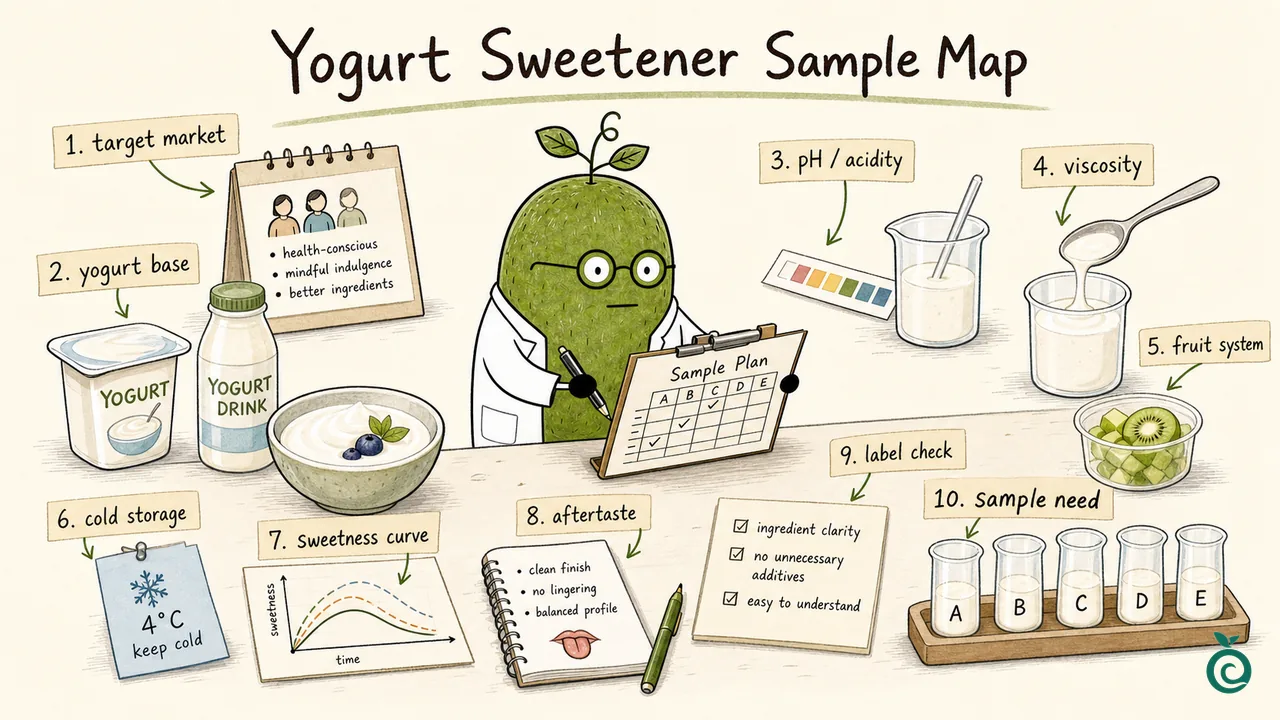
Name the product: set or stirred yogurt, drinkable fermented dairy, Greek-style base, fruit-on-bottom cup or fermented plant product. Record milk or plant base, protein, fat, total solids, fruit preparation, flavor, stabilizer and available pH/acidity results. Describe chilled storage or the actual heat treatment after fermentation. A plain dairy sample does not answer the same question as a high-protein fruit product or a plant-based version.
Separate sweetness from texture
A low-use sweetener can restore sweetness while leaving a different amount of solids in the yogurt. Decide whether the brief is a sweetness lift, partial sugar reduction or a replacement system that also addresses missing mass and body. Use the full ingredient composition, including any carrier, when comparing candidates.
- View monk fruit extract specifications
- View stevia specifications
- View allulose specifications
- See physical checks and the published yogurt total-solids comparison
| Direction to compare | Ask about the actual material | Question for the yogurt trial |
|---|---|---|
| Stevia or monk fruit sweetness lift | Ingredient identity, grade/profile, specification, carrier if any, and dose basis | Does the selected grade give the desired onset and finish in this base? |
| Partial-sugar reduction | Remaining sugar, replacement ingredients and the resulting solids/water balance | Can this reduction meet the taste brief before removing more sugar? |
| Allulose-supported or other bulk direction | Ingredient identity, powder/syrup form, solids/water contribution and target-market fit | What does the complete replacement system do to taste and body? |
| Erythritol-free blend brief | Composition of the complete blend, including carriers and separately added ingredients | Does the proposed formula meet the requested exclusion and the finished-product brief? |
Build a small sample matrix
Keep the current product or agreed sucrose reference. Start with one or two directions that fit the market and brief, rather than testing every sweetener family by default. Find comparable perceived sweetness in the real base; equal ingredient mass is not an equal-sweetness comparison. Record the remaining sugar, candidate dose, carrier and solids changes, so an apparent taste preference is not confused with a simultaneous change in body.
Record whether the sweetener is added before fermentation, after fermentation or through the fruit preparation. Keep that stage consistent in the first comparison and reproduce the intended production mixing, heat and cooling history. Do not assume that a post-fermentation bench addition proves performance when the same ingredient is dosed earlier in production.
Measure what buyers actually notice
Serve coded samples under consistent temperature, portion and handling conditions, and vary the tasting order to reduce order bias. Compare initial sweetness, peak, finish and aftertaste alongside sourness, bitterness, fruit/dairy notes, creaminess and watery mouthfeel. Keep an undisguised reference available as a separate benchmark, and use blind codes for the comparison itself. Repeat the agreed observations after storage; a clean first spoon does not describe the later product.
First compare taste without a promotional label or ingredient story. If you later test concept or label appeal, record it as a separate exercise. The 2025 rare-sugar yogurt study evaluated sensory responses and information effects; purchase intent in that study is not proof of sales for your product.
Check market and label fit early
Confirm the launch country, intended product category and exact ingredient identities before narrowing the formula. Removing added sucrose does not remove lactose from milk or sugars from fruit preparations. Review total sugars, added-sugar treatment and the proposed claim against the finished composition and applicable market rules. “Natural” or “erythritol-free” wording does not by itself establish a low-sugar or sugar-free claim.
Supplier brief for yogurt projects
Send the market, product type, base, flavor, reduction goal and the main taste issue first. Add current sugar/solids, available acidity results, culture/process, addition stage, package and storage conditions where known. For a quotation, identify the material and tested dose as well as quantity and document needs; compare the cost of the complete replacement system at its intended use level, not just price per kilogram of sweetener.
If you already tested a sample, send its code, specification or grade, dose basis and result. State whether a dose refers to the supplied blend, a diluted premix or the active ingredient. This is more useful than “stevia was bitter” or “monk fruit was too weak” without a record of what was actually used.
What the yogurt studies contribute
The 2025 Food Science and Technology study used equivalent-sweetness, time-intensity, sensory-description and acceptance methods in a specific yogurt model. Its concentrations are not universal doses. The 2025 Journal of Food Science rare-sugar study also examined sensory response and information effects. Together they support testing the real base and separating tasting from label appeal; neither establishes a Hengliyuan formula, a universal ingredient ranking or market approval.
Common questions
Which is best for yogurt: stevia, monk fruit or allulose?
There is no universal winner. Start with the target market, yogurt base, desired taste and the solids that must be replaced. Compare the actual grades and full compositions in a controlled real-base trial.
Discuss this requestCan I replace one stevia grade with another at the same dose?
Do not assume equivalence. Record the identity/profile, specification, carrier and dose basis, then recheck sweetness and finish in the actual yogurt. The word “stevia” alone does not define an interchangeable sample.
Discuss this requestCan monk fruit replace all the sugar by itself?
It can supply sweetness at low use levels. Account separately for removed sugar mass, solids and body; compare the complete replacement system rather than treating extract potency as a full formula.
Discuss this requestCan allulose be used in every yogurt market?
Do not assume that. Review the exact ingredient, product category, target country and finished label before adopting the route commercially. A sensory result or supplier document does not replace that review.
Discuss this requestDoes removing added sugar make dairy yogurt sugar-free?
Not automatically. Milk lactose and sugars in fruit or other ingredients still need to be considered. Check the finished composition and the intended market claim separately.
Discuss this requestWhat should buyers send for samples and quotation?
Send market, yogurt type/base, flavor, reduction goal, main issue and any current control results. Add process/addition stage, package, storage, quantity, required documents and sample needs when known. For an existing trial, include sample code, grade and the supplied-material or premix dose basis.
Discuss this request